
胃癌中的代谢重编程:特洛伊木马效应。
Metabolic Reprogramming in Gastric Cancer: Trojan Horse Effect.
作者信息
Bin Yu-Ling, Hu Hong-Sai, Tian Feng, Wen Zhen-Hua, Yang Mei-Feng, Wu Ben-Hua, Wang Li-Sheng, Yao Jun, Li De-Feng
机构信息
Department of Rheumatology and Immunology, ZhuZhou Central Hospital, Zhuzhou, China.
Department of Gastroenterology, ZhuZhou Central Hospital, Zhuzhou, China.
出版信息
Front Oncol. 2022 Jan 12;11:745209. doi: 10.3389/fonc.2021.745209. eCollection 2021.
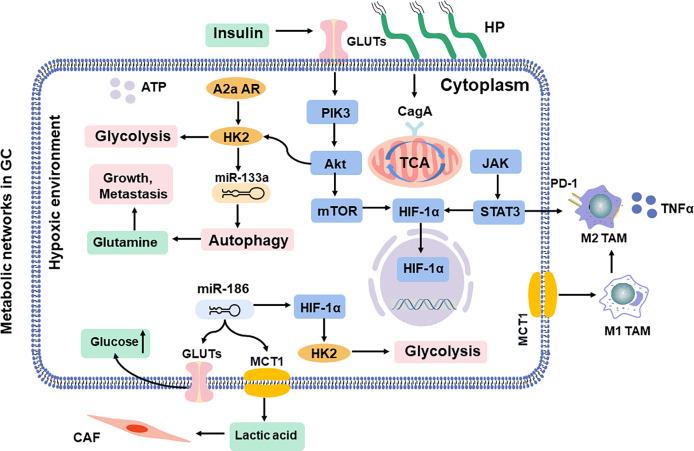
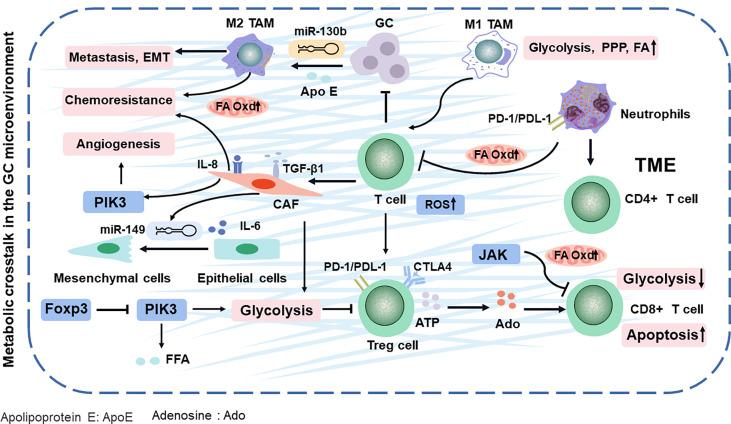
Worldwide, gastric cancer (GC) represents the fifth most common cancer for incidence and the third leading cause of death in developed countries. Despite the development of combination chemotherapies, the survival rates of GC patients remain unsatisfactory. The reprogramming of energy metabolism is a hallmark of cancer, especially increased dependence on aerobic glycolysis. In the present review, we summarized current evidence on how metabolic reprogramming in GC targets the tumor microenvironment, modulates metabolic networks and overcomes drug resistance. Preclinical and clinical studies on the combination of metabolic reprogramming targeted agents and conventional chemotherapeutics or molecularly targeted treatments [including vascular endothelial growth factor receptor (VEGFR) and HER2] and the value of biomarkers are examined. This deeper understanding of the molecular mechanisms underlying successful pharmacological combinations is crucial in finding the best-personalized treatment regimens for cancer patients.
在全球范围内,胃癌(GC)是发病率第五高的常见癌症,也是发达国家第三大主要死因。尽管联合化疗有所发展,但GC患者的生存率仍不尽人意。能量代谢重编程是癌症的一个标志,尤其是对有氧糖酵解的依赖性增加。在本综述中,我们总结了目前关于GC中的代谢重编程如何靶向肿瘤微环境、调节代谢网络以及克服耐药性的证据。我们还研究了代谢重编程靶向药物与传统化疗或分子靶向治疗(包括血管内皮生长因子受体(VEGFR)和HER2)联合应用的临床前和临床研究以及生物标志物的价值。对成功的药物联合背后分子机制的更深入理解对于为癌症患者找到最佳个性化治疗方案至关重要。

 Zotero 插件