
基于磁共振成像特征预测生长激素型垂体腺瘤亚型。
Predicting Subtype of Growth Hormone Pituitary Adenoma based on Magnetic Resonance Imaging Characteristics.
机构信息
From the Department of Radiology and Functional and Molecular Imaging Key Lab of Shaanxi Province, Tangdu Hospital, Air Force Medical University (Fourth Military Medical University), Xi'an.
Faculty of Medical Technology, Shaanxi University of Traditional Chinese Medicine, Xianyang.
出版信息
J Comput Assist Tomogr. 2022;46(1):124-130. doi: 10.1097/RCT.0000000000001249.
PURPOSE
This study aimed to investigate the value of magnetic resonance (MR) characteristics in differentiating the subtypes of growth hormone pituitary adenomas.
MATERIALS AND METHODS
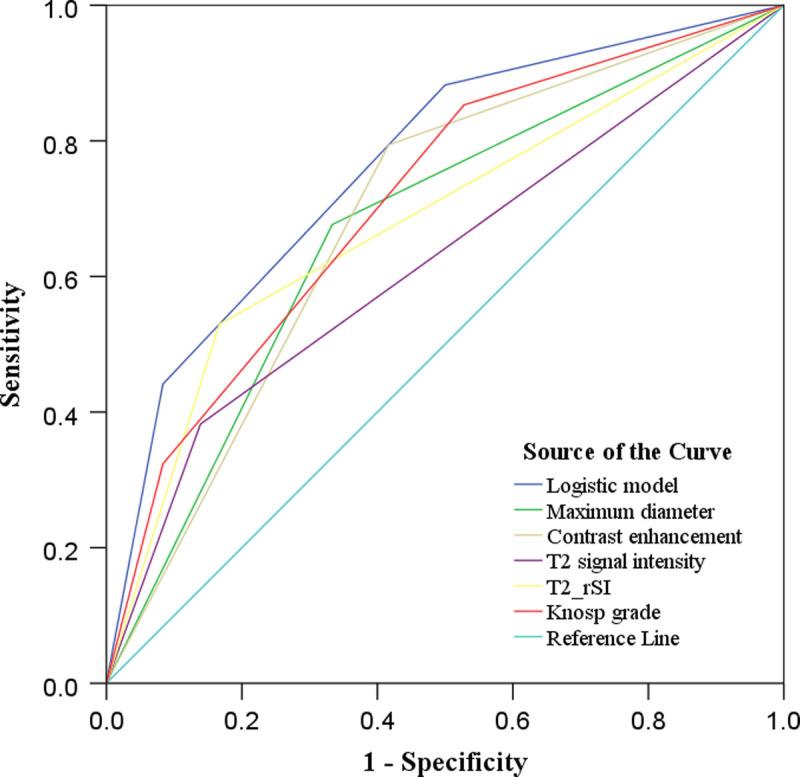
The clinical and MR imaging data of 70 patients with growth hormone pituitary adenoma confirmed by surgery and pathology were retrospectively analyzed. The tumors were divided into dense granular (DG; 36 cases) and sparse granular subtypes (SG; 34 cases). The tumors' MR features were analyzed, including the mean and maximum diameters, T2 signal intensity, T2 relative signal intensity (rSI), homogeneity, enhancement degree, and invasiveness (Knosp grade). Mann-Whitney U test and χ2 test were used to analyze MR characteristics between the 2 groups. The independent predictors and predictive probabilities of tumor subtypes were obtained via a logistic regression model, and the efficacy was compared by receiver operating characteristic curve.
RESULTS
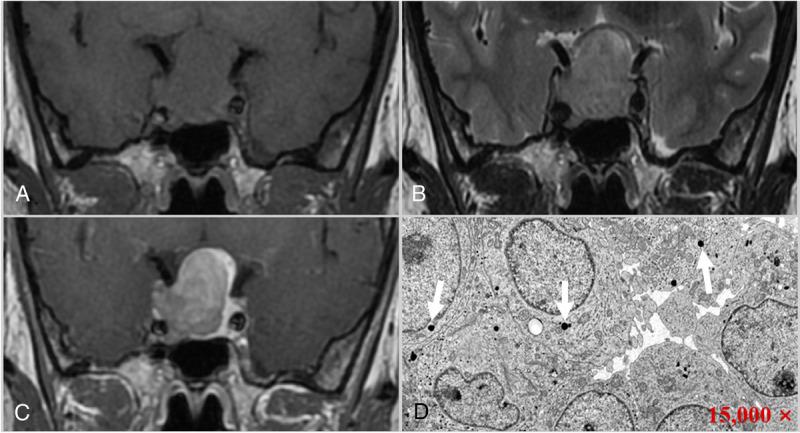
The mean and maximum diameters of growth hormone adenoma in DG and SG were 1.77 versus 2.45 and 1.95 versus 3.00 cm (median, P < 0.05), respectively. There was a significant difference between the 2 groups in T2 signal intensity and rSI (P values were 0.02 and 0.001, respectively). Most DG adenomas (86.1%) appeared as hypointense on T2 images, and 38.2% of SG adenomas were hyperintense. There was no significant difference in tumor homogeneity (P = 0.622). A significant difference was found in the Knosp grade between the 2 subtypes (P = 0.004). In addition, the enhancement degree of SG adenomas was significantly higher than that of DG adenomas (P = 0.001). Logistic regression analysis showed that high T2 rSI value and marked contrast enhancement were independent predictors of the 2 subtypes, and the odds ratios were 4.811 and 4.649, respectively. The multivariate logistic model obtained relatively high predicting efficacy, and the area under the curve, sensitivity, and specificity were 0.765, 0.882, and 0.500, respectively.
CONCLUSIONS
There are significant differences in tumor size, T2 signal intensity, T2 rSI, enhancement degree, and invasiveness between DG and SG adenomas. The logistic model based on the marked contrast enhancement and high T2 rSI value has an important value in predicting the subtype of growth hormone adenoma.
目的
本研究旨在探讨磁共振(MR)特征在鉴别生长激素型垂体腺瘤亚型中的价值。
材料与方法
回顾性分析经手术和病理证实的 70 例生长激素型垂体腺瘤患者的临床和 MR 成像资料。将肿瘤分为致密颗粒型(DG;36 例)和稀疏颗粒型(SG;34 例)。分析肿瘤的 MR 特征,包括平均直径和最大直径、T2 信号强度、T2 相对信号强度(rSI)、均匀度、强化程度和侵袭性(Knosp 分级)。采用 Mann-Whitney U 检验和 χ2 检验比较两组间的 MR 特征。通过逻辑回归模型获得肿瘤亚型的独立预测因子和预测概率,并通过受试者工作特征曲线比较其效能。
结果
DG 和 SG 中生长激素腺瘤的平均直径和最大直径分别为 1.77 cm 和 2.45 cm(中位数,P<0.05)和 1.95 cm 和 3.00 cm。两组间 T2 信号强度和 rSI 有显著差异(P 值分别为 0.02 和 0.001)。大多数 DG 腺瘤(86.1%)在 T2 图像上呈低信号,38.2%的 SG 腺瘤呈高信号。肿瘤均匀度无显著差异(P=0.622)。两组间 Knosp 分级有显著差异(P=0.004)。此外,SG 腺瘤的强化程度明显高于 DG 腺瘤(P=0.001)。Logistic 回归分析显示,高 T2 rSI 值和明显强化是两种亚型的独立预测因子,比值比分别为 4.811 和 4.649。多元 logistic 模型获得了较高的预测效能,曲线下面积、敏感度和特异度分别为 0.765、0.882 和 0.500。
结论
DG 和 SG 腺瘤在肿瘤大小、T2 信号强度、T2 rSI、强化程度和侵袭性方面存在显著差异。基于明显强化和高 T2 rSI 值的 logistic 模型对预测生长激素腺瘤的亚型具有重要价值。

 Zotero 插件