
老年人的肌肉质量和炎症:代谢综合征的影响。
Muscle Mass and Inflammation in Older Adults: Impact of the Metabolic Syndrome.
机构信息
Department of Endocrinology and Metabolic Diseases (including Division of Lipid Metabolism), Charité - Universitätsmedizin Berlin, Corporate Member of Freie Universität Berlin and Humboldt-Universität zu Berlin, Berlin, Germany.
Department of Internal Medicine B, Cardiology, University Medicine Greifswald, Greifswald, Germany.
出版信息
Gerontology. 2022;68(9):989-998. doi: 10.1159/000520096. Epub 2022 Jan 31.
BACKGROUND
Inflammatory processes are a cause of accelerated loss of muscle mass. Metabolic syndrome (MetS) is a highly prevalent age-related condition, which may promote and be promoted by inflammation. However, whether inflammation in MetS (metaflammation) is associated with lower muscle mass is still unclear.
METHODS
Complete cross-sectional data on body composition, MetS, and the inflammatory markers interleukin (IL)-1β, IL-6, IL-10, tumor necrosis factor (TNF), and C-reactive protein (CRP) were available for 1,377 BASE-II participants (51.1% women; 68 ± 4 years old). Appendicular lean mass (ALM) was assessed by dual-energy X-ray absorptiometry. Low muscle mass (low ALM-to-BMI ratio [ALMBMI]) was defined according to the Foundation for the National Institutes of Health (FNIH) Sarcopenia Project. Regression models, adjusted for an increasing number of confounders (sex, age, physical activity, morbidities, diabetes mellitus type II, TSH, albumin, HbA1c, smoking habits, alcohol intake, education, and energy intake/day), were used to calculate the association between low ALMBMI and high inflammation (tertile 3) according to MetS.
RESULTS
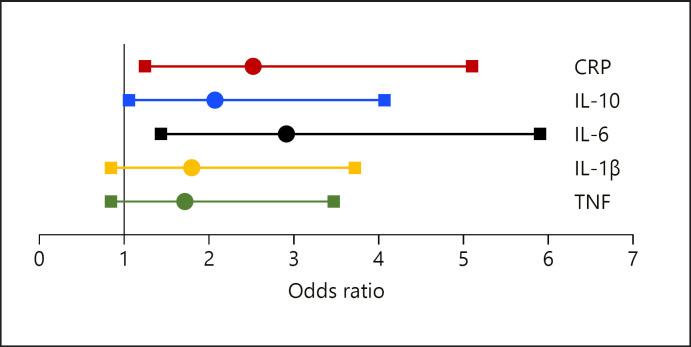
MetS was present in 36.2% of the study population, and 9% had low ALMBMI. In the whole study population, high CRP (odds ratio [OR]: 2.7 [95% CI: 1.6-4.7; p = 0.001]) and high IL-6 (OR: 2.1 [95% CI: 1.2-1.9; p = 0.005]) were associated with low ALMBMI. In contrast, no significant association was found between TNF, IL-10, or IL-1β with low ALMBMI. When participants were stratified by MetS, results for IL-6 remained significant only in participants with MetS.
CONCLUSIONS
Among BASE-II participants, low ALMBMI was associated with inflammation. Low-grade inflammation triggered by disease state, especially in the context of MetS, might favor loss of muscle mass, so a better control of MetS might help to prevent sarcopenia. Intervention studies to test whether strategies to prevent MetS might also prevent loss of muscle mass seem to be promising.
背景
炎症过程是肌肉质量加速丧失的一个原因。代谢综合征(MetS)是一种高发的与年龄相关的疾病,它可能促进并被炎症所促进。然而,MetS 中的炎症(代谢性炎症)是否与较低的肌肉质量有关仍不清楚。
方法
BASE-II 研究共有 1377 名参与者(51.1%为女性;68±4 岁),有完整的横断面数据,包括身体成分、MetS 和炎症标志物白细胞介素(IL)-1β、IL-6、IL-10、肿瘤坏死因子(TNF)和 C 反应蛋白(CRP)。四肢瘦组织(ALM)通过双能 X 射线吸收法进行评估。低肌肉质量(低 ALM 与 BMI 比值 [ALMBMI])根据美国国立卫生研究院(FNIH)肌少症项目定义。采用回归模型,根据 MetS,在调整了越来越多的混杂因素(性别、年龄、体力活动、合并症、2 型糖尿病、促甲状腺激素、白蛋白、糖化血红蛋白、吸烟习惯、饮酒习惯、教育程度和每天能量摄入)后,计算低 ALMBMI 与高炎症(按 MetS 分为第 3 三分位)之间的关联。
结果
研究人群中 36.2%存在 MetS,9%存在低 ALMBMI。在整个研究人群中,高 CRP(比值比[OR]:2.7[95%可信区间:1.6-4.7;p=0.001])和高 IL-6(OR:2.1[95%可信区间:1.2-1.9;p=0.005])与低 ALMBMI 相关。相比之下,TNF、IL-10 或 IL-1β 与低 ALMBMI 之间无显著相关性。当按 MetS 对参与者进行分层时,仅在患有 MetS 的参与者中,IL-6 的结果仍具有显著性。
结论
在 BASE-II 参与者中,低 ALMBMI 与炎症有关。疾病状态引发的低度炎症,特别是在 MetS 的情况下,可能导致肌肉质量的丧失,因此更好地控制 MetS 可能有助于预防肌少症。为了验证预防 MetS 的策略是否也能预防肌肉质量的丧失而进行的干预研究似乎很有前途。
 Zotero 插件