
重症肌无力中的不同单克隆抗体:一项贝叶斯网络荟萃分析。
Different Monoclonal Antibodies in Myasthenia Gravis: A Bayesian Network Meta-Analysis.
作者信息
Song Zhaoming, Zhang Jie, Meng Jiahao, Jiang Guannan, Yan Zeya, Yang Yanbo, Chen Zhouqing, You Wanchun, Wang Zhong, Chen Gang
机构信息
Department of Neurosurgery and Brain and Nerve Research Laboratory, The First Affiliated Hospital of Soochow University, Suzhou, China.
Department of Neurosurgery, China-Japan Friendship Hospital, Beijing, China.
出版信息
Front Pharmacol. 2022 Jan 18;12:790834. doi: 10.3389/fphar.2021.790834. eCollection 2021.
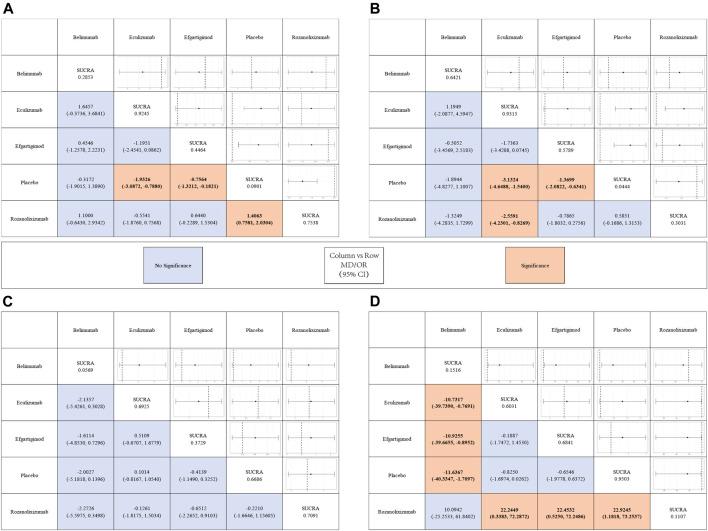
Myasthenia gravis (MG) is a common autoimmune disease with acquired neuromuscular transmission disorders. Recently, monoclonal antibodies have been shown to successfully treat a variety of diseases. In this meta-analysis, an appropriate search strategy was used to search eligible randomized controlled trials (RCTs) on different monoclonal antibodies to treat patients with MG published up to September 2021 from the embase, PubMed, and Cochrane Library. We assessed the average difference or odds ratio between each drug and placebo and summarized them as the average and 95% confidence interval (CI), respectively. In indicators of efficacy, patients receiving eculizumab (MD, -1.9; 95% CI, -3.2-0.76) had decreases in MG-ADL scores compared to placebo. In addition, only eculizumab (MD, -3.1; 95% CI, -4.7-1.5) and efgartigimod (MD, -1.4; 95% CI, -2.1-0.68) showed a significant difference from placebo in the amount of reduction in QMG scores, while neither of the other two monoclonal antibodies was statistically significant. With regard to the safety of monoclonal antibody therapy, there was no significant difference in the probability of AE in subjects treated with any of the four monoclonal antibodies compared to placebo. eculizumab was effective in reducing MG-ADL scores and QMG scores in myasthenia gravis. Meanwhile, eculizumab also caused fewer AE. As an emerging therapy, monoclonal antibodies are prospective in the treatment of MG. However, more researches are required to be invested in the future as the results obtained from small sample sizes are not reliable enough.
重症肌无力(MG)是一种常见的自身免疫性疾病,伴有获得性神经肌肉传递障碍。最近,单克隆抗体已被证明能成功治疗多种疾病。在这项荟萃分析中,我们采用了适当的检索策略,在Embase、PubMed和Cochrane图书馆中检索截至2021年9月发表的关于不同单克隆抗体治疗MG患者的合格随机对照试验(RCT)。我们评估了每种药物与安慰剂之间的平均差异或比值比,并分别将它们总结为平均值和95%置信区间(CI)。在疗效指标方面,与安慰剂相比,接受依库珠单抗治疗的患者(MD,-1.9;95%CI,-3.2 - 0.76)的MG - ADL评分有所下降。此外,只有依库珠单抗(MD,-3.1;95%CI,-4.7 - 1.5)和efgartigimod(MD,-1.4;95%CI,-2.1 - 0.68)在QMG评分降低量方面与安慰剂有显著差异,而其他两种单克隆抗体均无统计学意义。关于单克隆抗体治疗的安全性,与安慰剂相比,接受四种单克隆抗体中任何一种治疗的受试者发生不良事件(AE)的概率没有显著差异。依库珠单抗在降低重症肌无力患者的MG - ADL评分和QMG评分方面有效。同时,依库珠单抗引起的AE也较少。作为一种新兴疗法,单克隆抗体在MG治疗中具有前景。然而,由于小样本量获得的结果不够可靠,未来需要投入更多研究。



 Zotero 插件