
癌症临床试验中接受免疫治疗、靶向治疗或化疗的患者发生严重不良事件的风险的性别差异。
Sex Differences in Risk of Severe Adverse Events in Patients Receiving Immunotherapy, Targeted Therapy, or Chemotherapy in Cancer Clinical Trials.
机构信息
SWOG Statistics and Data Management Center, Fred Hutchinson Cancer Research Center, Seattle, WA.
Loyola University Chicago Stritch School of Medicine, Maywood, IL.
出版信息
J Clin Oncol. 2022 May 1;40(13):1474-1486. doi: 10.1200/JCO.21.02377. Epub 2022 Feb 4.
PURPOSE
Women have more adverse events (AEs) from chemotherapy than men, but few studies have investigated sex differences in immune or targeted therapies. We examined AEs by sex across different treatment domains.
METHODS
We analyzed treatment-related AEs by sex in SWOG phase II and III clinical trials conducted between 1980 and 2019, excluding sex-specific cancers. AE codes and grade were categorized using the Common Terminology Criteria for Adverse Events. Symptomatic AEs were defined as those aligned with the National Cancer Institute's Patient-Reported Outcome-Common Terminology Criteria for Adverse Events; laboratory-based or observable/measurable AEs were designated as objective (hematologic nonhematologic). Multivariable logistic regression was used, adjusting for age, race, and disease prognosis. Thirteen symptomatic and 14 objective AE categories were examined.
RESULTS
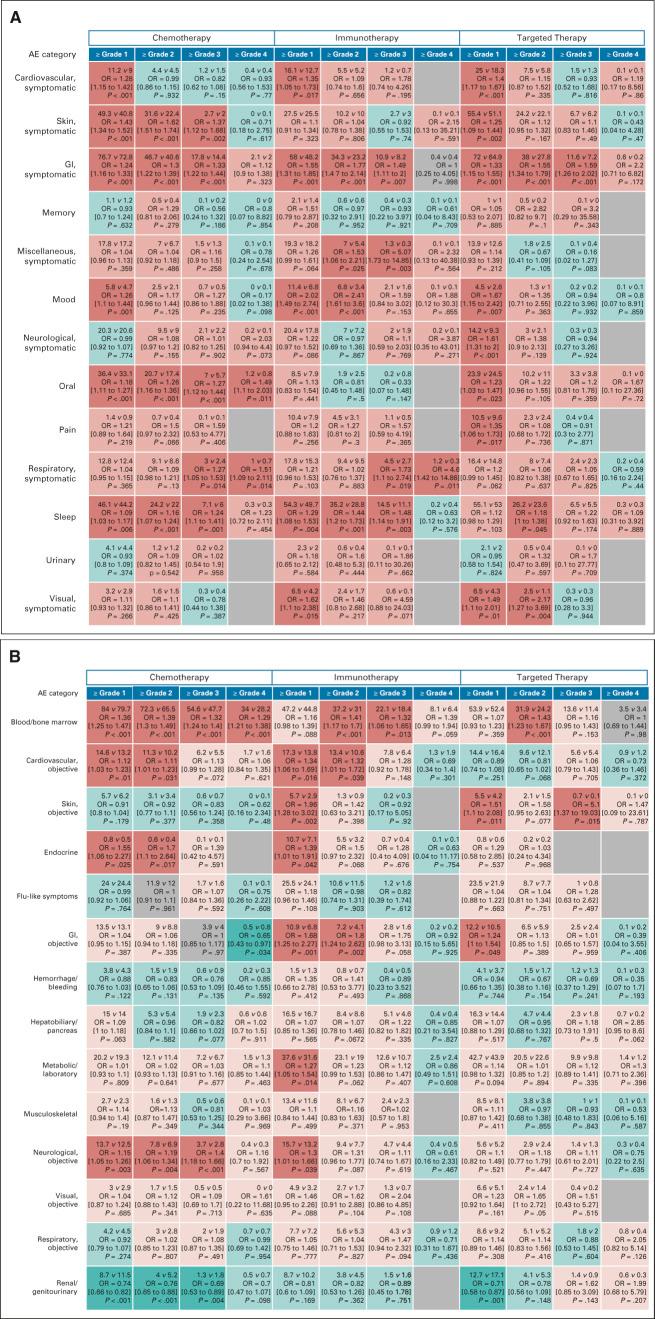
In total, N = 23,296 patients (women, 8,838 [37.9%]; men, 14,458 [62.1%]) from 202 trials experiencing 274,688 AEs were analyzed; 17,417 received chemotherapy, 2,319 received immunotherapy, and 3,560 received targeted therapy. Overall, 64.6% (n = 15,051) experienced one or more severe (grade ≥ 3) AEs. Women had a 34% increased risk of severe AEs compared with men (odds ratio [OR] = 1.34; 95% CI, 1.27 to 1.42; < .001), including a 49% increased risk among those receiving immunotherapy (OR = 1.49; 95% CI, 1.24 to 1.78; < .001). Women experienced an increased risk of severe symptomatic AEs among all treatments, especially immunotherapy (OR = 1.66; 95% CI, 1.37 to 2.01; < .001). Women receiving chemotherapy or immunotherapy experienced increased severe hematologic AE. No statistically significant sex differences in risk of nonhematologic AEs were found.
CONCLUSION
The greater severity of both symptomatic AEs and hematologic AEs in women across multiple treatment modalities indicates that broad-based sex differences exist. This could be due to differences in AE reported, pharmacogenomics of drug metabolism/disposition, total dose received, and/or adherence to therapy. Particularly large sex differences were observed for patients receiving immunotherapy, suggesting that studying AEs from these agents is a priority.
目的
女性接受化疗后的不良事件(AE)比男性多,但很少有研究调查免疫或靶向治疗中的性别差异。我们研究了不同治疗领域的 AE 性别差异。
方法
我们分析了 1980 年至 2019 年期间进行的 SWOG 二期和三期临床试验中与治疗相关的 AE,不包括特定于性别的癌症。使用常见不良事件术语标准(CTCAE)对 AE 代码和等级进行分类。症状性 AE 定义为与国家癌症研究所患者报告的结果-常见不良事件术语标准相一致的 AE;基于实验室或可观察/可测量的 AE 被指定为客观(血液学的和非血液学的)。采用多变量逻辑回归,调整年龄、种族和疾病预后。共检查了 13 个症状性和 14 个客观 AE 类别。
结果
共纳入来自 202 项试验的 23296 例患者(女性 8838 例[37.9%],男性 14458 例[62.1%]),共发生 274688 例 AE,其中 17417 例接受化疗,2319 例接受免疫治疗,3560 例接受靶向治疗。总体而言,64.6%(n=15051)经历了一种或多种严重(等级≥3)AE。与男性相比,女性发生严重 AE 的风险增加了 34%(比值比[OR]为 1.34;95%置信区间[CI]为 1.27 至 1.42;<0.001),接受免疫治疗的患者风险增加了 49%(OR 为 1.49;95%CI 为 1.24 至 1.78;<0.001)。女性在所有治疗中都经历了严重症状性 AE 的风险增加,尤其是免疫治疗(OR 为 1.66;95%CI 为 1.37 至 2.01;<0.001)。接受化疗或免疫治疗的女性发生严重血液学 AE 的风险增加。未发现非血液学 AE 风险存在统计学显著的性别差异。
结论
女性在多种治疗方式下的症状性 AE 和血液学 AE 严重程度均更高,这表明存在广泛的性别差异。这可能是由于 AE 报告、药物代谢/处置的药物基因组学、接受的总剂量和/或对治疗的依从性存在差异。在接受免疫治疗的患者中观察到特别大的性别差异,表明优先研究这些药物的 AE 是必要的。


 Zotero 插件