
[大学医院外科实施出院管理:成本、住院时间和患者满意度的探索性分析]
[Implementation of discharge management in the surgical department of a university hospital: exploratory analysis of costs, length of stay, and patient satisfaction].
作者信息
Aßfalg Volker, Hassiotis Sophia, Radonjic Marion, Göcmez Sarah, Friess Helmut, Frank Elke, Königstorfer Jörg
机构信息
Klinik und Poliklinik für Chirurgie, Klinikum rechts der Isar, TU München, Ismaningerstr. 22, 81675, München, Deutschland.
Lehrstuhl für Sport- und Gesundheitsmanagement, TU München, München, Deutschland.
出版信息
Bundesgesundheitsblatt Gesundheitsforschung Gesundheitsschutz. 2022 Mar;65(3):348-356. doi: 10.1007/s00103-022-03497-z. Epub 2022 Feb 9.
BACKGROUND
Discharge management has been mandatory by law in Germany since October 2017, and hospitals are required to finance and implement this. Currently there are no data available on the costs and effects of discharge management on the length of hospital stay.
AIMS
Determination of the costs of discharge management in the Department of Surgery at the University Hospital rechts der Isar of the Technical University of Munich, Germany, assessment of the length of stay in comparison with and without discharge management, and evaluation of patients' satisfaction to create first precedents for future negotiations about adequate financing.
METHODS
Cost analysis of discharge management in the Department of Surgery at the School of Medicine at the Technical University of Munich, retrospective analysis of the mean length of hospital stays before and after implementation of discharge management, and patient surveys on the quality of the structured transition process and their satisfaction.
RESULTS
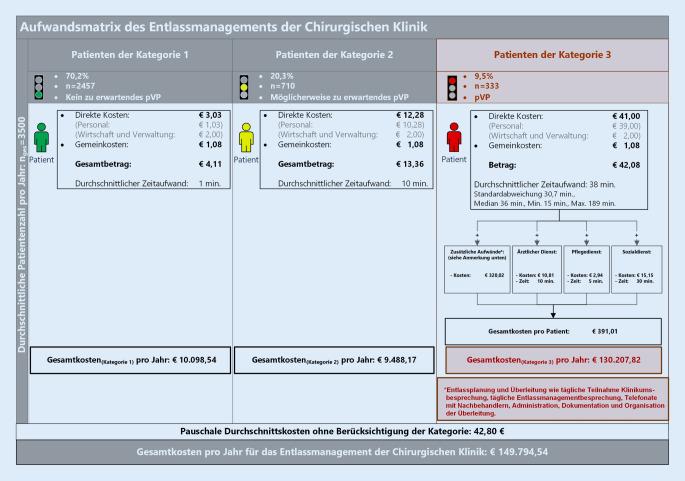
The cost analysis revealed lump costs of € 43 per patient and € 391 for patients with a need for complex management. No statistically significant shorter length of hospital stay after the implementation of discharge management was found by analyzing three patient subgroups. The overall rate of patients returning to the hospital due to complications associated with the surgical procedure was 3.4%.
DISCUSSION
Discharge management in the Department of Surgery at the hospital is an effective and potentially quality-enhancing but at the same time cost-driving measure, which, in the medium term, will enter G‑DRG rates and may thus increase costs. A possible solution to meet various stakeholders' needs could be a case-specific financial remuneration of discharge management that is adapted to the transition qualities of the various medical departments.
背景
自2017年10月起,德国法律规定必须进行出院管理,医院需为此提供资金并加以实施。目前尚无关于出院管理的成本及其对住院时间影响的数据。
目的
确定德国慕尼黑工业大学伊萨尔河右岸大学医院外科出院管理的成本,评估有无出院管理情况下的住院时间,并评估患者满意度,为未来关于适当资金投入的谈判创造先例。
方法
对慕尼黑工业大学医学院外科出院管理进行成本分析,回顾性分析出院管理实施前后的平均住院时间,并对结构化过渡过程的质量及其满意度进行患者调查。
结果
成本分析显示,每位患者的一次性成本为43欧元,需要复杂管理的患者为391欧元。通过对三个患者亚组的分析,未发现出院管理实施后住院时间有统计学意义上的显著缩短。因手术相关并发症返回医院的患者总体比例为3.4%。
讨论
该医院外科的出院管理是一项有效且可能提高质量但同时也会增加成本的措施,从中期来看,将纳入德国疾病诊断相关分组费率,可能因此增加成本。满足各利益相关方需求的一个可能解决方案是根据具体情况对出院管理进行财务补偿,使其适应各医疗科室的过渡质量。

 Zotero 插件