
SM-Omics 是一个自动化的高通量空间多组学平台。
SM-Omics is an automated platform for high-throughput spatial multi-omics.
机构信息
Klarman Cell Observatory Broad Institute of MIT and Harvard, Cambridge, MA, USA.
Department of Biology, Massachusetts Institute of Technology, Cambridge, MA, USA.
出版信息
Nat Commun. 2022 Feb 10;13(1):795. doi: 10.1038/s41467-022-28445-y.
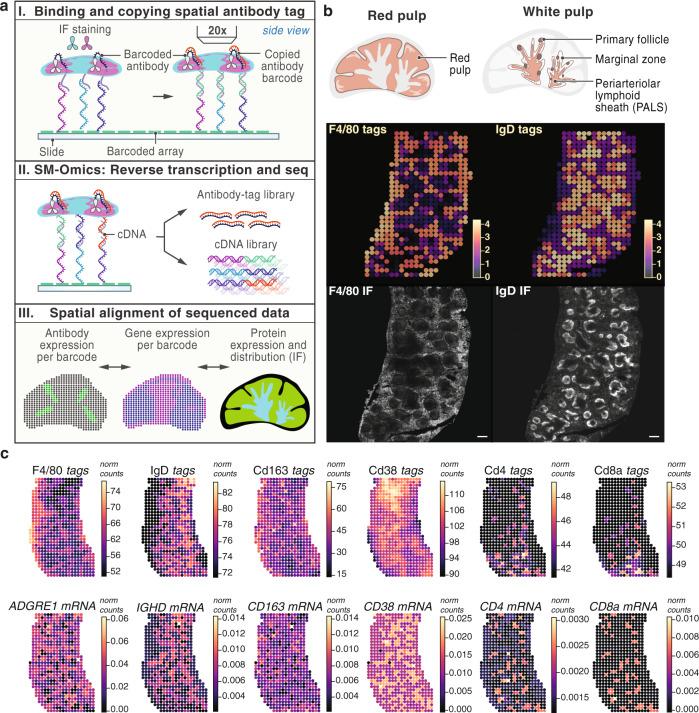
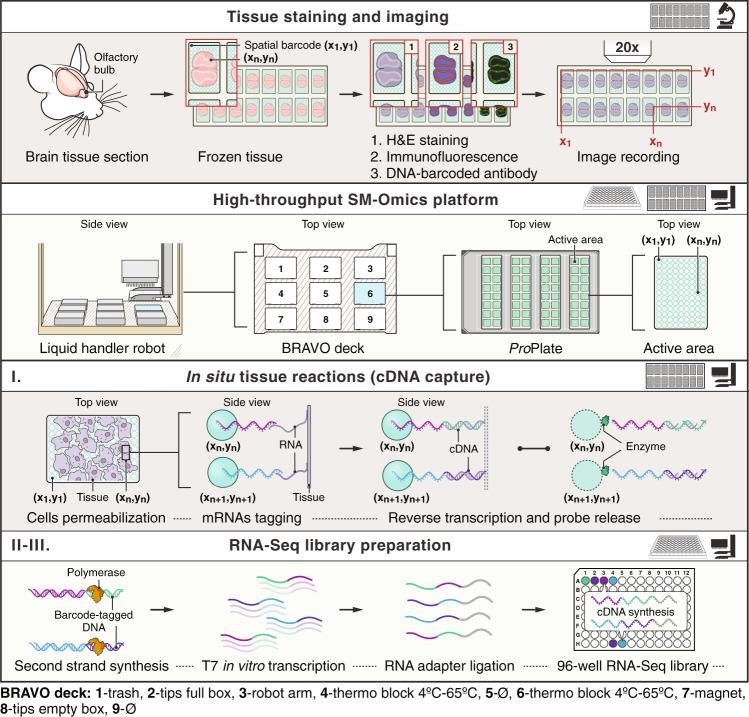
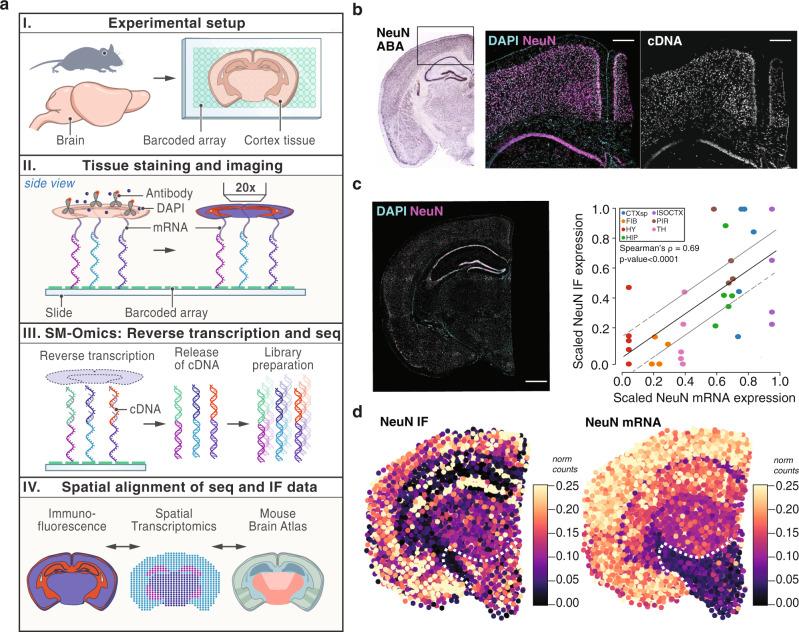
The spatial organization of cells and molecules plays a key role in tissue function in homeostasis and disease. Spatial transcriptomics has recently emerged as a key technique to capture and positionally barcode RNAs directly in tissues. Here, we advance the application of spatial transcriptomics at scale, by presenting Spatial Multi-Omics (SM-Omics) as a fully automated, high-throughput all-sequencing based platform for combined and spatially resolved transcriptomics and antibody-based protein measurements. SM-Omics uses DNA-barcoded antibodies, immunofluorescence or a combination thereof, to scale and combine spatial transcriptomics and spatial antibody-based multiplex protein detection. SM-Omics allows processing of up to 64 in situ spatial reactions or up to 96 sequencing-ready libraries, of high complexity, in a ~2 days process. We demonstrate SM-Omics in the mouse brain, spleen and colorectal cancer model, showing its broad utility as a high-throughput platform for spatial multi-omics.
细胞和分子的空间组织在组织的稳态和疾病中的功能中起着关键作用。空间转录组学最近成为一种关键技术,可以直接在组织中捕获和定位 RNA。在这里,我们通过提出空间多组学(SM-Omics)作为一个完全自动化的、基于高通量测序的平台,用于组合和空间分辨转录组学和基于抗体的蛋白质测量,来推进大规模的空间转录组学的应用。SM-Omics 使用 DNA 条形码抗体、免疫荧光或两者的组合来扩展和组合空间转录组学和空间抗体的多重蛋白质检测。SM-Omics 允许在大约 2 天的过程中处理多达 64 个原位空间反应或多达 96 个测序就绪的文库,具有高复杂性。我们在小鼠大脑、脾脏和结直肠癌模型中展示了 SM-Omics,表明它作为高通量空间多组学平台具有广泛的用途。

 Zotero 插件