
基于循环外周血单个核细胞流动变异分析预测乳腺癌风险
Prediction of breast cancer risk based on flow variant analysis of circulating peripheral blood mononuclear cells.
作者信息
Loke Johnny, Alim Ishraq, Yam Sarah, Klugman Susan, Xia Li C, Gruber Dorota, Tegay David, LaBella Andrea, Onel Kenan, Ostrer Harry
机构信息
Department of Pathology, Albert Einstein College of Medicine, Bronx, NY 10416, USA.
Morgan and Mendel Genomics, Bronx, NY 10461, USA.
出版信息
HGG Adv. 2022 Jan 8;3(2):100085. doi: 10.1016/j.xhgg.2022.100085. eCollection 2022 Apr 14.
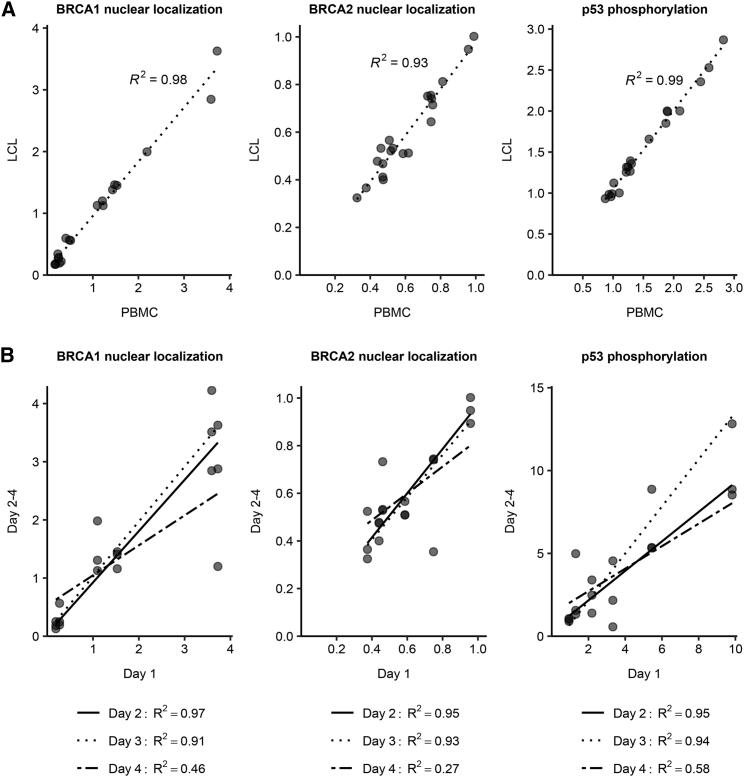
Identifying women at high risk for developing breast cancer is potentially lifesaving. Patients with pathogenic genetic variants can embark on a program of surveillance for early detection, chemoprevention, and/or prophylactic surgery. Newly diagnosed cancer patients can also use the results of gene panel sequencing to make decisions about surgery; therefore, rapid turnaround time for results is critical. Cancer Risk B (CR-B), a test that uses flow variant assays to assess the effects of variants in the DNA double-strand break repair, was applied to two groups of subjects who underwent coincidental gene panel testing, thereby allowing an assessment of sensitivity, specificity and accuracy, and utility for annotating variants of uncertain significance (VUS). The test was compared in matched peripheral blood mononuclear cells (PBMCs) and lymphoblastoid cells (LCLs) and tested for rescue in LCLs with gene transfer. The CR-B phenotype demonstrated a bimodal distribution: CR-B indicative of DSB repair defects, and CR-B, indicative of wild-type repair When comparing matched LCLs and PBMCs and inter-day tests, CR-B yielded highly reproducible results. The CR-B phenotype was rescued by gene transfer using wild-type cDNA expression plasmids. The CR-B phenotype predicted VUS as benign or likely benign. CR-B could represent a rapid alternative to panel sequencing for women with cancer and identifying women at high risk for cancer and is a useful adjunct for annotating VUS.
识别患乳腺癌高风险的女性可能会挽救生命。携带致病基因变异的患者可以启动一个监测计划,用于早期检测、化学预防和/或预防性手术。新诊断的癌症患者也可以利用基因检测板测序的结果来做出手术决策;因此,快速获得检测结果至关重要。癌症风险检测B(CR-B)是一种利用流式变异分析来评估DNA双链断裂修复中变异影响的检测方法,应用于两组同时进行基因检测板检测的受试者,从而能够评估其敏感性、特异性、准确性以及对注释意义不明确变异(VUS)的实用性。该检测方法在匹配的外周血单核细胞(PBMC)和成淋巴细胞(LCL)中进行比较,并在LCL中通过基因转移进行挽救测试。CR-B表型呈现双峰分布:CR-B表明存在双链断裂修复缺陷,而另一种CR-B则表明是野生型修复。在比较匹配的LCL和PBMC以及日间测试时,CR-B产生了高度可重复的结果。通过使用野生型cDNA表达质粒进行基因转移可挽救CR-B表型。CR-B表型将VUS预测为良性或可能良性。对于癌症女性患者,CR-B可能是基因检测板测序的一种快速替代方法,可用于识别癌症高风险女性,并且是注释VUS的一种有用辅助手段。


 Zotero 插件