
脑脊髓液中神经丝轻链和总 tau 水平升高与正常压力脑积水患者分流手术后不良结局相关。
Higher levels of neurofilament light chain and total tau in CSF are associated with negative outcome after shunt surgery in patients with normal pressure hydrocephalus.
机构信息
Department of Neuroscience, Neurology, Uppsala University, Akademiska sjukhuset, ing 85, 751 85, Uppsala, Sweden.
Department of Medical Sciences, Clinical Chemistry, Uppsala University, Uppsala, Sweden.
出版信息
Fluids Barriers CNS. 2022 Feb 14;19(1):15. doi: 10.1186/s12987-022-00306-2.
BACKGROUND
Lumbar punctures are a common examination in the work-up of patients with idiopathic normal pressure hydrocephalus (iNPH) and cerebrospinal fluid (CSF) biomarkers should therefore be available for use in selection of shunt candidates. The aim of this study was to investigate if CSF biomarkers are associated with outcome after shunt surgery alone or in combination with comorbidity and imaging markers, and investigate associations between CSF biomarkers and symptoms.
METHODS
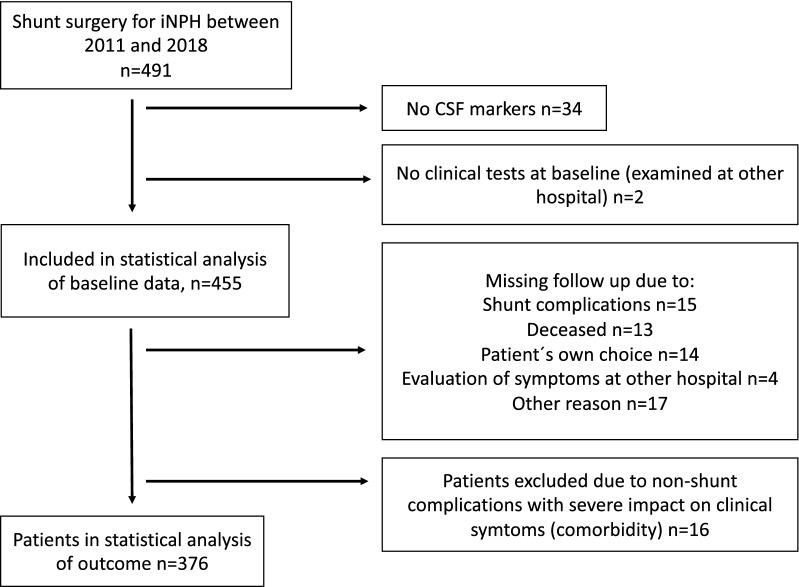
Preoperative CSF biomarkers were analyzed in 455 patients operated with shunt surgery for iNPH at a single center during 2011-2018. Symptoms before and 12 months after shunt surgery were graded with the Swedish iNPH scale. Neurofilament light chain protein (NfL), total tau (T-tau), phosphorylated tau (P-tau) and amyloid beta1-42 (Aβ1-42) CSF levels were measured. Evans' index and disproportionately enlarged subarachnoid space hydrocephalus were measured on preoperative CT-scans. Preoperative evaluation and follow-up 12 months after shunt surgery were available in 376 patients.
RESULTS
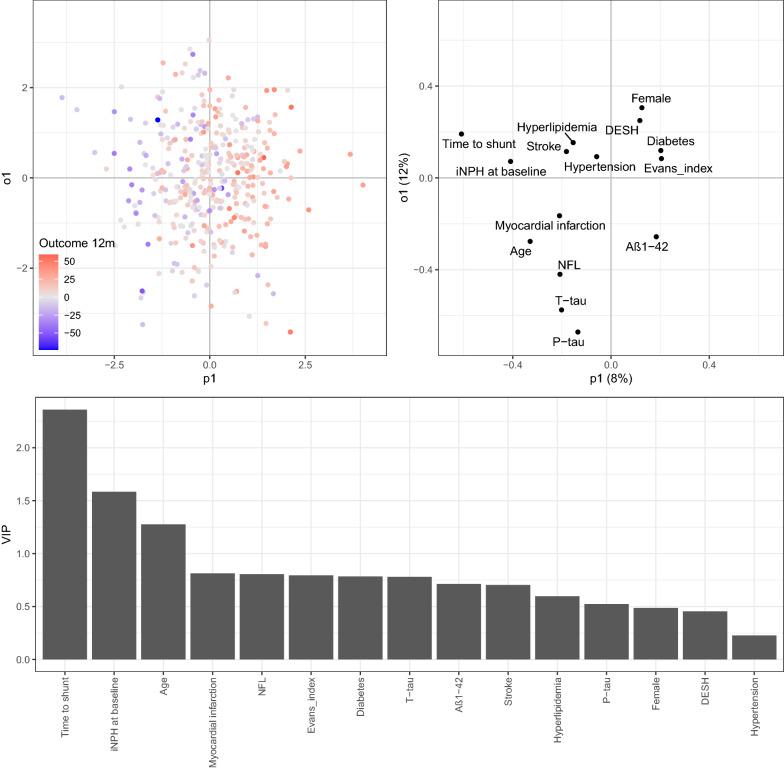
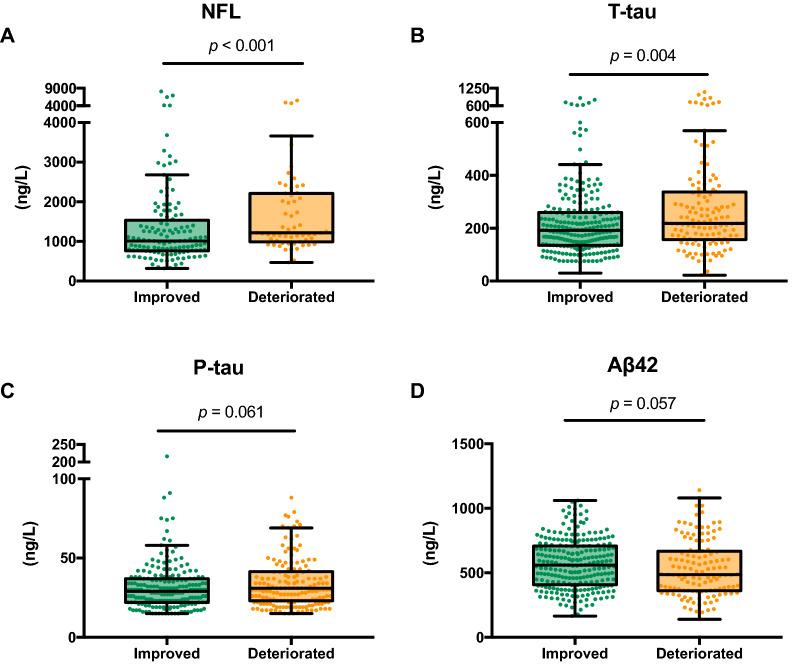
Higher levels of NfL and T-tau were associated with less improvement after shunt surgery (β = - 3.10, p = 0.016 and β = - 2.45, p = 0.012, respectively). Patients whose symptoms deteriorated after shunt surgery had higher preoperative levels of NfL (1250 ng/L [IQR:1020-2220] vs. 1020 [770-1649], p < 0.001) and T-tau (221 ng/L [IQR: 159-346] vs. 190 [135-261], p = 0.0039) than patients with postoperative improvement on the iNPH scale. Among the patients who improved ≥ 5 levels on the iNPH scale (55%), NfL was abnormal in 22%, T-tau in 14%, P-tau in 6% and Aβ1-42 in 45%, compared with normal reference limits. The inclusion of CSF biomarkers, imaging markers and comorbidity in multivariate predictive Orthogonal Projections to Latent Structures (OPLS) models to did not improve predictability in outcome after shunt surgery.
CONCLUSIONS
Higher levels of T-tau and NfL were associated with a less favorable response to shunt surgery, suggesting a more active neurodegeneration in this group of patients. However, CSF levels of these biomarkers can be elevated also in patients who respond to shunt surgery. Thus, none of these CSF biomarkers, alone or used in combination, are suitable for excluding patients from surgery.
背景
腰椎穿刺是特发性正常压力脑积水(iNPH)患者检查中的常见检查,因此脑脊液(CSF)生物标志物应该可用于选择分流候选者。本研究的目的是研究 CSF 生物标志物是否与分流手术后的结果相关,无论是否结合合并症和影像学标志物,以及研究 CSF 生物标志物与症状之间的相关性。
方法
在 2011 年至 2018 年间,在一家中心对 455 例接受 iNPH 分流手术的患者进行了术前 CSF 生物标志物分析。分流手术后 12 个月前和分流手术后 12 个月前的症状采用瑞典 iNPH 量表进行分级。神经丝轻链蛋白(NfL)、总 tau(T-tau)、磷酸化 tau(P-tau)和淀粉样β1-42(Aβ1-42)的 CSF 水平进行了测量。在术前 CT 扫描上测量了 Evans 指数和不成比例增大的蛛网膜下腔脑积水。376 例患者可获得术前评估和分流手术后 12 个月的随访。
结果
NfL 和 T-tau 水平升高与分流手术后改善程度较低相关(β=-3.10,p=0.016 和β=-2.45,p=0.012)。分流手术后症状恶化的患者术前 NfL 水平较高(1250ng/L [IQR:1020-2220] 比 1020ng/L [770-1649],p<0.001)和 T-tau 水平较高(221ng/L [IQR:159-346] 比 190ng/L [135-261],p=0.0039)。在 iNPH 量表上改善≥5 级的患者中(55%),NfL 异常占 22%,T-tau 异常占 14%,P-tau 异常占 6%,Aβ1-42 异常占 45%,与正常参考范围相比。将 CSF 生物标志物、影像学标志物和合并症纳入多元预测正交投影到潜在结构(OPLS)模型中并不能提高分流手术后结果的预测能力。
结论
T-tau 和 NfL 水平升高与分流手术的反应较差相关,提示这组患者的神经退行性变更为活跃。然而,这些生物标志物的 CSF 水平也可能升高在对分流手术有反应的患者中。因此,这些 CSF 生物标志物中的任何一种,单独或联合使用,都不适合排除手术患者。
 Zotero 插件