
远程干预措施支持妊娠焦虑症状女性:混合方法系统评价和荟萃分析。
Remotely Delivered Interventions to Support Women With Symptoms of Anxiety in Pregnancy: Mixed Methods Systematic Review and Meta-analysis.
机构信息
School of Health Sciences, University of Nottingham, Nottingham, United Kingdom.
Institute of Mental Health, School of Health Sciences, University of Nottingham, Nottingham, United Kingdom.
出版信息
J Med Internet Res. 2022 Feb 15;24(2):e28093. doi: 10.2196/28093.
BACKGROUND
Symptoms of anxiety are common in pregnancy, with severe symptoms associated with negative outcomes for women and babies. Low-level psychological therapy is recommended for women with mild to moderate anxiety, with the aim of preventing an escalation of symptoms and providing coping strategies. Remotely delivered interventions have been suggested to improve access to treatment and support and provide a cost-effective, flexible, and timely solution.
OBJECTIVE
This study identifies and evaluates remotely delivered, digital, or web-based interventions to support women with symptoms of anxiety during pregnancy.
METHODS
This mixed methods systematic review followed a convergent segregated approach to synthesize qualitative and quantitative data. The ACM Digital Library, Allied and Complementary Medicine Database, Applied Social Sciences Index and Abstracts, Centre for Reviews and Dissemination database, the Cochrane Central Register of Controlled Trials, the Cochrane Library, CINAHL, Embase, Health Technology Assessment Library, IEEE Xplore, Joanna Briggs Institute, Maternity and Infant Care, MEDLINE, PsycINFO, and the Social Science Citation Index were searched in October 2020. Quantitative or qualitative primary research that included pregnant women and evaluated remotely delivered interventions reporting measures of anxiety, fear, stress, distress, women's views, and opinions were included.
RESULTS
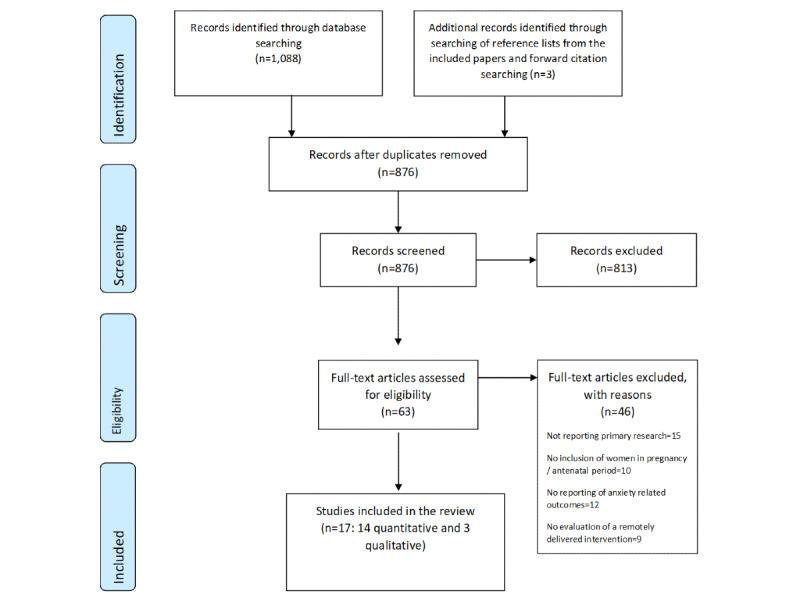
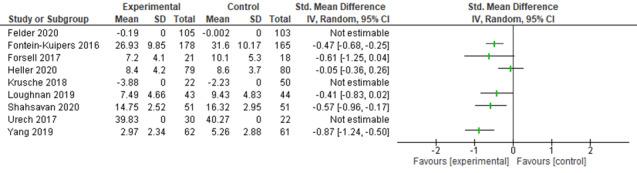
Overall, 3 qualitative studies and 14 quantitative studies were included. Populations included a general antenatal population and pregnant women having anxiety and depression, fear of childbirth, insomnia, and preterm labor. Interventions included cognitive behavioral therapy, problem solving, mindfulness, and educational designs. Most interventions were delivered via web-based platforms, and 62% (8/13) included direct contact from trained therapists or coaches. A meta-analysis of the quantitative data found internet-based cognitive behavioral therapy and facilitated interventions showed a beneficial effect in relation to the reduction of anxiety scores (standardized mean difference -0.49, 95% CI -0.75 to -0.22; standardized mean difference -0.48, 95% CI -0.75 to -0.22). Due to limitations in the amount of available data and study quality, the findings should be interpreted with caution. Synthesized findings found some evidence to suggest that interventions are more effective when women maintain regular participation which may be enhanced by providing regular contact with therapists or peer support, appropriate targeting of interventions involving components of relaxation and cognitive-based skills, and providing sufficient sessions to develop new skills without being too time consuming.
CONCLUSIONS
There is limited evidence to suggest that women who are pregnant may benefit from remotely delivered interventions. Components of interventions that may improve the effectiveness and acceptability of remotely delivered interventions included providing web-based contact with a therapist, health care professional, or peer community. Women may be more motivated to complete interventions that are perceived as relevant or tailored to their needs. Remote interventions may also provide women with greater anonymity to help them feel more confident in disclosing their symptoms.
背景
焦虑症状在妊娠中很常见,严重的症状与妇女和婴儿的不良结局有关。对于轻度至中度焦虑的妇女,建议进行低水平的心理治疗,目的是防止症状恶化,并提供应对策略。远程提供的干预措施被认为可以改善治疗和支持的可及性,并提供具有成本效益、灵活和及时的解决方案。
目的
本研究旨在确定和评估远程提供的、数字化的或基于网络的干预措施,以支持妊娠期间出现焦虑症状的妇女。
方法
本混合方法系统综述采用收敛分离方法,综合定性和定量数据。于 2020 年 10 月在 ACM 数字图书馆、辅助和补充医学数据库、应用社会科学索引和摘要、评论传播数据库、考科兰中央对照试验注册库、考科兰图书馆、CINAHL、Embase、卫生技术评估图书馆、IEEE Xplore、乔安娜布里格斯研究所、产妇和婴儿护理、医学文献分析与检索系统、心理信息数据库以及社会科学引文索引中进行了检索。纳入了包括孕妇在内的、评估远程干预措施并报告焦虑、恐惧、压力、困扰、妇女观点和意见的测量指标的定性或定量的原始研究。
结果
总体而言,纳入了 3 项定性研究和 14 项定量研究。研究人群包括一般产前人群以及患有焦虑和抑郁、分娩恐惧、失眠和早产的孕妇。干预措施包括认知行为疗法、解决问题、正念和教育设计。大多数干预措施通过基于网络的平台提供,其中 62%(8/13)包括经过培训的治疗师或教练的直接联系。对定量数据的荟萃分析发现,基于互联网的认知行为疗法和促进干预措施在降低焦虑评分方面显示出有益效果(标准化均数差-0.49,95%置信区间-0.75 至-0.22;标准化均数差-0.48,95%置信区间-0.75 至-0.22)。由于可用数据量和研究质量的限制,应谨慎解释这些发现。综合研究结果发现,有一些证据表明,当妇女定期参与时,干预措施更有效,而通过定期与治疗师或同伴支持保持联系、针对干预措施中涉及放松和认知技能的部分进行适当的目标定位、以及提供足够的课程来发展新技能而又不过分耗时,可能会增强妇女的参与度。
结论
目前有有限的证据表明,孕妇可能受益于远程干预措施。可能提高远程干预措施有效性和可接受性的干预措施组成部分包括提供与治疗师、医疗保健专业人员或同行社区的网络联系。妇女可能更有动力完成被认为与自己相关或量身定制的干预措施。远程干预措施还可以为妇女提供更大的匿名性,帮助她们更有信心地披露自己的症状。


 Zotero 插件