
新冠病毒疫苗接种和既往感染后对 SARS-CoV-2 的保护作用。
Protection against SARS-CoV-2 after Covid-19 Vaccination and Previous Infection.
机构信息
From the U.K. Health Security Agency (V.H., S.F., F.I., P.K., A. Saei, A.A., E.W., J.K., K.M., M. Cole, C.T., A.T.-K., N.H., D. Calbraith, N.S., I.M., Y.T., E. Linley, A.D.O., A. Semper, J.H., S.D., M. Chand, C.S.B., T.B., J.I., A.C., S.H.), Guy's and St. Thomas' NHS Foundation Trust (M. Chand), and the National Institute for Health Research (NIHR) Health Protection Research Unit in Vaccines and Immunisation, London School of Hygiene and Tropical Medicine, in partnership with Public Health England (A.C.), London, the Health Protection Research NIHR Unit in Healthcare Associated Infections and Antimicrobial Resistance, University of Oxford, Oxford (V.H., C.S.B., S.H.), the Medical Research Council Biostatistics Unit, University of Cambridge, Cambridge (P.K.), the Public Health Agency Northern Ireland, Belfast (D. Corrigan, L.C.), Glasgow Caledonian University and Public Health Scotland, Glasgow (L.P., S.S.), Public Health Wales (E. Lacy) and Health and Care Research Wales (C.N.), Cardiff, and the NIHR Health Protection Research Unit in Behavioural Science and Evaluation, University of Bristol, in partnership with Public Health England, Bristol (A.C.) - all in the United Kingdom.
出版信息
N Engl J Med. 2022 Mar 31;386(13):1207-1220. doi: 10.1056/NEJMoa2118691. Epub 2022 Feb 16.
BACKGROUND
The duration and effectiveness of immunity from infection with and vaccination against severe acute respiratory syndrome coronavirus 2 (SARS-CoV-2) are relevant to pandemic policy interventions, including the timing of vaccine boosters.
METHODS
We investigated the duration and effectiveness of immunity in a prospective cohort of asymptomatic health care workers in the United Kingdom who underwent routine polymerase-chain-reaction (PCR) testing. Vaccine effectiveness (≤10 months after the first dose of vaccine) and infection-acquired immunity were assessed by comparing the time to PCR-confirmed infection in vaccinated persons with that in unvaccinated persons, stratified according to previous infection status. We used a Cox regression model with adjustment for previous SARS-CoV-2 infection status, vaccine type and dosing interval, demographic characteristics, and workplace exposure to SARS-CoV-2.
RESULTS
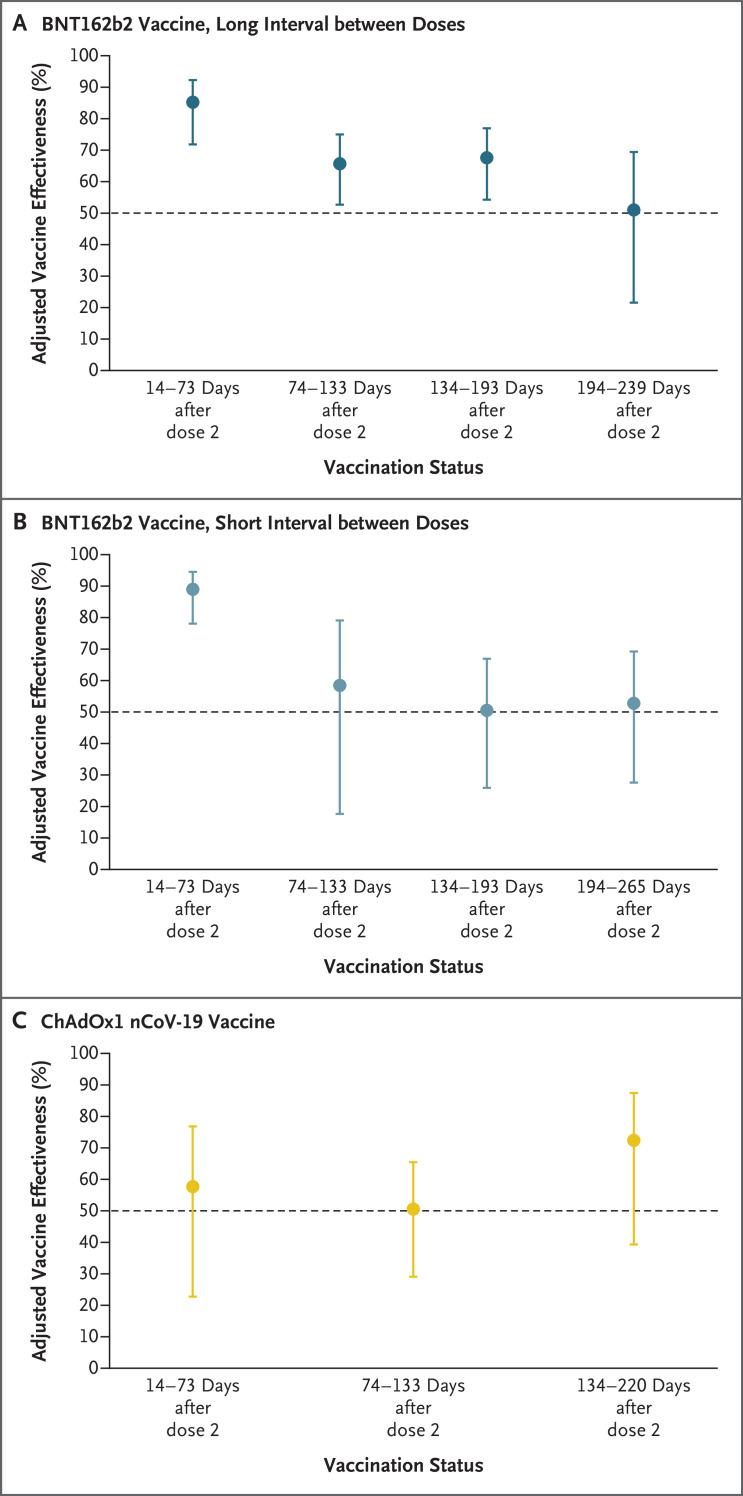
Of 35,768 participants, 27% (9488) had a previous SARS-CoV-2 infection. Vaccine coverage was high: 95% of the participants had received two doses (78% had received BNT162b2 vaccine [Pfizer-BioNTech] with a long interval between doses, 9% BNT162b2 vaccine with a short interval between doses, and 8% ChAdOx1 nCoV-19 vaccine [AstraZeneca]). Between December 7, 2020, and September 21, 2021, a total of 2747 primary infections and 210 reinfections were observed. Among previously uninfected participants who received long-interval BNT162b2 vaccine, adjusted vaccine effectiveness decreased from 85% (95% confidence interval [CI], 72 to 92) 14 to 73 days after the second dose to 51% (95% CI, 22 to 69) at a median of 201 days (interquartile range, 197 to 205) after the second dose; this effectiveness did not differ significantly between the long-interval and short-interval BNT162b2 vaccine recipients. At 14 to 73 days after the second dose, adjusted vaccine effectiveness among ChAdOx1 nCoV-19 vaccine recipients was 58% (95% CI, 23 to 77) - considerably lower than that among BNT162b2 vaccine recipients. Infection-acquired immunity waned after 1 year in unvaccinated participants but remained consistently higher than 90% in those who were subsequently vaccinated, even in persons infected more than 18 months previously.
CONCLUSIONS
Two doses of BNT162b2 vaccine were associated with high short-term protection against SARS-CoV-2 infection; this protection waned considerably after 6 months. Infection-acquired immunity boosted with vaccination remained high more than 1 year after infection. (Funded by the U.K. Health Security Agency and others; ISRCTN Registry number, ISRCTN11041050.).
背景
感染严重急性呼吸综合征冠状病毒 2(SARS-CoV-2)并接种疫苗后的免疫持续时间和效果与大流行政策干预相关,包括疫苗加强针的接种时机。
方法
我们在英国进行了一项无症状医护人员的前瞻性队列研究,这些人员接受了常规聚合酶链反应(PCR)检测。通过比较已接种疫苗者和未接种疫苗者的 PCR 确诊感染时间,评估疫苗有效性(在第一剂疫苗接种后≤10 个月)和感染获得的免疫力,按既往感染状态分层。我们使用 Cox 回归模型,对既往 SARS-CoV-2 感染状态、疫苗类型和接种间隔、人口统计学特征以及工作场所接触 SARS-CoV-2 进行了调整。
结果
在 35768 名参与者中,27%(9488 人)有 SARS-CoV-2 既往感染史。疫苗接种率很高:95%的参与者接受了两剂疫苗(78%接受了 BNT162b2 疫苗[辉瑞-生物科技],间隔时间较长,9%接受了 BNT162b2 疫苗,间隔时间较短,8%接受了 ChAdOx1 nCoV-19 疫苗[阿斯利康])。2020 年 12 月 7 日至 2021 年 9 月 21 日,共观察到 2747 例初次感染和 210 例再感染。在接受长间隔 BNT162b2 疫苗接种的既往未感染者中,第二剂后 14 至 73 天,调整后的疫苗有效性从 85%(95%置信区间[CI],72 至 92)下降至第二剂后中位数 201 天(四分位距,197 至 205)时的 51%(95%CI,22 至 69);长间隔和短间隔 BNT162b2 疫苗接种者之间的有效性无显著差异。第二剂后 14 至 73 天,ChAdOx1 nCoV-19 疫苗接种者的调整疫苗有效性为 58%(95%CI,23 至 77)-明显低于 BNT162b2 疫苗接种者。未接种疫苗者的感染获得性免疫在 1 年后减弱,但在随后接种疫苗的人群中,免疫始终保持在 90%以上,即使是在 18 个月前感染的人群中也是如此。
结论
两剂 BNT162b2 疫苗接种与 SARS-CoV-2 感染的短期高度保护相关;6 个月后,这种保护作用显著下降。接种疫苗后感染获得的免疫增强作用在感染后 1 年以上仍保持较高水平。(由英国卫生安全局和其他机构资助;ISRCTN 登记号,ISRCTN11041050。)

 Zotero 插件