
优化周细胞疗法以改善肢体固定后肌肉的恢复。
Optimization of a pericyte therapy to improve muscle recovery after limb immobilization.
机构信息
Department of Kinesiology and Community Health, University of Illinois at Urbana-Champaign, Champaign, Illinois.
Beckman Institute for Advanced Science and Technology, University of Illinois at Urbana-Champaign, Champaign, Illinois.
出版信息
J Appl Physiol (1985). 2022 Apr 1;132(4):1020-1030. doi: 10.1152/japplphysiol.00700.2021. Epub 2022 Feb 17.
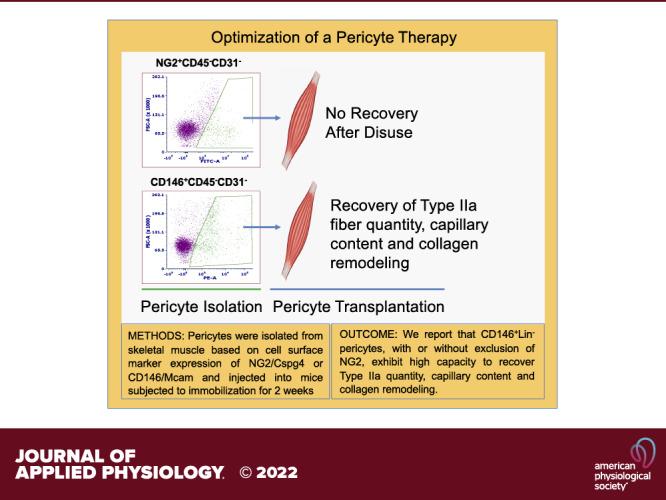
Extended bed rest or limb immobilization can significantly reduce skeletal muscle mass and function. Recovery may be incomplete, particularly in older adults. Our laboratory recently reported that vascular mural cell (pericyte) quantity is compromised after immobilization and appropriate replacement immediately before remobilization can effectively recover myofiber size in mice. Identification of a single cell surface marker for isolation of the most therapeutic pericyte would streamline efforts to optimize muscle recovery. The purpose of this study was to compare the capacity for neural/glial antigen 2 (Cspg4/NG2) and melanoma cell adhesion molecule (Mcam/CD146) positive pericytes to uniquely recover skeletal muscle post-disuse. A single hindlimb from adult C57BL/6J mice was immobilized in full dorsiflexion via a surgical staple inserted through the center of the foot and body of the gastrocnemius. Fourteen days after immobilization, the staple was removed and pericytes, either NG2CD45CD31[Lin], CD146NG2Lin, or CD146Lin pericytes, were injected into the atrophied tibialis anterior (TA) muscle. TA muscles were excised 14 days after transplantation and remobilization. Pericyte transplantation did not significantly improve muscle mass or myofiber cross-sectional area (CSA) after 14 days of remobilization. However, injection of CD146 pericytes significantly increased Type IIa quantity, capillarization, and collagen remodeling compared with NG2 pericytes ( < 0.05). Our results suggest that selection of pericytes based on CD146 rather than NG2 results in the isolation of therapeutic mural cells with high capacity to positively remodel skeletal muscle after a period of immobilization. In this study, pericytes were isolated from mouse skeletal muscle based on cell surface marker expression of neural/glial antigen 2 (NG2) or melanoma cell adhesion molecule (Mcam/CD146) and then compared for the capacity to recover skeletal muscle after a period of immobilization in recipient mice. We report that CD146Lin pericytes exhibit higher capacity than NG2Lin pericytes to recover Type IIa fiber quantity, capillary content, and collagen turnover after disuse.
延长卧床休息或肢体固定会显著减少骨骼肌的质量和功能。恢复可能不完全,特别是在老年人中。我们的实验室最近报告说,血管壁细胞(周细胞)数量在固定后减少,并且在重新运动前适当替换可以有效地恢复小鼠的肌纤维大小。鉴定一种用于分离最具治疗效果的周细胞的单一细胞表面标志物,将简化优化肌肉恢复的工作。本研究的目的是比较神经/神经胶质抗原 2(Cspg4/NG2)和黑色素瘤细胞黏附分子(Mcam/CD146)阳性周细胞在后停用状态下独特地恢复骨骼肌的能力。成年 C57BL/6J 小鼠的一条后肢通过插入穿过足部和腓肠肌体中心的手术钉固定在完全背屈位置。固定 14 天后,取出钉并将周细胞(NG2CD45CD31[Lin]、CD146NG2Lin 或 CD146Lin 周细胞)注射到萎缩的胫骨前肌(TA)中。移植和重新运动 14 天后切除 TA 肌肉。周细胞移植在重新运动 14 天后并没有显著增加肌肉质量或肌纤维横截面积(CSA)。然而,与 NG2 周细胞相比,注射 CD146 周细胞显著增加了 IIa 型数量、毛细血管化和胶原重塑(<0.05)。我们的结果表明,基于 CD146 而不是 NG2 选择周细胞可分离出具有在固定期后积极重塑骨骼肌的高能力的治疗性壁细胞。在这项研究中,基于神经胶质抗原 2(NG2)或黑色素瘤细胞黏附分子(Mcam/CD146)的细胞表面标志物表达从鼠骨骼肌中分离周细胞,然后在接受者小鼠中比较它们在固定一段时间后恢复骨骼肌的能力。我们报告说,CD146Lin 周细胞在失用后恢复 IIa 型纤维数量、毛细血管含量和胶原周转率的能力高于 NG2Lin 周细胞。
 Zotero 插件