
黄芪甲苷IV抑制自然杀伤细胞对小鼠急性缺血性脑卒中具有保护作用:抑制信号转导和转录激活因子3。
Suppressing NK Cells by Astragaloside IV Protects Against Acute Ischemic Stroke in Mice Inhibiting STAT3.
作者信息
Li Shichun, Dou Baokai, Shu Shi, Wei Luyao, Zhu Shiguo, Ke Zunji, Wang Zhifei
机构信息
School of Basic Medical Sciences, Shanghai University of Traditional Chinese Medicine, Shanghai, China.
Academy of Integrative Medicine, Shanghai University of Traditional Chinese Medicine, Shanghai, China.
出版信息
Front Pharmacol. 2022 Feb 3;12:802047. doi: 10.3389/fphar.2021.802047. eCollection 2021.
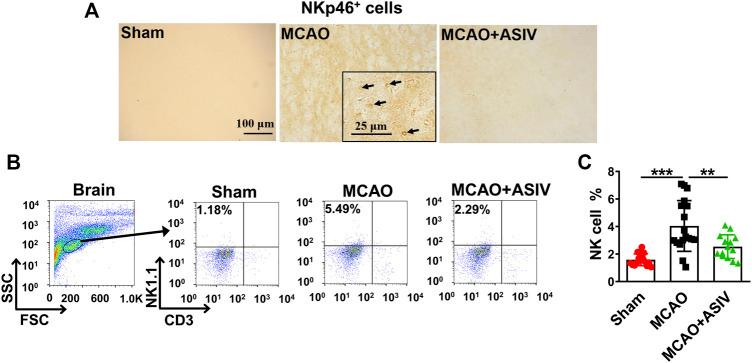
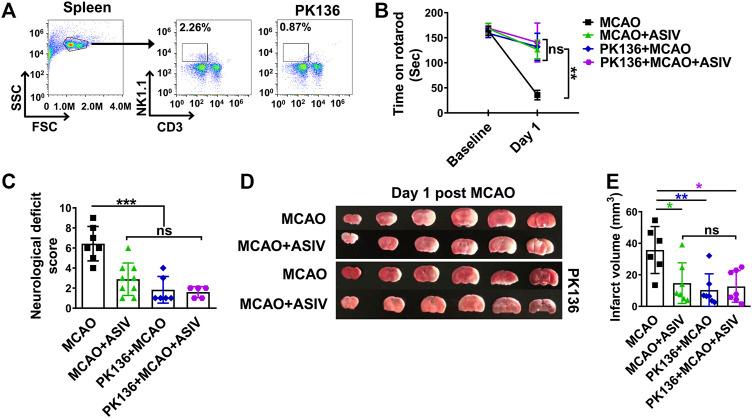
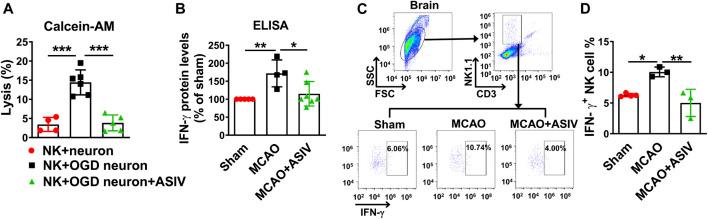
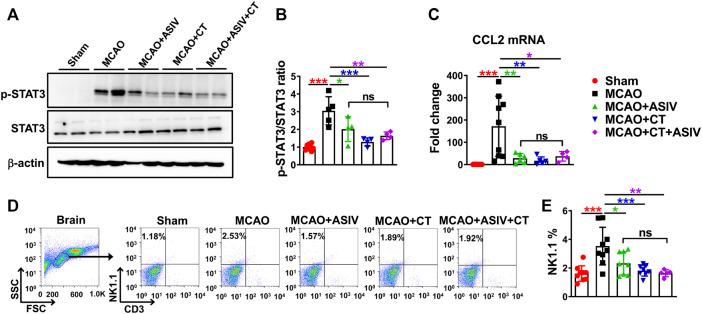
Natural killer (NK) cells, a key member of innate lymphocytes, are a promising immunotherapeutic target for ischemic stroke. Astragaloside IV (ASIV) is isolated from (Fabaceae), a herbal medicine possessing immunomodulatory ability. This study investigated the effect of ASIV on NK cells during the acute stage of brain ischemic injury in a mouse model of middle cerebral artery occlusion (MCAO). MCAO mice treated with ASIV had better functional outcomes, smaller brain infarction and less NK cell brain infiltration. NK cell depletion echoed the protective effect of ASIV. Notably, ASIV did not enhance the protective effect of NK cell depletion against brain ischemic injury. ASIV inhibited glial cell-derived CCL2-mediated chemotaxis to prevent post-ischemic NK cell brain recruitment. Meanwhile, ASIV also abrogated NK cell-mediated cytolytic killing of neurons subjected to oxygen-glucose deprivation and suppressed NK cell-derived IFN-γ and NKG2D expression in the ischemic brain. The inhibitory effect of ASIV on NK cell brain infiltration and activation was mimicked by cryptotanshinone, a STAT3 inhibitor. There was no additive effect when ASIV and cryptotanshinone were used together. In conclusion, ASIV inhibits post-ischemic brain infiltration and activation of NK cells through STAT3 suppression, and this inhibitory effect of ASIV on NK cells plays a key role in its protection against acute ischemic brain injury. Our findings suggest that ASIV is a promising therapeutic candidate in NK cell-based immunotherapy for the treatment of acute ischemic stroke and pave the way for potential clinical trials.
自然杀伤(NK)细胞是固有淋巴细胞的关键成员,是缺血性中风有前景的免疫治疗靶点。黄芪甲苷(ASIV)是从具有免疫调节能力的草药黄芪(豆科)中分离得到的。本研究在大脑中动脉闭塞(MCAO)小鼠模型中,调查了ASIV在脑缺血损伤急性期对NK细胞的影响。用ASIV治疗的MCAO小鼠功能结局更好,脑梗死面积更小,NK细胞向脑内浸润更少。去除NK细胞与ASIV的保护作用相似。值得注意的是,ASIV并未增强去除NK细胞对脑缺血损伤的保护作用。ASIV抑制胶质细胞衍生的CCL2介导的趋化作用,以防止缺血后NK细胞向脑内募集。同时,ASIV还消除了NK细胞介导的对氧葡萄糖剥夺神经元的溶细胞杀伤作用,并抑制了缺血脑中NK细胞衍生的IFN-γ和NKG2D表达。STAT3抑制剂隐丹参酮模拟了ASIV对NK细胞向脑内浸润和激活的抑制作用。ASIV和隐丹参酮联合使用时没有相加作用。总之,ASIV通过抑制STAT3来抑制缺血后脑内NK细胞的浸润和激活,ASIV对NK细胞的这种抑制作用在其对急性缺血性脑损伤的保护中起关键作用。我们的研究结果表明,ASIV在基于NK细胞的免疫治疗急性缺血性中风中是一种有前景的治疗候选药物,并为潜在的临床试验铺平了道路。




 Zotero 插件