
XRCC1 可拮抗聚(ADP 核糖)聚合酶(PARP)抑制剂奥拉帕利和他拉唑帕利,以及临床烷化剂替莫唑胺,促进 PARP1 从断裂的 DNA 上脱离。
XRCC1 counteracts poly(ADP ribose)polymerase (PARP) poisons, olaparib and talazoparib, and a clinical alkylating agent, temozolomide, by promoting the removal of trapped PARP1 from broken DNA.
机构信息
Department of Radiation Genetics, Graduate School of Medicine, Kyoto University, Kyoto, Japan.
Department of Chemistry, Graduate School of Science, Tokyo Metropolitan University, Tokyo, Japan.
出版信息
Genes Cells. 2022 May;27(5):331-344. doi: 10.1111/gtc.12929. Epub 2022 Mar 1.
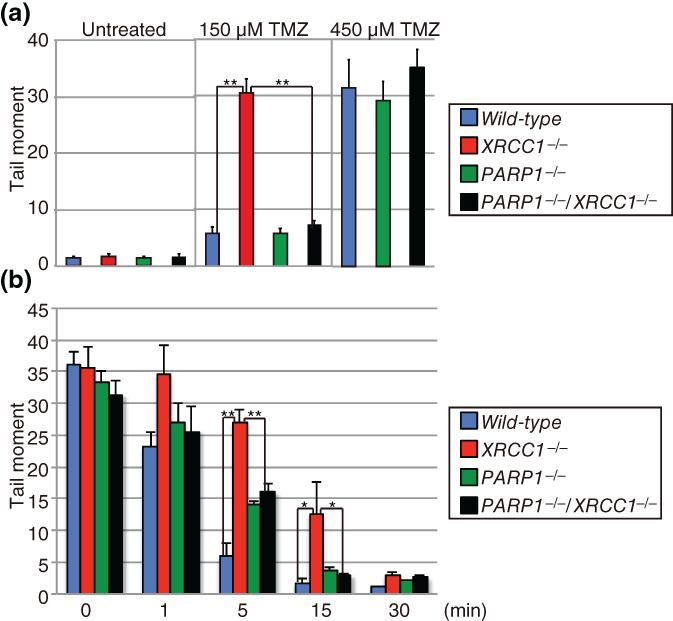
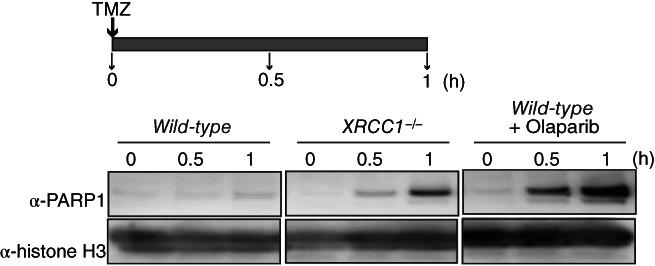
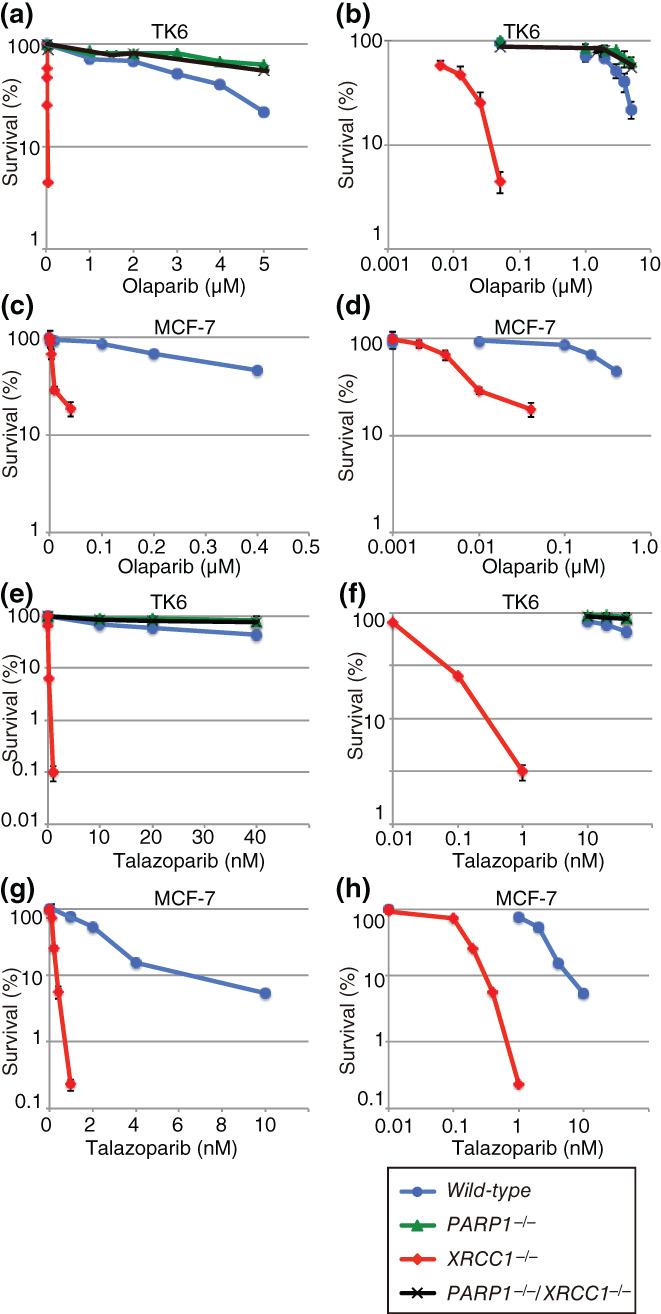
Base excision repair (BER) removes damaged bases by generating single-strand breaks (SSBs), gap-filling by DNA polymerase β (POLβ), and resealing SSBs. A base-damaging agent, methyl methanesulfonate (MMS) is widely used to study BER. BER increases cellular tolerance to MMS, anti-cancer base-damaging drugs, temozolomide, carmustine, and lomustine, and to clinical poly(ADP ribose)polymerase (PARP) poisons, olaparib and talazoparib. The poisons stabilize PARP1/SSB complexes, inhibiting access of BER factors to SSBs. PARP1 and XRCC1 collaboratively promote SSB resealing by recruiting POLβ to SSBs, but XRCC1 cells are much more sensitive to MMS than PARP1 cells. We recently report that the PARP1 loss in XRCC1 cells restores their MMS tolerance and conclude that XPCC1 facilitates the release of PARP1 from SSBs by maintaining its autoPARylation. We here show that the PARP1 loss in XRCC1 cells also restores their tolerance to the three anti-cancer base-damaging drugs, although they and MMS induce different sets of base damage. We reveal the synthetic lethality of the XRCC1 mutation, but not POLβ , with olaparib and talazoparib, indicating that XRCC1 is a unique BER factor in suppressing toxic PARP1/SSB complex and can suppress even when PARP1 catalysis is inhibited. In conclusion, XRCC1 suppresses the PARP1/SSB complex via PARP1 catalysis-dependent and independent mechanisms.
碱基切除修复 (BER) 通过产生单链断裂 (SSB)、DNA 聚合酶 β (POLβ) 填补缺口和修复 SSB 来去除受损碱基。一种碱基损伤试剂甲基甲磺酸酯 (MMS) 被广泛用于研究 BER。BER 增加了细胞对 MMS、抗癌碱基损伤药物替莫唑胺、卡莫司汀和洛莫司汀以及临床多聚 (ADP 核糖) 聚合酶 (PARP) 抑制剂奥拉帕利和他拉唑帕利的耐受性。这些抑制剂通过稳定 PARP1/SSB 复合物,抑制 BER 因子与 SSB 的结合,从而抑制 PARP1 的活性。PARP1 和 XRCC1 通过将 POLβ 募集到 SSB 上共同促进 SSB 修复,但 XRCC1 细胞对 MMS 的敏感性比 PARP1 细胞高得多。我们最近报道,XRCC1 细胞中 PARP1 的缺失恢复了它们对 MMS 的耐受性,并得出结论认为 XPCC1 通过维持其自身 PAR 化来促进 PARP1 从 SSB 上的释放。我们在这里表明,XRCC1 细胞中 PARP1 的缺失也恢复了它们对三种抗癌碱基损伤药物的耐受性,尽管它们和 MMS 诱导了不同类型的碱基损伤。我们揭示了 XRCC1 突变的合成致死性,但与奥拉帕利和他拉唑帕利不同的是,POLβ 突变的合成致死性,这表明 XRCC1 是一种独特的 BER 因子,能够抑制有毒的 PARP1/SSB 复合物,即使 PARP1 催化被抑制时也能发挥作用。总之,XRCC1 通过 PARP1 催化依赖性和非依赖性机制抑制 PARP1/SSB 复合物。



 Zotero 插件