
子宫内膜癌:从组织学到基因组学的转变。
Endometrial Cancer: Transitioning from Histology to Genomics.
机构信息
Department of Gynecologic Oncology, Princess Margaret Cancer Center, University Health Network, Sinai Health System, Toronto, ON M5B 2M9, Canada.
Department of Obstetrics and Gynecology, University of Toronto, Toronto, ON M5G 1X8, Canada.
出版信息
Curr Oncol. 2022 Jan 31;29(2):741-757. doi: 10.3390/curroncol29020063.
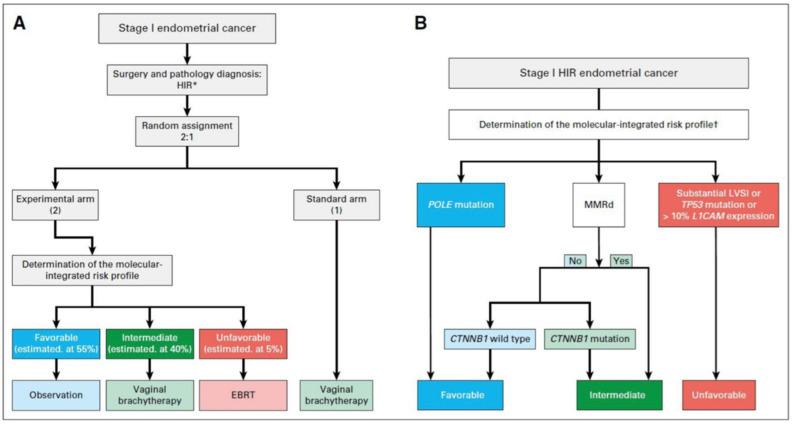
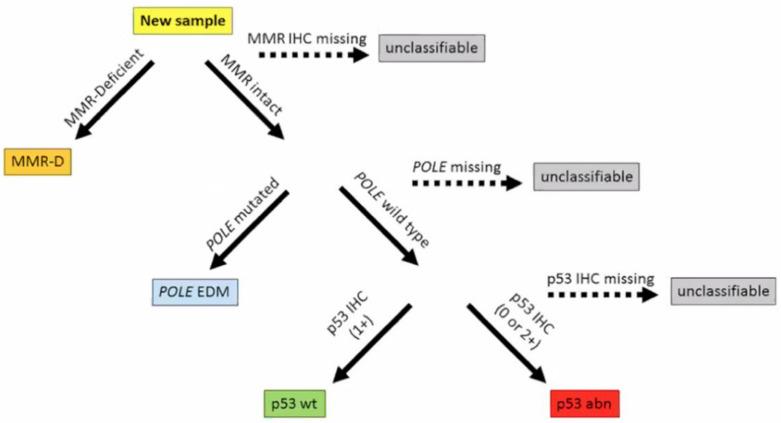
Endometrial carcinoma (EC) is traditionally treated with surgery and adjuvant treatment depending on clinicopathological risk factors. The genomic analysis of EC in 2013 and subsequent studies using immunohistochemistry have led to the current EC molecular classification into: polymerase epsilon mutated (POLEmut), p53 abnormal (p53abn), mismatch repair deficient (MMRd), and no specific molecular profile (NSMP). The four groups have prognostic value and represent a promising tool for clinical decision-making regarding adjuvant treatment. Molecular classification was integrated into the recent European Society of Gynecologic Oncology (ESGO) management guidelines. POLEmut EC has favorable outcomes and retrospective studies found that omitting adjuvant treatment is safe in this group; two prospective clinical trials, PORTEC-4 and TAPER, are ongoing to assess this. p53 abn is associated with increased recurrence, decreased survival, and benefitted from chemotherapy in the PORTEC-3 subgroup molecular analysis. The clinical trials PORTEC-4a and CANSTAMP will prospectively assess this. MMRd and NSMP groups have intermediate prognosis and will likely continue to rely closely on clinicopathological features for adjuvant treatment decisions. In addition, the molecular classification has led to exploring novel treatments such as checkpoint inhibitors. Overall, the molecular perspective on EC and associated clinical trials will likely refine EC risk stratification to optimize care and avoid overtreatment.
子宫内膜癌(EC)传统上采用手术和辅助治疗,具体取决于临床病理危险因素。2013 年对 EC 的基因组分析以及随后使用免疫组织化学的研究导致了当前的 EC 分子分类为:聚合酶 epsilon 突变(POLEmut)、p53 异常(p53abn)、错配修复缺陷(MMRd)和无特定分子特征(NSMP)。这四组具有预后价值,并代表了针对辅助治疗的临床决策的有前途的工具。分子分类已纳入最近的欧洲妇科肿瘤学会(ESGO)管理指南。POLEmut EC 具有良好的结局,回顾性研究发现,在该组中省略辅助治疗是安全的;两项前瞻性临床试验,PORTEC-4 和 TAPER,正在进行中以评估这一点。p53 abn 与复发增加、生存减少相关,并在 PORTEC-3 亚组分子分析中受益于化疗。临床试验 PORTEC-4a 和 CANSTAMP 将前瞻性评估这一点。MMRd 和 NSMP 组具有中等预后,可能仍然需要密切依赖临床病理特征来做出辅助治疗决策。此外,分子分类促使探索新的治疗方法,如检查点抑制剂。总的来说,对 EC 的分子视角和相关的临床试验可能会完善 EC 的风险分层,以优化护理并避免过度治疗。

 Zotero 插件