
时钟进化的幽灵:过去、现在与未来。
Spectres of Clock Evolution: Past, Present, and Yet to Come.
作者信息
Jabbur Maria Luísa, Johnson Carl Hirschie
机构信息
Department of Biological Sciences, Vanderbilt University, Nashville, TN, United States.
出版信息
Front Physiol. 2022 Feb 11;12:815847. doi: 10.3389/fphys.2021.815847. eCollection 2021.
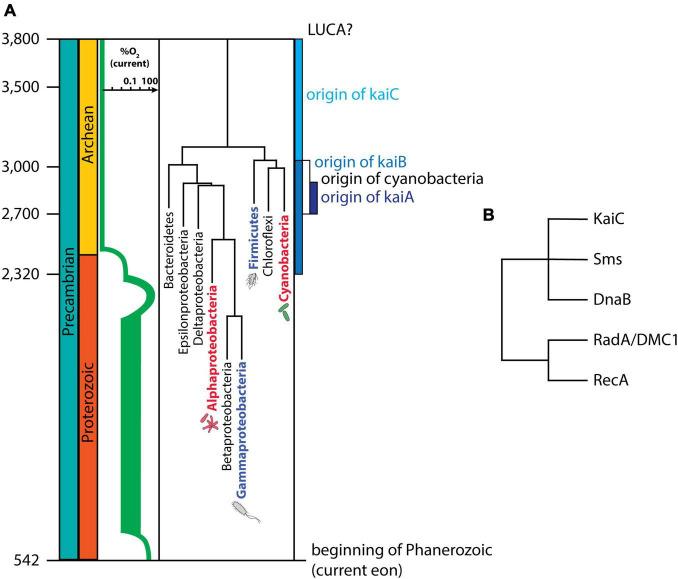
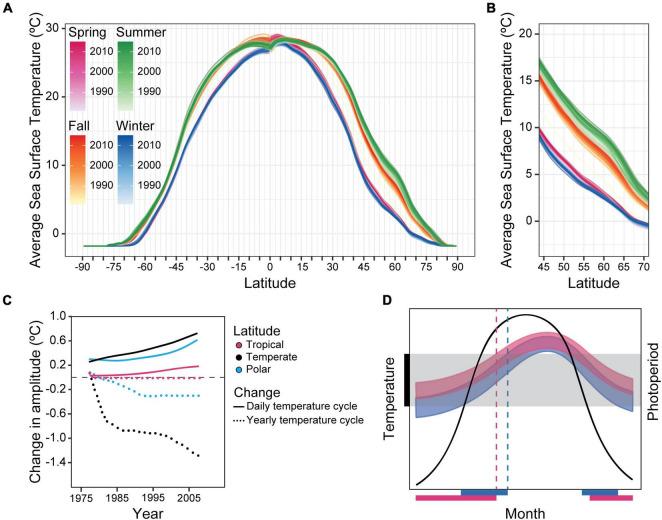
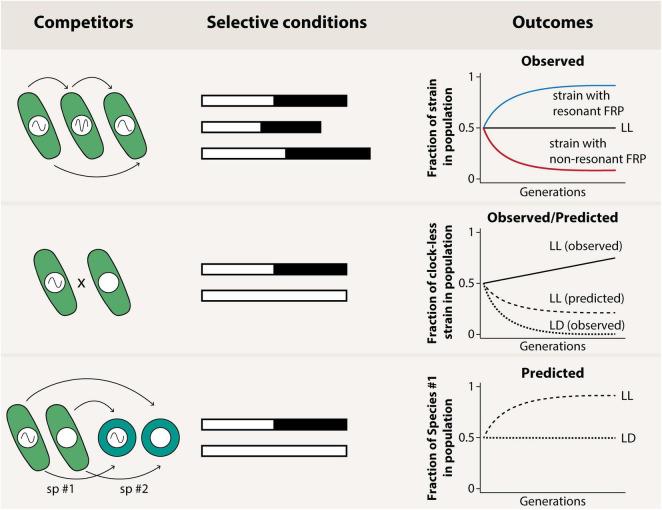
Circadian clocks are phylogenetically widespread biological oscillators that allow organisms to entrain to environmental cycles and use their steady-state phase relationship to anticipate predictable daily phenomena - such as the light-dark transitions of a day - and prepare accordingly. Present from cyanobacteria to mammals, circadian clocks are evolutionarily ancient and are thought to increase the fitness of the organisms that possess them by allowing for better resource usage and/or proper internal temporal order. Here, we review literature with respect to the ecology and evolution of circadian clocks, with a special focus on cyanobacteria as model organisms. We first discuss what can be inferred about future clock evolution in response to climate change, based on data from latitudinal clines and domestication. We then address our current understanding of the role that circadian clocks might be contributing to the adaptive fitness of cyanobacteria at the present time. Lastly, we discuss what is currently known about the oldest known circadian clock, and the early Earth conditions that could have led to its evolution.
昼夜节律钟是在系统发育上广泛存在的生物振荡器,它使生物体能够与环境周期同步,并利用它们的稳态相位关系来预测可预测的日常现象,比如一天中的明暗转换,并据此做好准备。从蓝细菌到哺乳动物都有昼夜节律钟,它们在进化上很古老,并且被认为通过更好地利用资源和/或维持适当的内部时间秩序来提高拥有它们的生物体的适应性。在这里,我们回顾了关于昼夜节律钟的生态学和进化的文献,特别关注作为模式生物的蓝细菌。我们首先根据来自纬度梯度和驯化的数据,讨论可以推断出的昼夜节律钟在应对气候变化时未来的进化情况。然后,我们阐述目前对昼夜节律钟目前可能对蓝细菌适应性所起作用的理解。最后,我们讨论目前已知的最古老的昼夜节律钟以及可能导致其进化的早期地球条件。
 Zotero 插件