
两种身心干预对纤维肌痛患者脑灌注的差异变化:动脉自旋标记功能磁共振成像研究
Differential Brain Perfusion Changes Following Two Mind-Body Interventions for Fibromyalgia Patients: an Arterial Spin Labelling fMRI Study.
作者信息
Medina Sonia, O'Daly Owen G, Howard Matthew A, Feliu-Soler Albert, Luciano Juan V
机构信息
Department of Neuroimaging, King's College London, London, UK.
Department of Clinical & Health Psychology, Autonomous University of Barcelona, Bellaterra, Spain.
出版信息
Mindfulness (N Y). 2022;13(2):449-461. doi: 10.1007/s12671-021-01806-2. Epub 2022 Jan 5.
OBJECTIVES
Further mechanistic insight on mind-body techniques for fibromyalgia (FMS) is needed. Arterial spin labelling (ASL) imaging can capture changes in regional cerebral blood flow (rCBF) that relate to spontaneous pain.
METHODS
We recruited FMS patients undergoing either mindfulness-based stress reduction training (MBSR, = 14) or a psychoeducational programme (FibroQoL, = 18), and a control FMS group with no add-on treatment ( = 14). We acquired whole-brain rCBF maps and self-report measures at baseline and following treatment and explored interaction effects in brain perfusion between the treatment group and session with a focus on the amygdala, the insula and the anterior cingulate cortex (ACC).
RESULTS
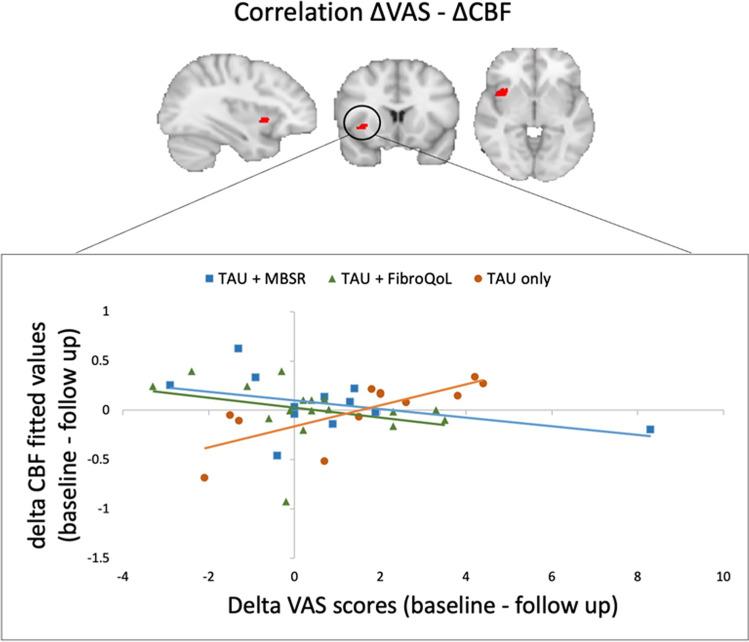
We identified a significant interaction effect in the amygdala, which corresponded with rCBF decreases following FibroQoL specifically. At baseline, rCBF in the amygdala for the FibroQoL group correlated with pain catastrophizing and anxiety scores, but not after treatment, suggesting a decoupling between activity in the amygdala and negative emotional symptoms of FMS as a consequence of treatment. Baseline rCBF correlated positively with pain symptoms in the ACC and the anterior insula across all patients; moreover, the correlation between rCBF changes post intervention in the insula and pain improvement was negative for both treatments and significantly different from the control group. We suggest that there is disruption of the typical relationship between clinical pain and activity as a product of these two nonpharmacological therapies.
CONCLUSIONS
We have demonstrated that different mind-to-body treatments correspond to differential changes in clinical symptoms and brain activity patterns, which encourages future research investigating predictors of treatment response.
TRIAL REGISTRATION
NCT02561416.
SUPPLEMENTARY INFORMATION
The online version contains supplementary material available at 10.1007/s12671-021-01806-2.
目的
需要对纤维肌痛(FMS)的身心治疗方法有更深入的机制性认识。动脉自旋标记(ASL)成像可以捕捉与自发性疼痛相关的局部脑血流(rCBF)变化。
方法
我们招募了接受基于正念减压训练(MBSR,n = 14)或心理教育项目(FibroQoL,n = 18)的FMS患者,以及未接受附加治疗的FMS对照组(n = 14)。我们在基线和治疗后获取了全脑rCBF图谱和自我报告测量数据,并探讨了治疗组与治疗阶段之间在脑灌注方面的交互作用,重点关注杏仁核、岛叶和前扣带回皮质(ACC)。
结果
我们在杏仁核中发现了显著的交互作用,这与FibroQoL治疗后rCBF的降低相对应。在基线时,FibroQoL组杏仁核中的rCBF与疼痛灾难化和焦虑评分相关,但治疗后则不相关,这表明治疗后杏仁核活动与FMS的负面情绪症状之间的解耦。所有患者的ACC和前岛叶的基线rCBF与疼痛症状呈正相关;此外,两种治疗方法干预后岛叶rCBF变化与疼痛改善之间的相关性均为负,且与对照组有显著差异。我们认为,这两种非药物疗法导致了临床疼痛与活动之间典型关系的破坏。
结论
我们已经证明,不同的身心治疗方法对应于临床症状和脑活动模式的不同变化,这鼓励了未来对治疗反应预测因素的研究。
试验注册
NCT02561416。
补充信息
在线版本包含可在10.1007/s12671-021-01806-2获取的补充材料。


 Zotero 插件