
LEP和LEPR基因单核苷酸多态性与乳腺癌风险的关系:一项中国女性多中心病例对照研究的结果
Single-Nucleotide Polymorphisms in LEP and LEPR Associated With Breast Cancer Risk: Results From a Multicenter Case-Control Study in Chinese Females.
作者信息
Li Liang, Meng Xingchen, Liu Liyuan, Xiang Yujuan, Wang Fei, Yu Lixiang, Zhou Fei, Zheng Chao, Zhou Wenzhong, Cui Shude, Tian Fuguo, Fan Zhimin, Geng Cuizhi, Cao Xuchen, Yang Zhenlin, Wang Xiang, Liang Hong, Wang Shu, Jiang Hongchuan, Duan Xuening, Wang Haibo, Li Guolou, Wang Qitang, Zhang Jianguo, Jin Feng, Tang Jinhai, Li Liang, Zhu Shiguang, Zuo Wenshu, Ye Chunmiao, Yin Gengshen, Ma Zhongbing, Huang Shuya, Yu Zhigang
机构信息
Department of Breast Surgery, The Second Hospital, Cheeloo College of Medicine, Shandong University, Jinan, China.
School of Medicine, Cheeloo College of Medicine, Shandong University, Jinan, China.
出版信息
Front Oncol. 2022 Feb 10;12:809570. doi: 10.3389/fonc.2022.809570. eCollection 2022.
BACKGROUND
Leptin (LEP) plays a physiological role through its specific receptor (LEPR) and is involved in the occurrence and development of breast cancer. Our current study aimed at determining the influence of single-nucleotide polymorphisms (SNPs) in the genes coding for LEP and LEPR on breast cancer risk.
METHODS
In the present study, 963 breast cancer cases and 953 controls were enrolled. Five SNPs of LEP and two of LEPR were chosen to evaluate the correlation of selected SNPs with breast cancer susceptibility among women in northern and eastern China. Analyses were further stratified by body mass index (BMI), waist-hip rate (WHR), estrogen receptor, and progesterone receptor status. The expression patterns of risk variant-associated genes were detected by expression quantitative trait locus (eQTL) analysis with eQTLGen and The Cancer Genome Atlas database.
RESULTS
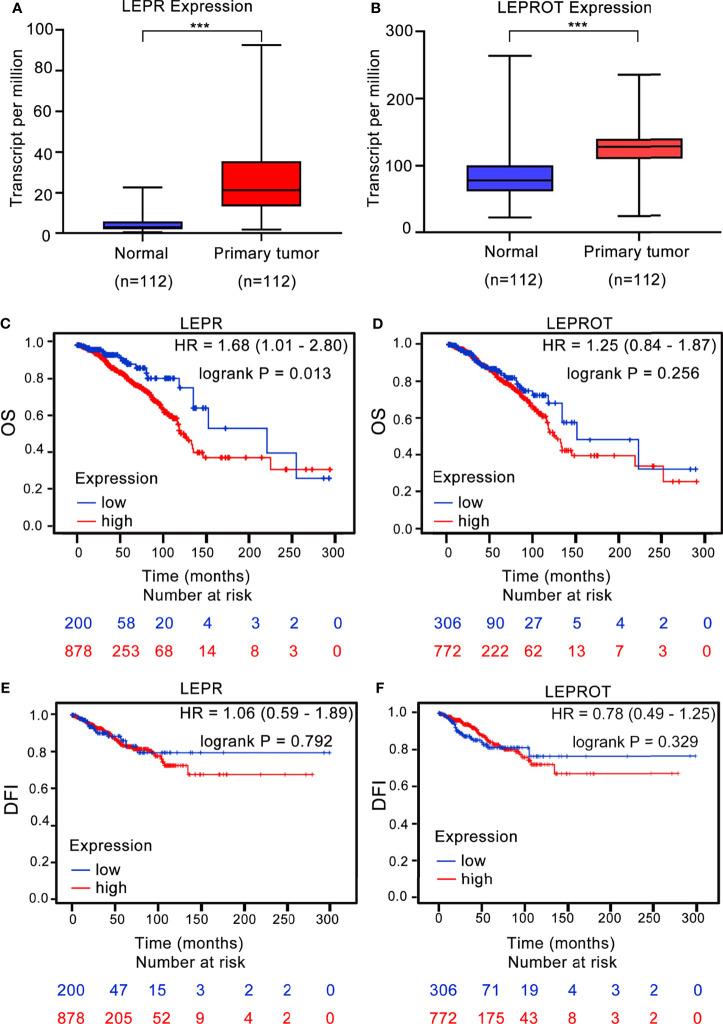
There were significant differences between breast cancer cases and control groups in the menopausal status and family history of breast cancer. Two SNPs (rs1137101 and rs4655555) of the LEPR gene decreased overall breast cancer risk, and other five SNPs showed no significant association with breast cancer risk. rs1137101 (GA vs. GG; adjusted OR = 0.719, 95% CI = 0.578-0.894, p = 0.003) and rs4655555 (TT vs. AA; adjusted OR = 0.574, 95% CI = 0.377-0.873, p = 0.009) significantly decreased breast cancer risk after Bonferroni correction for multiple testing. In subgroup analyses, the GA and GA + AA genotypes of LEPR rs1137101 associated with decreased breast cancer risk in the subgroup of BMI ≤ 24 kg/m or WHR ≥ 0.85 after Bonferroni correction. Furthermore, we found that the expressions of rs4655555-associated gene LEPR and leptin receptor overlapping transcript (LEPROT) were upregulated in breast cancer tumor tissues compared with adjacent normal tissues, and a higher expression of LEPR in tumor tissues was correlated with poor prognosis of breast cancer patients using The Cancer Genome Atlas Breast Invasive Carcinoma (TCGA-BRCA) data.
CONCLUSION
Our study demonstrated that the polymorphisms rs1137101 and rs4655555 located in the LEPR gene decreased breast cancer risk in Chinese females, which might be a research-worthy bio-diagnostic marker and applied for early prediction and risk assessment of breast cancer.
背景
瘦素(LEP)通过其特异性受体(LEPR)发挥生理作用,并参与乳腺癌的发生和发展。我们当前的研究旨在确定LEP和LEPR编码基因中的单核苷酸多态性(SNP)对乳腺癌风险的影响。
方法
在本研究中,纳入了963例乳腺癌病例和953例对照。选择LEP的5个SNP和LEPR的2个SNP,以评估所选择的SNP与中国北方和东部女性乳腺癌易感性之间的相关性。分析进一步按体重指数(BMI)、腰臀比(WHR)、雌激素受体和孕激素受体状态进行分层。通过使用eQTLGen和癌症基因组图谱数据库进行表达定量性状位点(eQTL)分析,检测风险变异相关基因的表达模式。
结果
乳腺癌病例组和对照组在绝经状态和乳腺癌家族史方面存在显著差异。LEPR基因的两个SNP(rs1137101和rs4655555)降低了总体乳腺癌风险,而其他五个SNP与乳腺癌风险无显著关联。经多重检验的Bonferroni校正后,rs1137101(GA与GG相比;校正OR = 0.719,95% CI = 0.578 - 0.894,p = 0.003)和rs4655555(TT与AA相比;校正OR = 0.574,95% CI = 0.377 - 0.873,p = 0.009)显著降低了乳腺癌风险。在亚组分析中,经Bonferroni校正后,LEPR rs1137101的GA和GA + AA基因型在BMI≤24 kg/m或WHR≥0.85的亚组中与降低乳腺癌风险相关。此外,我们发现与rs4655555相关的基因LEPR和瘦素受体重叠转录本(LEPROT)在乳腺癌肿瘤组织中的表达与相邻正常组织相比上调,并且使用癌症基因组图谱乳腺浸润性癌(TCGA - BRCA)数据,肿瘤组织中LEPR的高表达与乳腺癌患者的不良预后相关。
结论
我们的研究表明,位于LEPR基因中的多态性rs1137101和rs4655555降低了中国女性的乳腺癌风险,这可能是一个值得研究的生物诊断标志物,可用于乳腺癌的早期预测和风险评估。
 Zotero 插件