
新辅助全身治疗后临床淋巴结阳性乳腺癌降阶梯腋窝处理的 3 年随访:MARI 方案。
Three-year follow-up of de-escalated axillary treatment after neoadjuvant systemic therapy in clinically node-positive breast cancer: the MARI-protocol.
机构信息
Department of Surgical Oncology, Netherlands Cancer Institute - Antoni Van Leeuwenhoek, Amsterdam, The Netherlands.
Department of Surgery, Amsterdam University Medical Center, Meibergdreef 9, 1105 AZ, Amsterdam, The Netherlands.
出版信息
Breast Cancer Res Treat. 2022 May;193(1):37-48. doi: 10.1007/s10549-022-06545-z. Epub 2022 Mar 3.
PURPOSE
In clinically node-positive (cN+) breast cancer patients, evidence supporting response-guided treatment after neoadjuvant systemic therapy (NST) instead of axillary lymph node dissection (ALND) is increasing, but follow-up results are lacking. We assessed three-year axillary recurrence-free interval (aRFI) in cN+ patients with response-adjusted axillary treatment according to the 'Marking Axillary lymph nodes with Radioactive Iodine seeds' (MARI)-protocol.
METHODS
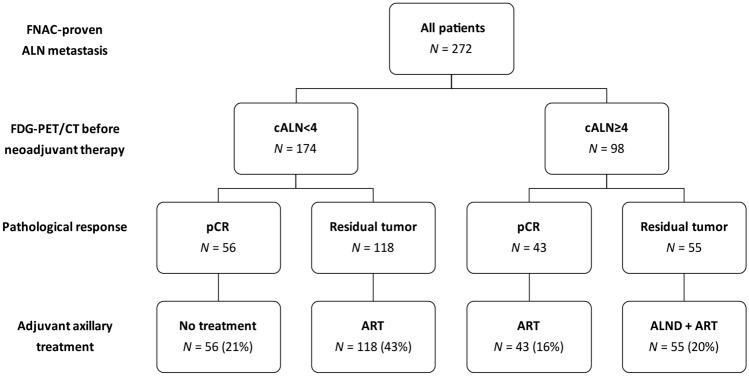
We retrospectively assessed all stage II-III cytologically proven cN+ breast cancer patients who underwent the MARI-protocol between July 2014 and November 2018. Pre-NST axillary staging with FDG-PET/CT (less- or more than four suspicious axillary nodes; cALN < 4 or cALN ≥ 4) and post-NST pathological axillary response measured in the pre-NST largest tumor-positive axillary lymph node marked with an iodine seed (MARI-node; ypMARI-neg or ypMARI-pos) determined axillary treatment: no further treatment (cALN < 4, ypMARI-neg), axillary radiotherapy (ART) (cALN < 4, ypMARI-pos and cALN ≥ 4, ypMARI-neg) or ALND plus ART (cALN ≥ 4, ypMARI-pos).
RESULTS
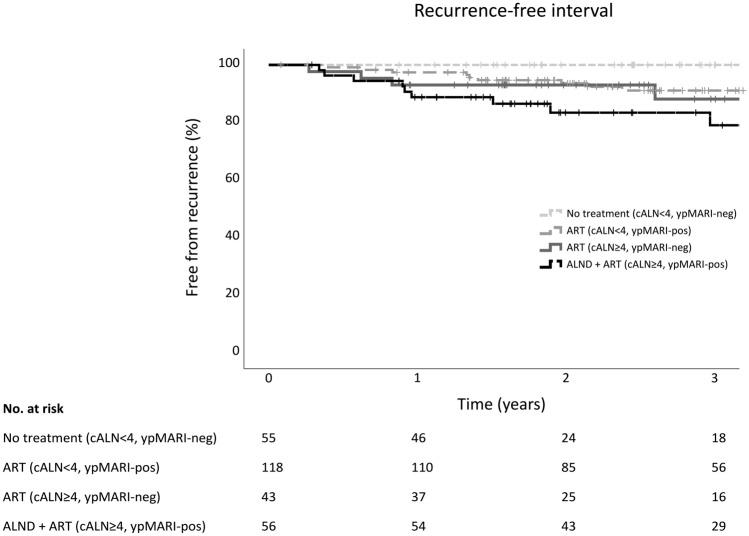
Of 272 women included, the MARI-node was tumor-negative in 56 (32%) of 174 cALN < 4 patients and 43 (44%) of 98 cALN ≥ 4 patients. According to protocol, 56 (21%) patients received no further axillary treatment, 161 (59%) received ART and 55 (20%) received ALND plus ART. Median follow-up was 3.0 years (IQR 1.9-4.1). Five patients (one no further treatment, four ART) had axillary metastases. Three-year aRFI was 98% (95% CI 96-100). The overall recurrence risk remained highest for patients with ALND (HR 4.36; 95% CI 0.95-20.04, p = 0.059).
CONCLUSIONS
De-escalation of axillary treatment according to the MARI-protocol prevented ALND in 80% of cN+ patients with an excellent three-year aRFI of 98%.
目的
在临床淋巴结阳性(cN+)乳腺癌患者中,支持新辅助全身治疗(NST)后根据反应调整辅助腋窝治疗而不是腋窝淋巴结清扫(ALND)的证据越来越多,但随访结果尚缺乏。我们根据“放射性碘种子标记腋窝淋巴结(MARI)”方案评估了接受反应调整腋窝治疗的 cN+患者的 3 年腋窝无复发生存期(aRFI)。
方法
我们回顾性评估了 2014 年 7 月至 2018 年 11 月期间接受 MARI 方案的所有 II 期至 III 期细胞学证实的 cN+乳腺癌患者。在 NST 前,采用 FDG-PET/CT 进行腋窝分期(可疑腋窝淋巴结少于或多于 4 个;cALN<4 或 cALN≥4),在 NST 前最大肿瘤阳性腋窝淋巴结上用碘种子标记物(MARI 节点)测量新辅助治疗后的病理腋窝反应(ypMARI-neg 或 ypMARI-pos),决定腋窝治疗:不再进行进一步治疗(cALN<4,ypMARI-neg),腋窝放疗(ART)(cALN<4,ypMARI-pos 和 cALN≥4,ypMARI-neg)或 ALND 加 ART(cALN≥4,ypMARI-pos)。
结果
在 272 名女性中,174 名 cALN<4 的患者中,MARI 节点肿瘤阴性的有 56 名(32%),98 名 cALN≥4 的患者中,MARI 节点肿瘤阴性的有 43 名(44%)。根据方案,56 名(21%)患者未进行进一步腋窝治疗,161 名(59%)患者接受 ART,55 名(20%)患者接受 ALND 加 ART。中位随访时间为 3.0 年(IQR 1.9-4.1)。5 名患者(1 名未进一步治疗,4 名 ART)发生腋窝转移。3 年 aRFI 为 98%(95%CI 96-100)。ALND 患者的总体复发风险仍然最高(HR 4.36;95%CI 0.95-20.04,p=0.059)。
结论
根据 MARI 方案对腋窝治疗进行降级处理,可使 80%的 cN+患者避免 ALND,并获得极佳的 3 年 aRFI(98%)。

 Zotero 插件