
创伤性脑损伤、精神健康和物质使用的综合护理系统评价。
A systematic review on integrated care for traumatic brain injury, mental health, and substance use.
机构信息
KITE-Toronto Rehabilitation Institute, University Health Network, Toronto, Ontario, Canada.
Institute of Health Policy, Management and Evaluation, University of Toronto, Toronto, Ontario, Canada.
出版信息
PLoS One. 2022 Mar 3;17(3):e0264116. doi: 10.1371/journal.pone.0264116. eCollection 2022.
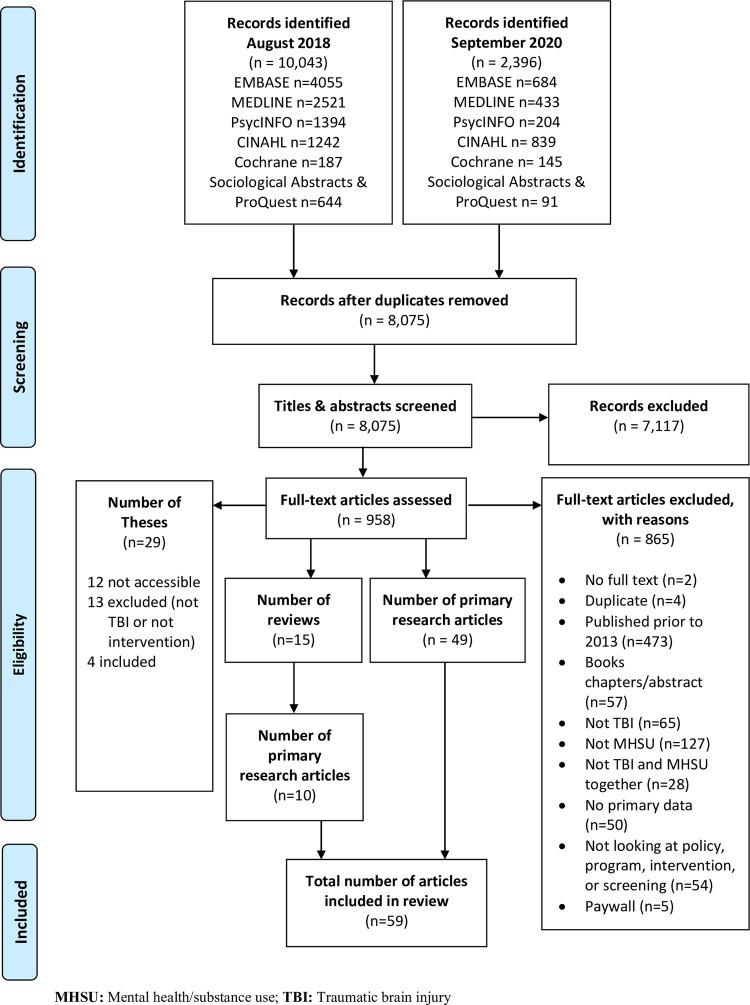
Traumatic brain injuries (TBI) and mental health or substance use disorders (MHSU) are global public health concerns due to their prevalence and impact on individuals and societies. However, care for individuals with TBI and MHSU remains fragmented with a lack of appropriate services and supports across the continuum of healthcare. This systematic review provided an evidence-based foundation to inform opportunities to mobilize and adapt existing resources to integrate care for individuals with TBI and MHSU by comprehensively summarizing existing integrated activities and reported barriers and facilitators to care integration. MEDLINE, EMBASE, PsycINFO, CINAHL, Cochrane Central Register of Controlled Trials, Sociological Abstracts, and Dissertations & Theses Global were independently reviewed by two reviewers based on pre-determined eligibility criteria. Data on the integration activity, level and type of integration, reported barriers and facilitators, and the strategies aligning with the World Health Organization's (WHO) Framework on Integrated Person-Centred Care were extracted to form the basis for a narrative synthesis. Fifty-nine peer-reviewed articles were included, describing treatments (N = 49), programs (N = 4), or screening activities (N = 7). Studies discussing clinical integration at the micro- (N = 38) and meso- (N = 10) levels, service integration at the micro- (N = 6) and meso- (N = 5) levels, and functional integration at the meso-level (N = 1) were identified. A minority of articles reported on facilitators (e.g., cognitive accommodations in treatment plans; N = 7), barriers (e.g., lack of education on cognitive challenges associated with TBI; N = 2), or both (N = 6), related to integrating care. This review demonstrated that integrated TBI and MHSU care already exists across a range of levels and types. Given the finite and competing demands for healthcare resources, cognitive accommodations across treatment plans to facilitate integrated TBI and MHSU care should be considered. Multidisciplinary teams should also be explored to provide opportunities for education among health professionals so they can be familiar with TBI and MHSU. Trial registration: Prospero Registration: CRD42018108343.
创伤性脑损伤(TBI)和精神健康或物质使用障碍(MHSU)是全球公共卫生关注的问题,因为它们的普遍性和对个人和社会的影响。然而,由于缺乏适当的服务和支持,TBI 和 MHSU 患者的护理仍然分散,在整个医疗保健连续体中都存在这种情况。这项系统评价提供了循证基础,通过全面总结现有的综合活动以及报告的护理整合障碍和促进因素,为动员和调整现有资源以整合 TBI 和 MHSU 患者的护理提供了机会。根据预先确定的资格标准,两位评审员分别对 MEDLINE、EMBASE、PsycINFO、CINAHL、Cochrane 中央对照试验注册中心、社会学摘要和全球论文与论文进行了独立审查。关于整合活动、整合水平和类型、报告的障碍和促进因素以及与世界卫生组织(WHO)综合以人为本的护理框架一致的策略的数据被提取出来,作为叙述性综合的基础。纳入了 59 篇同行评议文章,描述了治疗(N = 49)、方案(N = 4)或筛查活动(N = 7)。讨论微观层面(N = 38)和中观层面(N = 10)临床整合、微观层面(N = 6)和中观层面(N = 5)服务整合以及中观层面(N = 1)功能整合的研究被确定。少数文章报告了与整合护理相关的促进因素(例如,治疗计划中的认知适应;N = 7)、障碍(例如,缺乏与 TBI 相关的认知挑战方面的教育;N = 2)或两者(N = 6)。这项审查表明,TBI 和 MHSU 护理的整合已经存在于多个层面和类型。鉴于医疗资源的有限性和竞争需求,应考虑在治疗计划中进行认知适应,以促进 TBI 和 MHSU 的整合护理。还应探索多学科团队,为卫生专业人员提供教育机会,使他们熟悉 TBI 和 MHSU。试验注册:PROSPERO 注册:CRD42018108343。
 Zotero 插件