
帕金森病中的语音:一项机器学习研究。
Voice in Parkinson's Disease: A Machine Learning Study.
作者信息
Suppa Antonio, Costantini Giovanni, Asci Francesco, Di Leo Pietro, Al-Wardat Mohammad Sami, Di Lazzaro Giulia, Scalise Simona, Pisani Antonio, Saggio Giovanni
机构信息
Department of Human Neurosciences, Sapienza University of Rome, Rome, Italy.
IRCCS Neuromed Institute, Pozzilli, Italy.
出版信息
Front Neurol. 2022 Feb 15;13:831428. doi: 10.3389/fneur.2022.831428. eCollection 2022.
INTRODUCTION
Parkinson's disease (PD) is characterized by specific voice disorders collectively termed hypokinetic dysarthria. We here investigated voice changes by using machine learning algorithms, in a large cohort of patients with PD in different stages of the disease, OFF and ON therapy.
METHODS
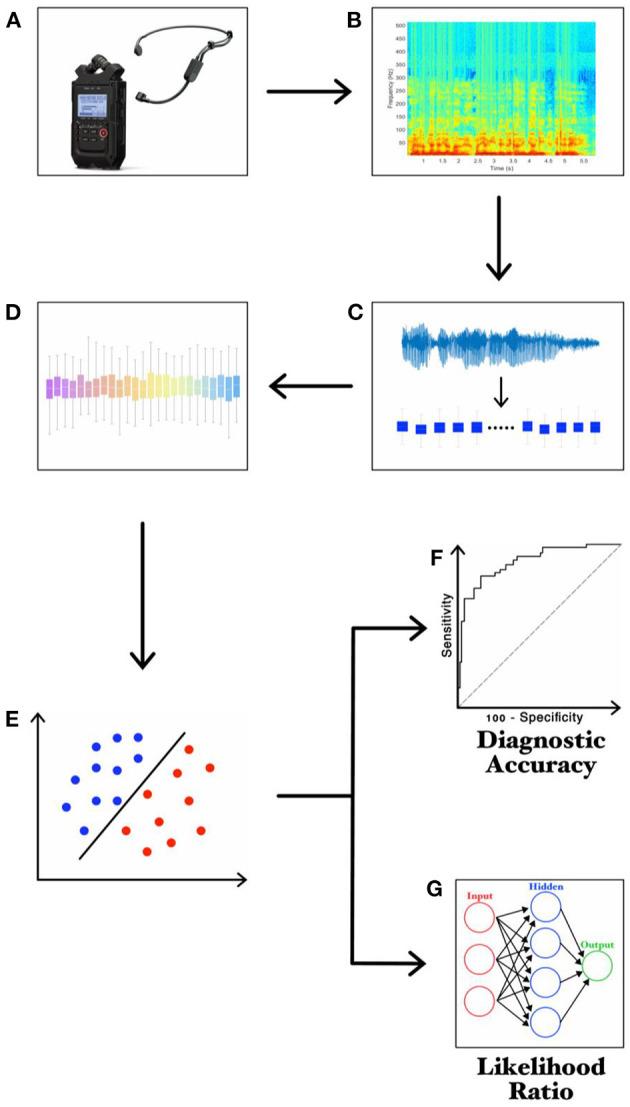
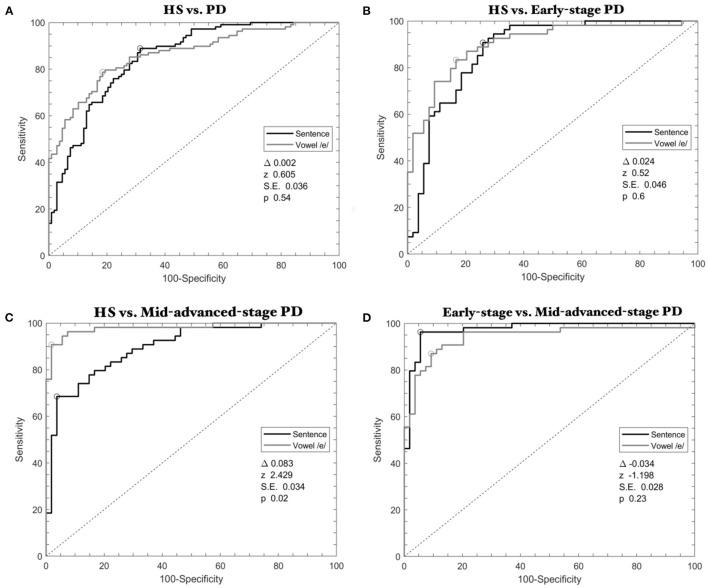
We investigated 115 patients affected by PD (mean age: 68.2 ± 9.2 years) and 108 age-matched healthy subjects (mean age: 60.2 ± 11.0 years). The PD cohort included 57 patients (Hoehn &Yahr ≤ 2) who never took L-Dopa for their disease at the time of the study, and 58 patients (Hoehn &Yahr >2) who were with L-Dopa. We clinically evaluated voices using specific subitems of the Unified Parkinson's Disease Rating Scale and the Voice Handicap Index. Voice samples recorded through a high-definition audio recorder underwent machine learning analysis based on the support vector machine classifier. We also calculated the receiver operating characteristic curves to examine the diagnostic accuracy of the analysis and assessed possible clinical-instrumental correlations.
RESULTS
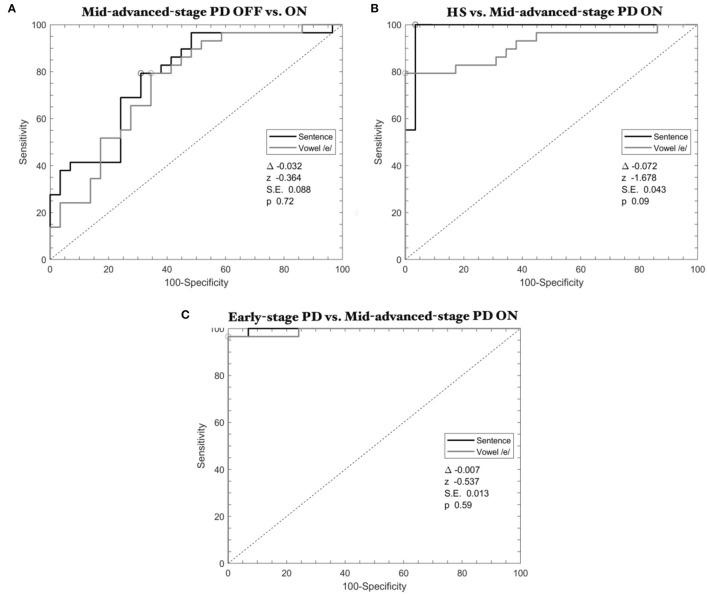
Voice is abnormal in PD and as the disease progresses, voice increasingly degradres as demonstrated by high accuracy in the discrimination between healthy subjects and PD patients in the and . Also, L-dopa therapy improves but not restore voice in PD as shown by high accuracy in the comparison between patients OFF and ON therapy. Finally, for the first time we achieved significant clinical-instrumental correlations by using a new score (LR value) calculated by machine learning.
CONCLUSION
Voice is abnormal in PD, progressively degrades in and can be improved but not restored by L-Dopa. Lastly, machine learning allows tracking disease severity and quantifying the symptomatic effect of L-Dopa on voice parameters with previously unreported high accuracy, thus representing a potential new biomarker of PD.
引言
帕金森病(PD)的特征是特定的语音障碍,统称为运动减少型构音障碍。我们在此使用机器学习算法,对一大群处于疾病不同阶段、未服药和服药状态的帕金森病患者的语音变化进行了研究。
方法
我们调查了115例帕金森病患者(平均年龄:68.2±9.2岁)和108名年龄匹配的健康受试者(平均年龄:60.2±11.0岁)。帕金森病队列包括57例在研究时从未服用左旋多巴治疗疾病的患者(Hoehn&Yahr≤2),以及58例正在服用左旋多巴的患者(Hoehn&Yahr>2)。我们使用统一帕金森病评定量表和嗓音障碍指数的特定子项目对语音进行临床评估。通过高清录音机录制的语音样本基于支持向量机分类器进行机器学习分析。我们还计算了受试者工作特征曲线,以检验分析的诊断准确性,并评估可能的临床与仪器测量之间的相关性。
结果
帕金森病患者的语音存在异常,并且随着疾病进展,语音逐渐退化,这在健康受试者与帕金森病患者之间的区分中具有很高的准确性。此外,左旋多巴治疗可改善但不能恢复帕金森病患者的语音,这在未服药和服药患者的比较中具有很高的准确性。最后,我们首次通过使用机器学习计算的新分数(LR值)实现了显著的临床与仪器测量之间的相关性。
结论
帕金森病患者的语音存在异常,在疾病进展过程中逐渐退化,左旋多巴可改善但不能恢复语音。最后,机器学习能够以前所未有的高精度追踪疾病严重程度,并量化左旋多巴对语音参数的症状性影响,因此代表了一种潜在的帕金森病新生物标志物。

 Zotero 插件