
网络药理学分析与实验研究策略揭示了葛根素抗轮状病毒的潜在机制。
Network pharmacology analysis and experimental study strategy reveals the potential mechanism of puerarin against rotavirus.
作者信息
Chen Ting, Lin Yujie, Cao Zhiqun, Xue Ye, Wang Wei, Wang Xiaoyan
机构信息
The First Clinical Medical College of Shandong University of Traditional Chinese Medicine, Jinan, China.
Department of Traditional Chinese Medicine, Sun Yat-sen Memorial Hospital Affiliated to Sun Yat-sen University, Guangzhou, China.
出版信息
Ann Transl Med. 2022 Jan;10(1):14. doi: 10.21037/atm-21-6089.
BACKGROUND
This study aimed to explore the underlying mechanism of puerarin against rotavirus (RV), based on network pharmacology analysis and experimental study .
METHODS
The cytopathic effect inhibition assay with different concentrations of puerarin at different times of infection was applied to evaluate the effect of puerarin against human RV G1P[8] Wa strain (HRV Wa). Subsequently, the potential targets of puerarin and RV-related genes were obtained from online databases. Kyoto Encyclopedia of Genes and Genomes (KEGG) pathway enrichment analyses of the major target genes were also performed. Furthermore, the major targets and signaling pathway related to RV infection were verified at the molecular level via Western blot, quantitative real-time reverse transcription PCR (RT-qPCR), and Enzyme-linked immunosorbent assay (ELISA) tests.
RESULTS
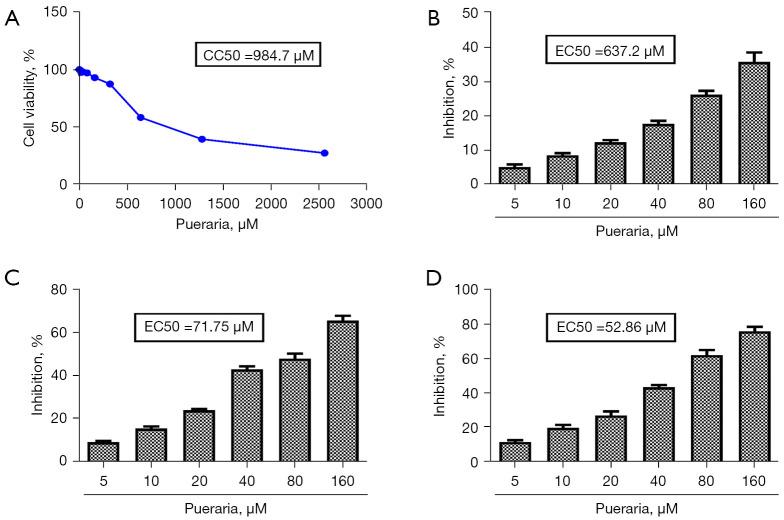
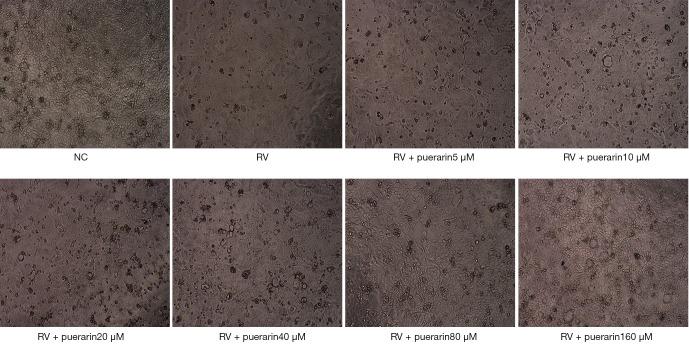
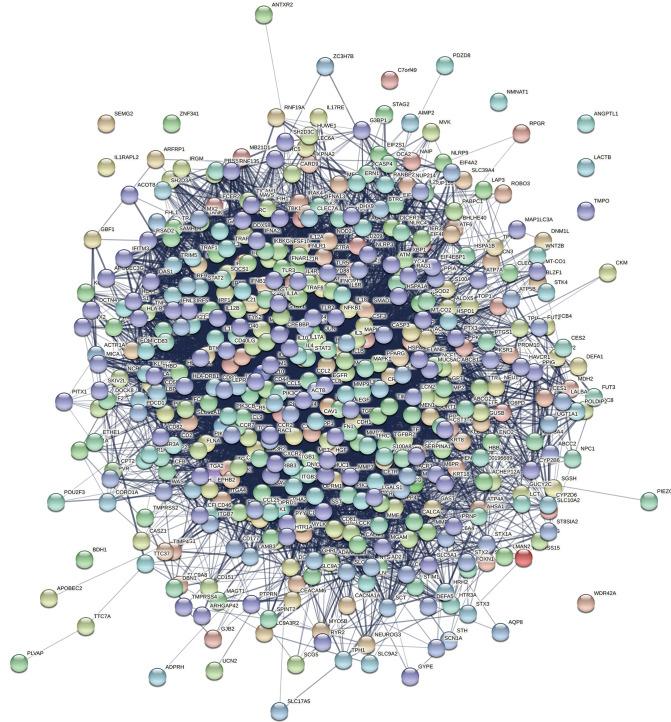
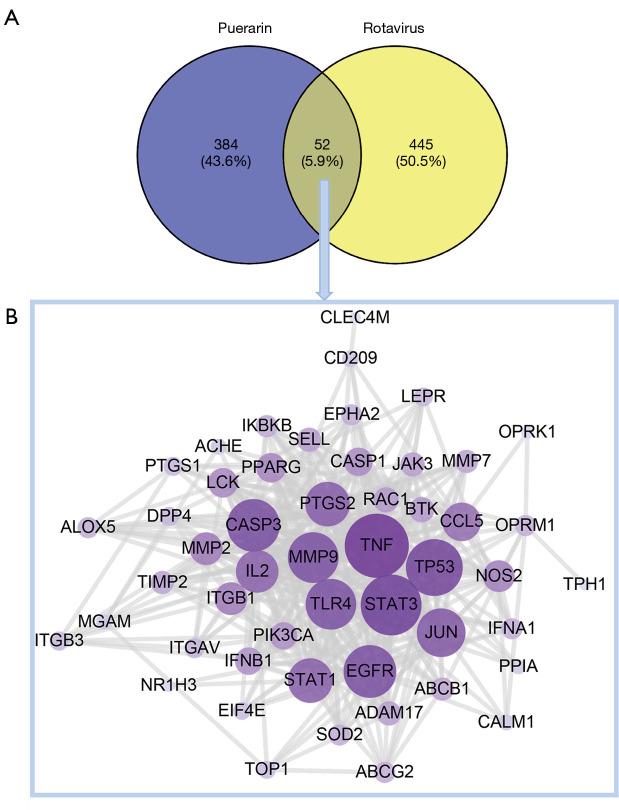
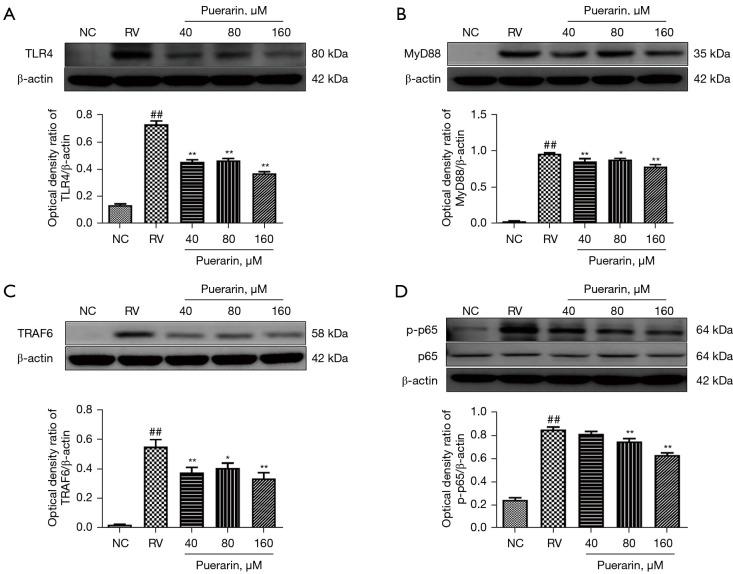
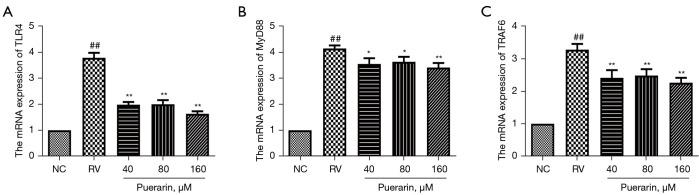
Our results suggest that puerarin had a certain inhibitory effect on viral replication and proliferation. The network pharmacology analysis showed that a total of 436 puerarin corresponding target and 497 RV-related targets were acquired from the online databases. The core targets of puerarin against RV, such as Toll-like receptor 4 (TLR4), tumor necrosis factor (TNF), and caspase 3 (CASP3), were identified from the protein-protein interaction (PPI) network. The KEGG analysis indicated that the TLR signaling pathway was one of the crucial mechanisms of puerarin against RV. In particular, puerarin could inhibit the expression of key factors of the TLR4/nuclear factor kappa-B (NF-κB) signaling pathway in HRV-infected Caco-2 cells and regulate the levels of cellular inflammatory factors.
CONCLUSIONS
Based on the network pharmacology analysis and experimental study, the study showed that puerarin not only had an anti-RV effect, but could also modulate the inflammatory response induced by RV infection via the TLR4/NF-κB signaling pathway. This study reveals the potential of puerarin in the treatment of RV infection, suggesting that it might be a promising therapeutic agent.
背景
本研究旨在基于网络药理学分析和实验研究,探索葛根素抗轮状病毒(RV)的潜在机制。
方法
采用不同浓度葛根素在不同感染时间的细胞病变效应抑制试验,评估葛根素对人RV G1P[8] Wa株(HRV Wa)的作用。随后,从在线数据库中获取葛根素的潜在靶点和RV相关基因。还对主要靶基因进行了京都基因与基因组百科全书(KEGG)通路富集分析。此外,通过蛋白质印迹法、定量实时逆转录PCR(RT-qPCR)和酶联免疫吸附测定(ELISA)试验,在分子水平验证了与RV感染相关的主要靶点和信号通路。
结果
我们的结果表明,葛根素对病毒复制和增殖有一定的抑制作用。网络药理学分析显示,从在线数据库中总共获得了436个葛根素相应靶点和497个RV相关靶点。从蛋白质-蛋白质相互作用(PPI)网络中鉴定出葛根素抗RV的核心靶点,如Toll样受体4(TLR4)、肿瘤坏死因子(TNF)和半胱天冬酶3(CASP3)。KEGG分析表明,TLR信号通路是葛根素抗RV的关键机制之一。特别是,葛根素可以抑制HRV感染的Caco-2细胞中TLR4/核因子κB(NF-κB)信号通路关键因子的表达,并调节细胞炎症因子水平。
结论
基于网络药理学分析和实验研究,本研究表明葛根素不仅具有抗RV作用,还可通过TLR4/NF-κB信号通路调节RV感染诱导的炎症反应。本研究揭示了葛根素在治疗RV感染方面的潜力,表明它可能是一种有前景的治疗药物。




 Zotero 插件