
在斑马鱼中基因敲除 Bsx 同源域转录因子:对成熟松果体形态和昼夜节律行为的影响。
Genetic ablation of the Bsx homeodomain transcription factor in zebrafish: Impact on mature pineal gland morphology and circadian behavior.
机构信息
Department of Neuroscience, Faculty of Health and Medical Sciences, University of Copenhagen, Copenhagen, Denmark.
School of Neurobiology, Biochemistry and Biophysics, Faculty of Life Sciences, Tel Aviv University, Tel Aviv, Israel.
出版信息
J Pineal Res. 2022 May;72(4):e12795. doi: 10.1111/jpi.12795. Epub 2022 Mar 31.
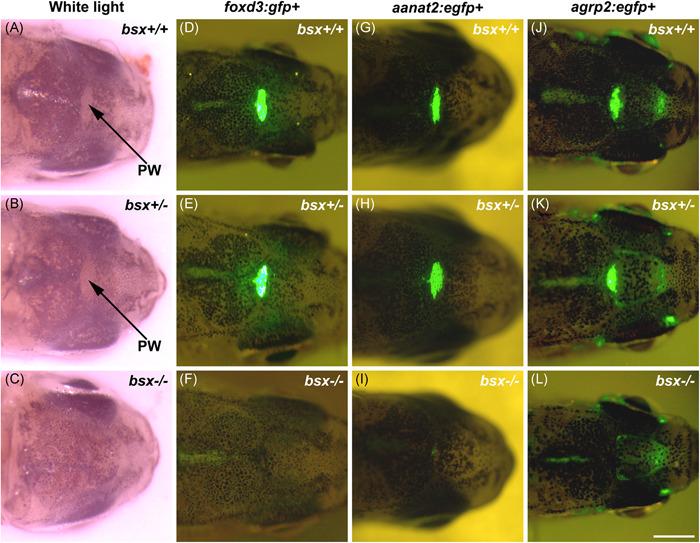
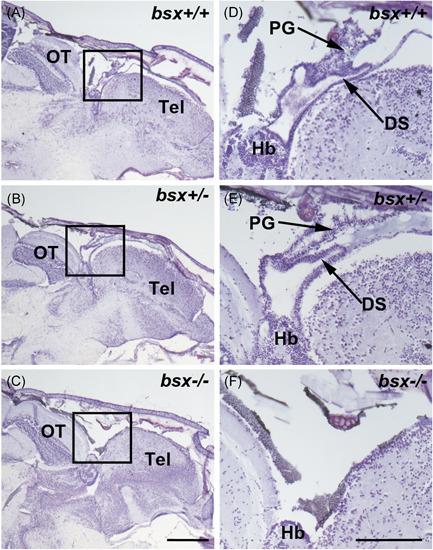
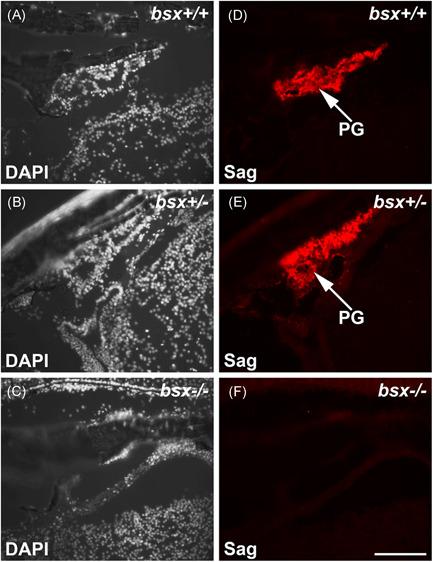
The pineal gland is a neuroendocrine structure in the brain, which produces and secretes the hormone melatonin at nighttime and is considered a key element in the circadian clock system. Early morphogenesis of the gland is controlled by a number of transcription factors, some of which remain active in adult life. One of these is the brain-specific homeobox (Bsx), a highly conserved homeodomain transcription factor with a developmental role in the pineal gland of several species, including zebrafish, and regulatory roles in mature pinealocytes of the rat. To determine the role of Bsx in circadian biology, we here examined the effects of a bsx loss-of-function mutation on the pineal gland in adult zebrafish and on behavioral circadian rhythms in larvae. In pineal cell type-specific Gfp/Egfp reporter zebrafish lines, we did not detect fluorescence signals in the pineal area of homozygous (bsx ) mutants. Interestingly, a nonpigmented area on the dorsal surface of the head above the gland, known as the pineal window, was pigmented in the homozygous mutants. Furthermore, a structure corresponding to the pineal gland was not detectable in the midline of the adult brain in histological sections analyzed by Nissl staining and S-antigen immunohistochemistry. Moreover, the levels of pineal transcripts were greatly reduced in bsx mutants, as revealed by quantitative real-time polymerase chain reaction analysis. Notably, analysis of locomotor activity at the larval stage revealed altered circadian rhythmicity in the bsx mutants with periods and phases similar to wildtype, but severely reduced amplitudes in locomotor activity patterns. Thus, Bsx is essential for full development of the pineal gland, with its absence resulting in a phenotype of morphological pineal gland ablation and disrupted circadian behavior.
松果体是大脑中的神经内分泌结构,它在夜间产生和分泌褪黑素,并被认为是昼夜节律钟系统的关键组成部分。腺体的早期形态发生受许多转录因子的控制,其中一些在成年期仍然活跃。其中之一是脑特异性同源盒(Bsx),它是一种高度保守的同源域转录因子,在包括斑马鱼在内的几种物种的松果体中具有发育作用,在大鼠成熟的松果体细胞中具有调节作用。为了确定 Bsx 在昼夜生物学中的作用,我们在此检查了 bsx 功能丧失突变对成年斑马鱼松果体的影响以及对幼虫行为昼夜节律的影响。在松果体细胞类型特异性 GFP/Egfp 报告斑马鱼系中,我们在纯合子(bsx )突变体的松果体区域未检测到荧光信号。有趣的是,在头部背面上方腺体上方的一个无色素区域,称为松果窗,在纯合子突变体中被色素化。此外,在通过尼氏染色和 S-抗原免疫组织化学分析的组织切片中,在成年大脑的中线中未检测到与松果体相对应的结构。此外,通过定量实时聚合酶链反应分析显示,bsx 突变体中的松果体转录本水平大大降低。值得注意的是,在幼虫阶段对运动活性的分析表明,bsx 突变体的昼夜节律性发生改变,其周期和相位与野生型相似,但运动活性模式的幅度严重降低。因此,Bsx 对于松果体的完全发育是必不可少的,其缺失导致形态学松果体消融和昼夜行为紊乱的表型。


 Zotero 插件