
使用滞后环虚拟患者模型重建机械通气中的失同步。
Reconstructing asynchrony for mechanical ventilation using a hysteresis loop virtual patient model.
机构信息
School of Civil Aviation & Yangtze River Delta Research Institute, Northwestern Polytechnical University, Xian, China.
Dept of Mechanical Engineering, Centre for Bio-Engineering, University of Canterbury, Christchurch, New Zealand.
出版信息
Biomed Eng Online. 2022 Mar 7;21(1):16. doi: 10.1186/s12938-022-00986-9.
BACKGROUND
Patient-specific lung mechanics during mechanical ventilation (MV) can be identified from measured waveforms of fully ventilated, sedated patients. However, asynchrony due to spontaneous breathing (SB) effort can be common, altering these waveforms and reducing the accuracy of identified, model-based, and patient-specific lung mechanics.
METHODS
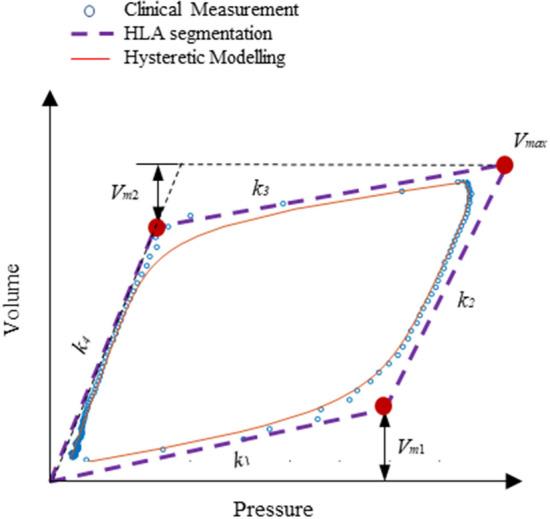
Changes in patient-specific lung elastance over a pressure-volume (PV) loop, identified using hysteresis loop analysis (HLA), are used to detect the occurrence of asynchrony and identify its type and pattern. The identified HLA parameters are then combined with a nonlinear mechanics hysteresis loop model (HLM) to extract and reconstruct ventilated waveforms unaffected by asynchronous breaths. Asynchrony magnitude can then be quantified using an energy-dissipation metric, E, comparing PV loop area between model-reconstructed and original, altered asynchronous breathing cycles. Performance is evaluated using both test-lung experimental data with a known ground truth and clinical data from four patients with varying levels of asynchrony.
RESULTS
Root mean square errors for reconstructed PV loops are within 5% for test-lung experimental data, and 10% for over 90% of clinical data. E clearly matches known asynchrony magnitude for experimental data with RMS errors < 4.1%. Clinical data performance shows 57% breaths having E > 50% for Patient 1 and 13% for Patient 2. Patient 3 only presents 20% breaths with E > 10%. Patient 4 has E = 0 for 96% breaths showing accuracy in a case without asynchrony.
CONCLUSIONS
Experimental test-lung validation demonstrates the method's reconstruction accuracy and generality in controlled scenarios. Clinical validation matches direct observations of asynchrony in incidence and quantifies magnitude, including cases without asynchrony, validating its robustness and potential efficacy as a clinical real-time asynchrony monitoring tool.
背景
通过对充分通气镇静患者的压力-容积(PV)波形进行测量,可以识别出患者特异性肺力学。然而,由于自主呼吸(SB)的努力,可能会出现不同步现象,从而改变这些波形,并降低基于模型和患者特异性肺力学的识别准确性。
方法
使用滞后环分析(HLA)来检测同步现象的发生,并识别其类型和模式,从而识别 PV 环上的患者特异性肺弹性变化。然后将识别出的 HLA 参数与非线性力学滞后环模型(HLM)相结合,以提取和重建不受异步呼吸影响的通气波形。然后使用能量耗散度量 E 来量化异步程度,E 通过比较模型重建和原始、改变的异步呼吸周期的 PV 环面积来计算。使用具有已知真实值的测试肺实验数据和具有不同异步程度的 4 名患者的临床数据来评估性能。
结果
测试肺实验数据的重建 PV 环的均方根误差在 5%以内,超过 90%的临床数据的均方根误差在 10%以内。对于实验数据,E 与已知的异步程度非常吻合,其 RMS 误差 < 4.1%。临床数据的性能显示,对于患者 1,有 57%的呼吸 E>50%,对于患者 2,有 13%的呼吸 E>10%。患者 3 仅有 20%的呼吸 E>10%。患者 4 96%的呼吸 E=0,这表明在没有不同步的情况下,该方法具有准确性。
结论
实验性测试肺验证证明了该方法在控制场景中的重建准确性和通用性。临床验证与异步发生率的直接观察相吻合,并量化了异步的幅度,包括没有不同步的情况,验证了其作为临床实时异步监测工具的稳健性和潜在疗效。




 Zotero 插件