
接受精细分割放疗与粗分割放疗的犬附肢骨肉瘤的骨折率及骨折时间:一项单机构研究
Fracture rate and time to fracture in dogs with appendicular osteosarcoma receiving finely fractionated compared to coarsely fractionated radiation therapy: A single institution study.
作者信息
Norquest Carissa J, Maitz Charles A, Keys Deborah A, Moore Melanie, Bryan Jeffrey N, Ehling Tara J, Lattimer Jimmy C, Flesner Brian K
机构信息
Veterinary Health Center, University of Missouri, Columbia, Missouri.
Kaleidoscope Statistics LLC, Athens, Georgia.
出版信息
Vet Med Sci. 2022 May;8(3):1013-1024. doi: 10.1002/vms3.782. Epub 2022 Mar 8.
BACKGROUND
Radiation therapy (RT) is used for local pain alleviation in dogs with appendicular osteosarcoma (OS), especially among dogs that are poor surgical candidates for amputation. However, many historical reports of fractionated protocols lack time to fracture and fracture rates.
OBJECTIVES
The primary objectives of this retrospective study were to determine fracture rate and time to fracture of dogs receiving RT (coarse or fine fractionated) for appendicular OS. Secondary objectives were to evaluate tolerability and disease outcome measures.
METHODS
Fifty-one dogs that received RT as part of treatment for appendicular OS were available for evaluation. Forty-five received coarse fractionation (C-RT, 8 or 6 Gy per fraction protocols [C-RT8 or C-RT6]) while the remaining six received fine fractionation (F-RT).
RESULTS
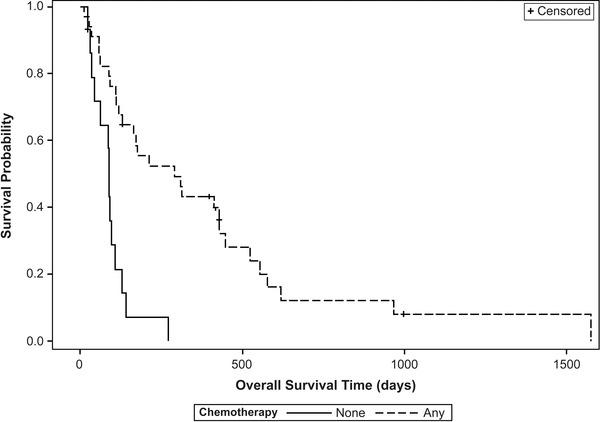
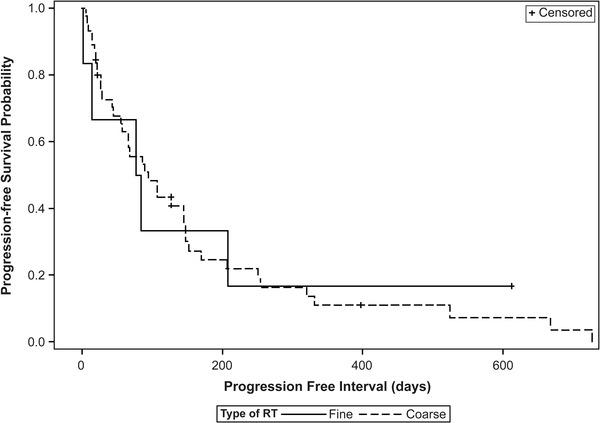
The overall pathologic fracture rate was 37%. Pathologic fracture rate was significantly higher for dogs that received F-RT (5/6, 83%) compared to dogs that received C-RT (12/40, 30%, p = 0.021). In the 17 dogs that fractured, the overall median time to fracture was 57 days. For all dogs, the median progression free interval (PFI) and median overall survival time (OST) were 90 and 140 days, respectively. In a very small cohort of dogs (n = 7) treated with zoledronate and RT, fracture rate was 0% and extended survival times were noted.
CONCLUSIONS
In conclusion, C-RT is recommended over F-RT due to lower risk of pathologic fracture and similar PFI. Prospective evaluation of combined C-RT and zoledronate, especially for dogs with poor surgical candidacy, is warranted for the treatment of canine appendicular osteosarcoma.
背景
放射治疗(RT)用于缓解患有附肢骨肉瘤(OS)犬的局部疼痛,特别是对于那些不适合截肢手术的犬。然而,许多关于分次放疗方案的历史报告缺乏骨折时间和骨折发生率的数据。
目的
这项回顾性研究的主要目的是确定接受RT(粗分割或细分割)治疗附肢OS的犬的骨折发生率和骨折时间。次要目的是评估耐受性和疾病转归指标。
方法
51只接受RT作为附肢OS治疗一部分的犬可供评估。45只接受粗分割放疗(C-RT,每次分割剂量为8或6 Gy的方案[C-RT8或C-RT6]),其余6只接受细分割放疗(F-RT)。
结果
总体病理性骨折发生率为37%。接受F-RT的犬(5/6,83%)的病理性骨折发生率显著高于接受C-RT的犬(12/40,30%,p = 0.021)。在发生骨折的17只犬中,总体骨折中位时间为57天。对于所有犬,无进展生存期(PFI)和总生存期(OST)的中位时间分别为90天和140天。在一小群接受唑来膦酸和RT治疗的犬(n = 7)中,骨折发生率为0%,且生存期延长。
结论
总之,由于病理性骨折风险较低且PFI相似,推荐C-RT而非F-RT。对于犬附肢骨肉瘤的治疗,有必要对C-RT联合唑来膦酸进行前瞻性评估,特别是对于手术候选性差的犬。

 Zotero 插件