
功能化金纳米颗粒在疾病应用中的药理作用。
Pharmacological Role of Functionalized Gold Nanoparticles in Disease Applications.
作者信息
Ko Wen-Chin, Wang Su-Jane, Hsiao Chien-Yu, Hung Chen-Ting, Hsu Yu-Jou, Chang Der-Chen, Hung Chi-Feng
机构信息
School of Medicine, Fu Jen Catholic University, New Taipei City 24205, Taiwan.
Division of Cardiac Electrophysiology, Department of Cardiovascular Center, Cathay General Hospital, Taipei 10630, Taiwan.
出版信息
Molecules. 2022 Feb 25;27(5):1551. doi: 10.3390/molecules27051551.
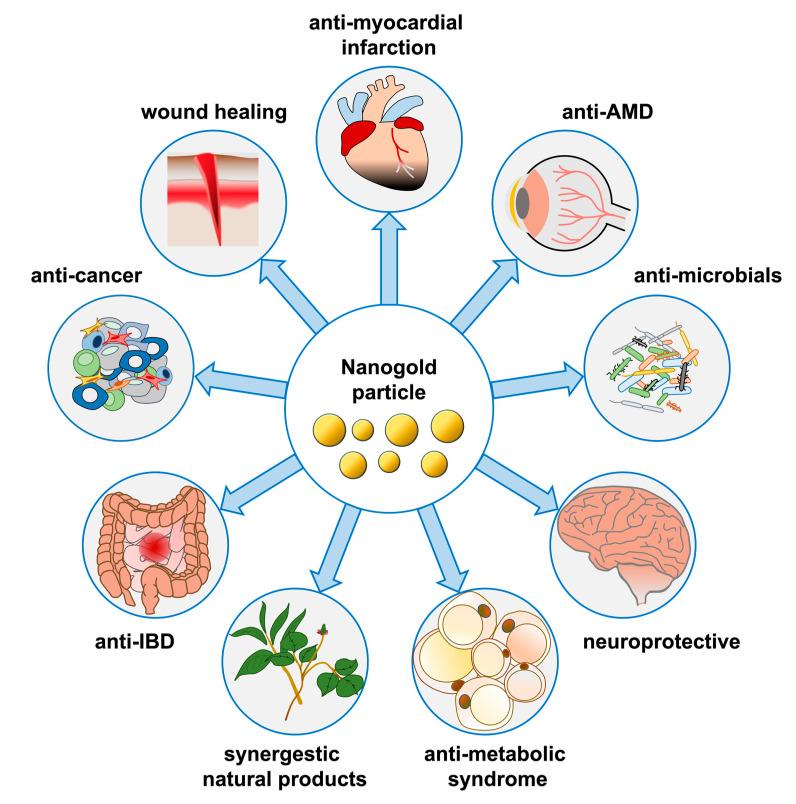
Gold has always been regarded as a symbol of nobility, and its shiny golden appearance has always attracted the attention of many people. Gold has good ductility, molecular recognition properties, and good biocompatibility. At present, gold is being used in many fields. When gold particles are as small as several nanometers, their physical and chemical properties vary with their size in nanometers. The surface area of a nano-sized gold surface has a special effect. Therefore, gold nanoparticles can, directly and indirectly, give rise to different biological activities. For example, if the surface of the gold is sulfided. Various substances have a strong chemical reactivity and are easy to combine with sulfhydryl groups; hence, nanogold is often used in biomedical testing, disease diagnosis, and gene detection. Nanogold is easy to bind to proteins, such as antibodies, enzymes, or cytokines. In fact, scientists use nanogold to bind special antibodies, as a tool for targeting cancer cells. Gold nanoparticles are also directly cytotoxic to cancer cells. For diseases caused by inflammation and oxidative damage, gold nanoparticles also have antioxidant and anti-inflammatory effects. Based on these unique properties, gold nanoparticles have become the most widely studied metal nanomaterials. Many recent studies have further demonstrated that gold nanoparticles are beneficial for humans, due to their functional pharmacological properties in a variety of diseases. The content of this review will be the application of gold nanoparticles in treating or diagnosing pressing diseases, such as cancers, retinopathy, neurological diseases, skin disorders, bowel diseases, bone cartilage disorders, cardiovascular diseases, infections, and metabolic syndrome. Gold nanoparticles have shown very obvious therapeutic and application potential.
黄金一直被视为高贵的象征,其闪亮的金色外观一直吸引着许多人的注意。黄金具有良好的延展性、分子识别特性和良好的生物相容性。目前,黄金正被应用于许多领域。当金颗粒小至几纳米时,其物理和化学性质会随纳米尺寸而变化。纳米尺寸的金表面面积具有特殊作用。因此,金纳米颗粒可直接或间接产生不同的生物活性。例如,如果金的表面被硫化。各种物质具有很强的化学反应性,容易与巯基结合;因此,纳米金常用于生物医学检测、疾病诊断和基因检测。纳米金很容易与蛋白质结合,如抗体、酶或细胞因子。事实上,科学家们利用纳米金结合特殊抗体,作为靶向癌细胞的工具。金纳米颗粒对癌细胞也具有直接的细胞毒性。对于由炎症和氧化损伤引起的疾病,金纳米颗粒也具有抗氧化和抗炎作用。基于这些独特的性质,金纳米颗粒已成为研究最广泛的金属纳米材料。最近的许多研究进一步证明,由于金纳米颗粒在多种疾病中具有功能性药理特性,它们对人类有益。本综述的内容将是金纳米颗粒在治疗或诊断诸如癌症、视网膜病变、神经疾病、皮肤疾病、肠道疾病、骨软骨疾病、心血管疾病、感染和代谢综合征等紧迫疾病中的应用。金纳米颗粒已显示出非常明显的治疗和应用潜力。
 Zotero 插件