
加拿大安大略省 COVID-19 大流行对提供阿片类激动剂治疗带药回家方案的影响:基于人群的时间序列分析。
Impact of the COVID-19 pandemic on the provision of take-home doses of opioid agonist therapy in Ontario, Canada: A population-based time-series analysis.
机构信息
ICES, 2075 Bayview Ave, Toronto, ON M4N 3M5, Canada.
Li Ka Shing Knowledge Institute of St. Michael's Hospital, 30 Bond St, Toronto, ON M5B 1W8, Canada.
出版信息
Int J Drug Policy. 2022 May;103:103644. doi: 10.1016/j.drugpo.2022.103644. Epub 2022 Mar 1.
BACKGROUND
In March 2020, the Ontario government declared a state of emergency due to the growing risk of COVID-19. In response, new guidance for the management of opioid agonist therapy (OAT) was released, which included the expansion of eligibility for take-home doses. We investigated the impact of these changes on trends in the distribution of take-home doses of OAT.
METHODS
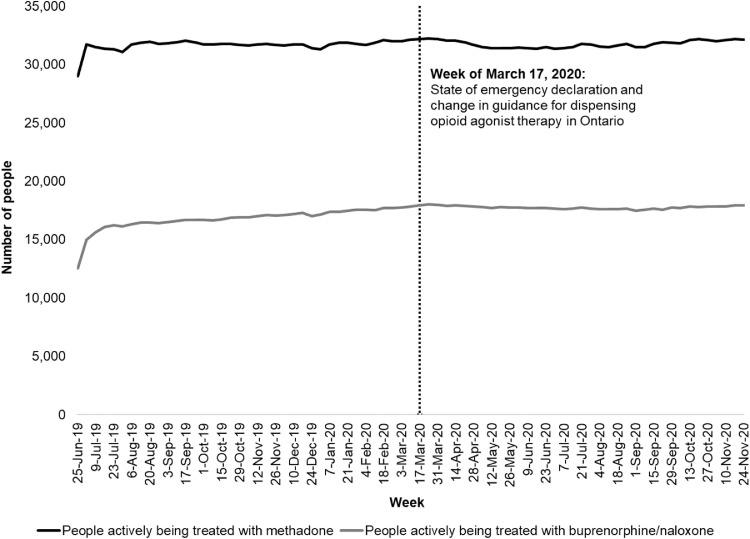
We conducted a population-based time series analysis among residents of Ontario, Canada who were dispensed OAT between June 25, 2019 and November 30, 2020. For each week of the study period, we calculated the percentage of people dispensed (a) methadone and (b) buprenorphine/naloxone by the number of take-home doses received. We used interventional autoregressive integrated moving average models to estimate changes in the percentage of people dispensed each category of take-home doses in the weeks following the declaration of the state of emergency and release of the OAT dispensing guidance.
RESULTS
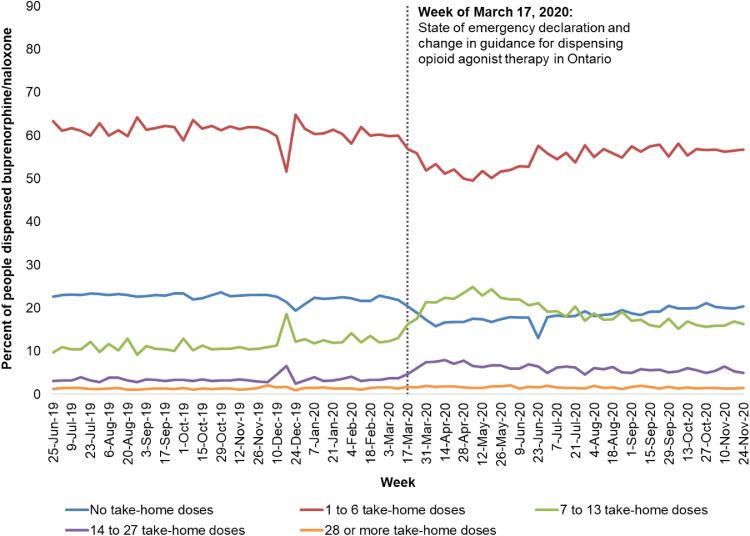
Following the state of emergency and release of the OAT dispensing guidance, there was a significant increase in the percentage of Ontarians dispensed 7 to 13 (3.6% increase; p = 0.033) and 14 or more (0.8% increase; p<0.001) take-home doses of methadone, and in the percentage of people dispensed 7 to 13 (4.3% increase; p = 0.001), 14 to 27 (2.8% increase; p<0.001), and 28 or more (0.3% increase; p = 0.008) take-home doses of buprenorphine/naloxone. There were significant decreases in the percentage of Ontarians receiving daily dispensed buprenorphine/naloxone (-3.1%; p = 0.001), as well as the percentage dispensed 1 to 6 take-home doses of methadone (-4.5%; p = 0.001) and buprenorphine/naloxone (-4.9%; p = 0.001).
CONCLUSION
The new guidance for dispensing OAT in Ontario resulted in increases in the duration of take-home doses of methadone and buprenorphine/naloxone supplied. However, given that changes were small, strategies to improve retention in OAT and ensure equitable access to take-home dosing should continue.
背景
2020 年 3 月,安大略省政府因 COVID-19 风险不断增加而宣布进入紧急状态。作为回应,发布了阿片类激动剂治疗(OAT)管理的新指南,其中包括扩大美沙酮带回家剂量的资格。我们调查了这些变化对 OAT 带回家剂量分布趋势的影响。
方法
我们对 2019 年 6 月 25 日至 2020 年 11 月 30 日期间在加拿大安大略省接受 OAT 治疗的居民进行了基于人群的时间序列分析。对于研究期间的每一周,我们根据收到的带回家剂量计算了(a)美沙酮和(b)丁丙诺啡/纳洛酮的给药人数百分比。我们使用干预自回归综合移动平均模型来估计在宣布紧急状态和发布 OAT 配药指南后的几周内,每种带回家剂量的给药人数百分比的变化。
结果
在紧急状态和发布 OAT 配药指南后,接受 7 至 13 剂(增加 3.6%;p=0.033)和 14 剂或更多剂(增加 0.8%;p<0.001)美沙酮带回家剂量的安大略省居民的百分比以及接受 7 至 13 剂(增加 4.3%;p=0.001)、14 至 27 剂(增加 2.8%;p<0.001)和 28 剂或更多剂(增加 0.3%;p=0.008)丁丙诺啡/纳洛酮带回家剂量的患者百分比显著增加。接受每日丁丙诺啡/纳洛酮剂量的安大略省居民的百分比(减少 3.1%;p=0.001)以及接受 1 至 6 剂美沙酮带回家剂量的患者百分比(减少 4.5%;p=0.001)和丁丙诺啡/纳洛酮带回家剂量(减少 4.9%;p=0.001)显著减少。
结论
安大略省 OAT 配药新指南导致美沙酮和丁丙诺啡/纳洛酮带回家剂量的持续时间增加。然而,鉴于变化很小,应继续采取策略来提高 OAT 的保留率并确保公平获得带回家剂量。


 Zotero 插件