
肯尼亚一家私立儿科医院的医院获得性感染:回顾性横断面研究。
Hospital acquired infections in a private paediatric hospital in Kenya: a retrospective cross-sectional study.
机构信息
Department of Paediatrics, Gertrude´s Children´s Hospital, Nairobi, Kenya.
Department of Clinical Pathology, Gertrude´s Children´s Hospital, Nairobi, Kenya.
出版信息
Pan Afr Med J. 2022 Jan 11;41:28. doi: 10.11604/pamj.2022.41.28.25820. eCollection 2022.
INTRODUCTION
Hospital acquired infections (HAI) or infections acquired in a hospital setting significantly increase morbidity and mortality, prolong hospital stay and increase healthcare costs. Factors like malnutrition and irrational use of antibiotics in a resource limited setting contribute to poor outcome in children. Thus a retrospective cross-sectional study was undertaken to study the different types of HAI in children, the different organisms causing them and their sensitivity to different antimicrobials so as to inform appropriate empirical antimicrobial therapy initiation and thus prevent antimicrobial resistance in the region.
METHODS
children aged one day to eighteen years, admitted to the hospital for at least 48 hours, during the period of January 2015 to December 2016, with positive laboratory findings on clinical specimens and clinical features in keeping with HAI were included.
RESULTS
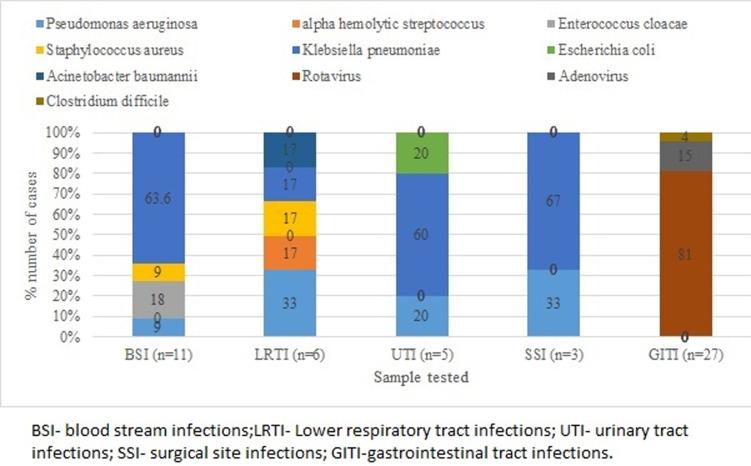
the total number of HAI were fifty-two infections in forty-one cases of which, twenty-five cases were culture proven bacterial HAI. Six cases had more than one HAI. The point prevalence of culture positive bacterial HAI in this study was 2.62% (95%CI: 3.8-6.7). The gastrointestinal infections (53%), blood stream infections (21%), lower respiratory tract infections (11%) were the commonest hospital acquired infections. Klebsiella Pneumoniae was the most common bacteria causing HAI with 61.53% of multidrug resistance strains.
CONCLUSION
gastrointestinal infections were the commonest HAI followed by blood stream infections. The commonest bacteria causing HAI was Klebsiella pneumoniae. The multidrug resistant organisms were Klebsiella Pneumoniae, Enterobacter Cloacae and Acinetobacter baumannii mainly resistant to third and fourth generation cephalosporins and carbapenems.
简介
医院获得性感染(HAI)或在医院环境中获得的感染会显著增加发病率和死亡率,延长住院时间并增加医疗保健成本。在资源有限的情况下,营养不良和不合理使用抗生素等因素会导致儿童预后不良。因此,进行了一项回顾性横断面研究,以研究儿童 HAI 的不同类型、导致它们的不同病原体以及它们对不同抗菌药物的敏感性,以便为适当的经验性抗菌治疗方案提供信息,并防止该地区出现抗菌药物耐药性。
方法
纳入 2015 年 1 月至 2016 年 12 月期间在医院住院至少 48 小时的 1 天至 18 岁的儿童,其临床标本实验室检查结果阳性且具有与 HAI 相符的临床特征。
结果
共发生 52 例 HAI,41 例患儿中发生 52 例 HAI,其中 25 例为培养证实的细菌性 HAI。6 例患儿发生多种 HAI。本研究中,培养阳性的细菌性 HAI 的时点患病率为 2.62%(95%CI:3.8-6.7)。胃肠道感染(53%)、血流感染(21%)、下呼吸道感染(11%)是最常见的医院获得性感染。引起 HAI 的最常见细菌是肺炎克雷伯菌,其耐药率高达 61.53%。
结论
胃肠道感染是最常见的 HAI,其次是血流感染。引起 HAI 的最常见细菌是肺炎克雷伯菌。耐多药菌主要是肺炎克雷伯菌、阴沟肠杆菌和鲍曼不动杆菌,主要对第三代和第四代头孢菌素和碳青霉烯类耐药。
 Zotero 插件