
β-淀粉样蛋白积累的时空模式:一种亚型和阶段推断模型分析
Spatial-Temporal Patterns of β-Amyloid Accumulation: A Subtype and Stage Inference Model Analysis.
作者信息
Collij Lyduine E, Salvadó Gemma, Wottschel Viktor, Mastenbroek Sophie E, Schoenmakers Pierre, Heeman Fiona, Aksman Leon, Wink Alle Meije, Berckel Bart N M, van de Flier Wiesje M, Scheltens Philip, Visser Pieter Jelle, Barkhof Frederik, Haller Sven, Gispert Juan Domingo, Lopes Alves Isadora
机构信息
From the Department of Radiology and Nuclear Medicine (L.E.C., V.W., S.E.M., P.S., F.H., A.M.W., B.N.M.B., F.B., I.L.A.), Alzheimer Center and Department of Neurology (W.M.v.d.F., P.S., P.J.V.), and Department of Epidemiology & Data Science (W.M.v.d.F.), Amsterdam UMC, Vrije Universiteit Amsterdam, the Netherlands; Barcelonaβeta Brain Research Center (BBRC) (G.S., J.D.G.), Pasqual Maragall Foundation; IMIM (Hospital del Mar Medical Research Institute) (G.S., J.D.G.), Barcelona, Spain; Stevens Neuroimaging and Informatics Institute (L.A.), Keck School of Medicine, University of Southern California, Los Angeles; Centre for Medical Image Computing and Queen Square Institute of Neurology (F.B.), UCL, UK; Faculty of Medicine of the University of Geneva (S.H.); CIMC-Centre d'Imagerie Médicale de Cornavin (S.H.), Genève, Switzerland; Department of Surgical Sciences, Radiology (S.H.), Uppsala University, Sweden; Department of Radiology (S.H.), Beijing Tiantan Hospital, Capital Medical University, Beijing, China; and Centro de Investigación Biomédica en Red de Bioingeniería, Biomateriales y Nanomedicina (CIBER-BBN) (J.D.G.), Madrid, Spain.
出版信息
Neurology. 2022 Apr 26;98(17):e1692-e1703. doi: 10.1212/WNL.0000000000200148. Epub 2022 Mar 15.
BACKGROUND AND OBJECTIVES
β-amyloid (Aβ) staging models assume a single spatial-temporal progression of amyloid accumulation. We assessed evidence for Aβ accumulation subtypes by applying the data-driven Subtype and Stage Inference (SuStaIn) model to amyloid-PET data.
METHODS
Amyloid-PET data of 3,010 participants were pooled from 6 cohorts (ALFA+, EMIF-AD, ABIDE, OASIS, and ADNI). Standardized uptake value ratios were calculated for 17 regions. We applied the SuStaIn algorithm to identify consistent subtypes in the pooled dataset based on the cross-validation information criterion and the most probable subtype/stage classification per scan. The effects of demographics and risk factors on subtype assignment were assessed using multinomial logistic regression.
RESULTS
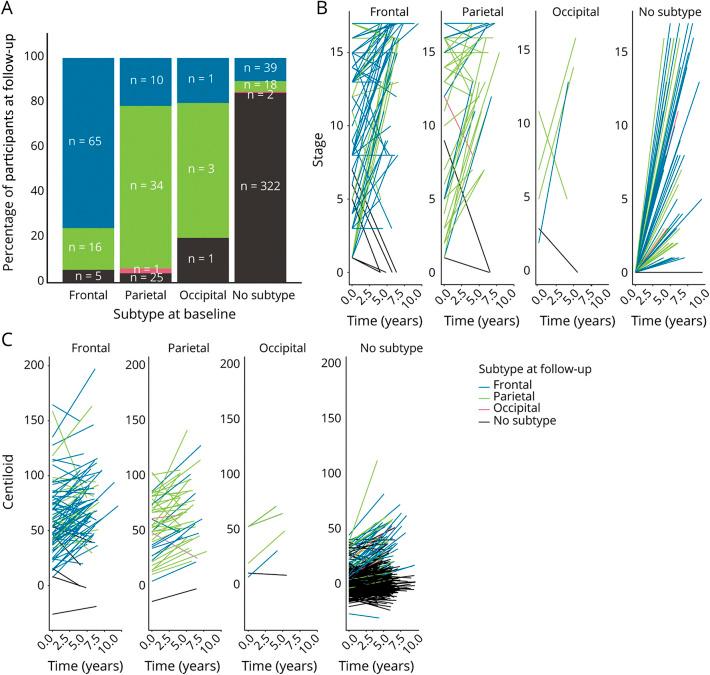
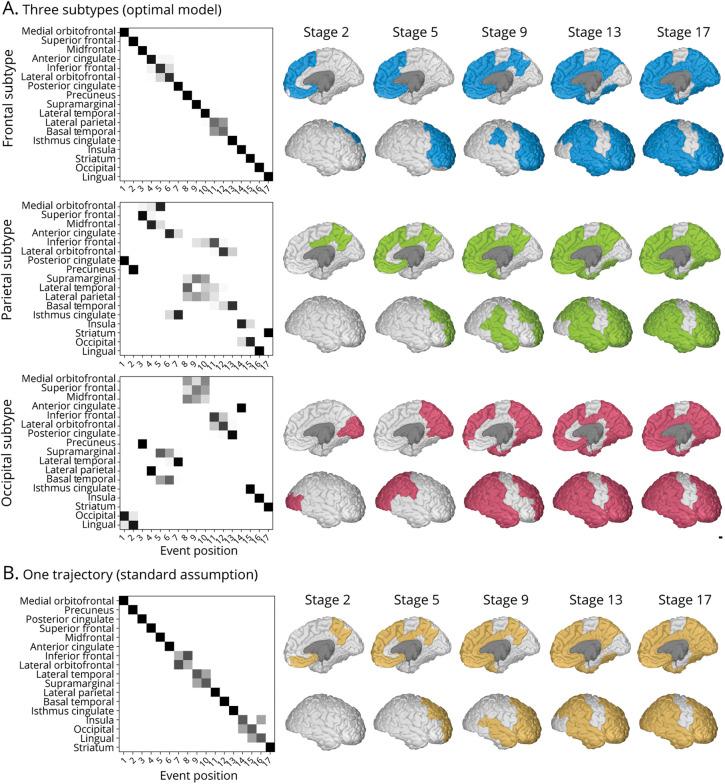
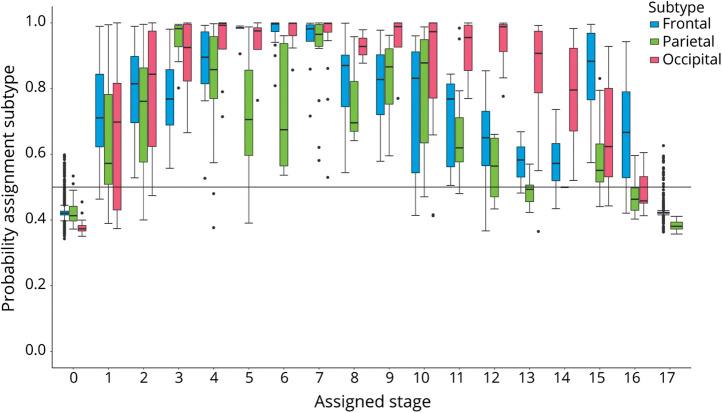
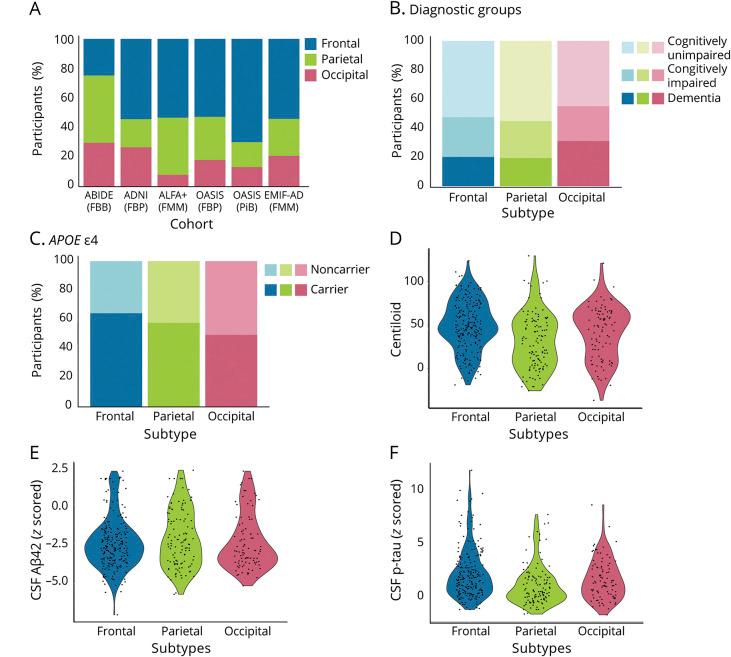
Participants were mostly cognitively unimpaired (n = 1890 [62.8%]), had a mean age of 68.72 (SD 9.1) years, 42.1% were ε4 carriers, and 51.8% were female. A 1-subtype model recovered the traditional amyloid accumulation trajectory, but SuStaIn identified 3 optimal subtypes, referred to as frontal, parietal, and occipital based on the first regions to show abnormality. Of the 788 (26.2%) with strong subtype assignment (>50% probability), the majority was assigned to frontal (n = 415 [52.5%]), followed by parietal (n = 199 [25.3%]) and occipital subtypes (n = 175 [22.2%]). Significant differences across subtypes included distinct proportions of ε4 carriers (frontal 61.8%, parietal 57.1%, occipital 49.4%), participants with dementia (frontal 19.7%, parietal 19.1%, occipital 31.0%), and lower age for the parietal subtype (frontal/occipital 72.1 years, parietal 69.3 years). Higher amyloid (Centiloid) and CSF p-tau burden was observed for the frontal subtype; parietal and occipital subtypes did not differ. At follow-up, most participants (81.1%) maintained baseline subtype assignment and 25.6% progressed to a later stage.
DISCUSSION
Whereas a 1-trajectory model recovers the established pattern of amyloid accumulation, SuStaIn determined that 3 subtypes were optimal, showing distinct associations with Alzheimer disease risk factors. Further analyses to determine clinical utility are warranted.
背景与目的
β-淀粉样蛋白(Aβ)分期模型假定淀粉样蛋白积累存在单一的时空进展。我们通过将数据驱动的亚型与阶段推断(SuStaIn)模型应用于淀粉样蛋白PET数据,评估Aβ积累亚型的证据。
方法
从6个队列(ALFA +、EMIF-AD、ABIDE、OASIS和ADNI)汇总了3010名参与者的淀粉样蛋白PET数据。计算了17个区域的标准化摄取值比率。我们应用SuStaIn算法,基于交叉验证信息准则和每次扫描最可能的亚型/阶段分类,在汇总数据集中识别一致的亚型。使用多项逻辑回归评估人口统计学和风险因素对亚型分配的影响。
结果
参与者大多认知未受损(n = 1890 [62.8%]),平均年龄为68.72(标准差9.1)岁,42.1%为ε4携带者,51.8%为女性。单亚型模型恢复了传统的淀粉样蛋白积累轨迹,但SuStaIn识别出3种最佳亚型,根据最先出现异常的区域分别称为额叶型、顶叶型和枕叶型。在788名(26.2%)具有强亚型分配(概率>50%)的参与者中,大多数被分配到额叶型(n = 415 [52.5%]),其次是顶叶型(n = 199 [25.3%])和枕叶型(n = 175 [22.2%])。各亚型之间的显著差异包括ε4携带者的不同比例(额叶型61.8%,顶叶型57.1%,枕叶型49.4%)、痴呆参与者的比例(额叶型19.7%,顶叶型19.1%,枕叶型31.0%)以及顶叶亚型的年龄较低(额叶/枕叶型72.1岁,顶叶型69.3岁)。额叶亚型的淀粉样蛋白(Centiloid)和脑脊液p-tau负担较高;顶叶和枕叶亚型无差异。在随访中,大多数参与者(81.1%)维持基线亚型分配,25.6%进展到更晚期。
讨论
虽然单轨迹模型恢复了已确立的淀粉样蛋白积累模式,但SuStaIn确定3种亚型是最佳的,它们与阿尔茨海默病风险因素存在不同关联。有必要进行进一步分析以确定临床效用。
 Zotero 插件