
基于力量-速度曲线特征的个体化训练对老年男性身体功能的效果。
Effectiveness of individualized training based on force-velocity profiling on physical function in older men.
机构信息
Department of Sport Science and Physical Education, University of Agder, Kristiansand, Norway.
Department of Physical Performance, Norwegian School of Sport Sciences, Oslo, Norway.
出版信息
Scand J Med Sci Sports. 2022 Jun;32(6):1013-1025. doi: 10.1111/sms.14157. Epub 2022 Mar 22.
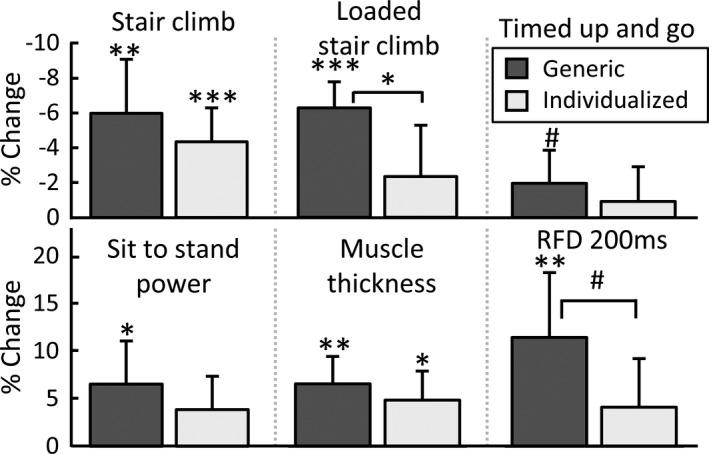
The study aimed to investigate the effectiveness of an individualized power training program based on force-velocity (FV) profiling on physical function, muscle morphology, and neuromuscular adaptations in older men. Forty-nine healthy men (68 ± 5 years) completed a 10-week training period to enhance muscular power. They were randomized to either a generic power training group (GPT) or an individualized power training group (IPT). Unlike generic training, individualized training was based on low- or high-resistance exercises, from an initial force-velocity profile. Lower-limb FV profile was measured in a pneumatic leg-press, and physical function was assessed as timed up-and-go time (TUG), sit-to-stand power, grip strength, and stair-climbing time (loaded [20kg] and unloaded). Vastus lateralis morphology was measured with ultrasonography. Rate of force development (RFD) and rate of myoelectric activity (RMA) were measured during an isometric knee extension. The GPT group improved loaded stair-climbing time (6.3 ± 3.8 vs. 2.3% ± 7.3%, p = 0.04) more than IPT. Both groups improved stair-climbing time, sit to stand, and leg press power, grip strength, muscle thickness, pennation angle, fascicle length, and RMA from baseline (p < 0.05). Only GPT increased loaded stair-climbing time and RFD (p < 0.05). An individualized power training program based on FV profiling did not improve physical function to a greater degree than generic power training. A generic power training approach combining both heavy and low loads might be advantageous through eliciting both force- and velocity-related neuromuscular adaptions with a concomitant increase in muscular power and physical function in older men.
本研究旨在探究基于力量-速度(FV) profiling 的个体化力量训练方案对老年男性身体机能、肌肉形态和神经肌肉适应性的有效性。49 名健康男性(68±5 岁)完成了 10 周的增强肌肉力量的训练周期。他们被随机分为通用力量训练组(GPT)或个体化力量训练组(IPT)。与通用训练不同,个体化训练基于初始 FV 轮廓的低阻力或高阻力练习。下肢 FV 轮廓在气动腿蹬机中进行测量,身体机能通过计时起立行走测试(TUG)、坐立起力量、握力和上下楼梯时间(负重[20kg]和无负重)进行评估。使用超声测量股外侧肌形态。在等长膝关节伸展过程中测量力量发展速率(RFD)和肌电活动速率(RMA)。GPT 组在负重上下楼梯时间上的改善程度(6.3±3.8%对 2.3%±7.3%,p=0.04)大于 IPT 组。两组均从基线改善了上下楼梯时间、坐立起、腿蹬力量、握力、肌肉厚度、肌纤维角度、肌纤维长度和 RMA(p<0.05)。仅 GPT 增加了负重上下楼梯时间和 RFD(p<0.05)。基于 FV 轮廓的个体化力量训练方案并未在改善身体机能方面优于通用力量训练。通用力量训练方法结合了重负荷和低负荷,可能会通过同时增加肌肉力量和老年男性的身体机能,从而引起与力量和速度相关的神经肌肉适应性的增加而具有优势。

 Zotero 插件