
应用全基因组测序技术揭示新德里金属β-内酰胺酶产生菌的医院同期暴发
Simultaneous Hospital Outbreaks of New Delhi Metallo-β-Lactamase-Producing Unraveled Using Whole-Genome Sequencing.
机构信息
Bacteriology Department, Bichat Claude Bernard University Hospital, AP-HP Nord-University of Paris, Paris, France.
INSERM, IAME UMR 1137, University of Paris, Paris, France.
出版信息
Microbiol Spectr. 2022 Apr 27;10(2):e0228721. doi: 10.1128/spectrum.02287-21. Epub 2022 Mar 21.
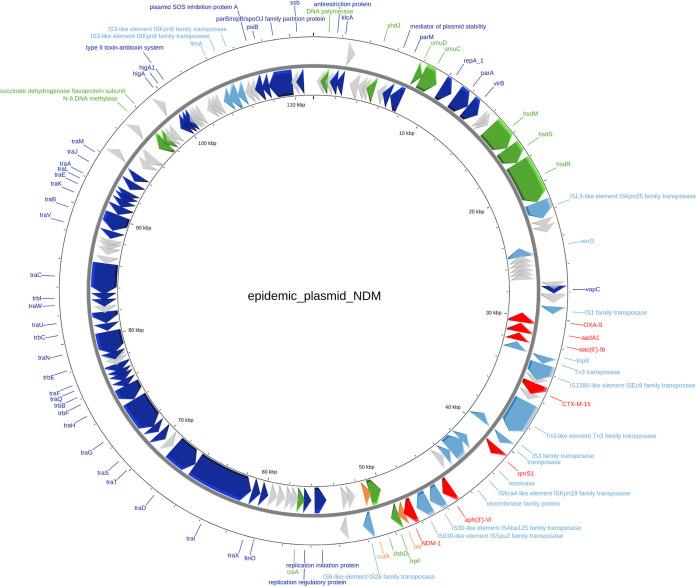
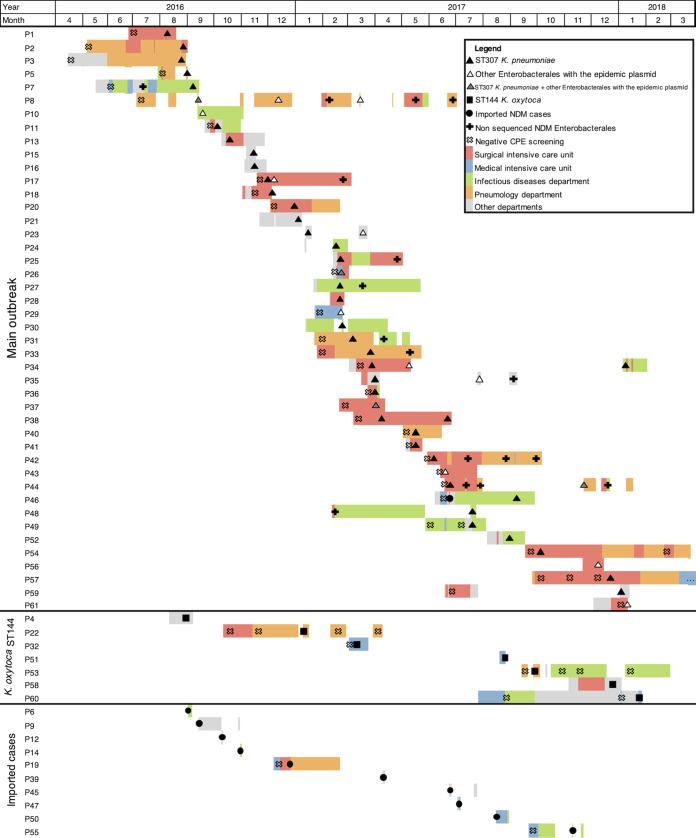
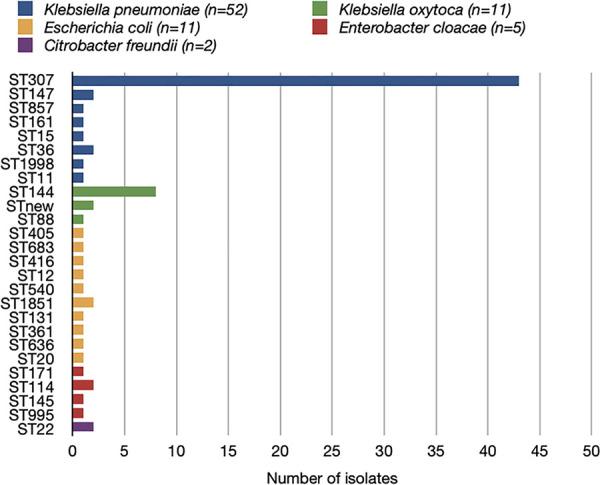
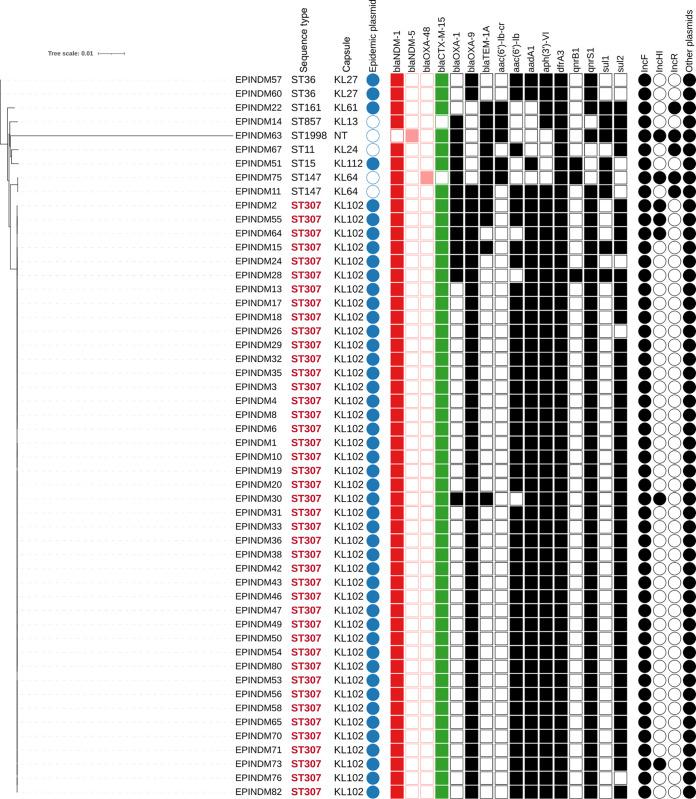
Multidrug-resistant , including carbapenemase producers, are currently spreading in health care facilities and the community. The Bichat Claude Bernard hospital in Paris faced a prolonged NDM-producing (NDM-CPE) outbreak. Whole-genome sequencing (WGS) was performed on all isolated NDM-CPE to evaluate its benefits for outbreak surveillance and comprehension. All NDM-CPE isolates collected during the outbreak period (August 2016 to January 2018) were sequenced using the Illumina NextSeq platform. Gene content and core genomes were compared. Genomics results underwent epidemiological analysis which classified NDM-CPE cases as imported (positive sample during the 48 h after admission), hospital acquired, or uncertain. Over the epidemic period, 61 patients were colonized or infected with 81 distinct NDM-CPE isolates. Klebsiella pneumoniae was the most common species ( = 52, 64%), followed by Escherichia coli (13.5%) and other species (22.5%). In all, 43/52 (83%) K. pneumoniae isolates were clonal (≤18 single nucleotide polymorphisms [SNPs] except for three isolates) and belonged to ST307. The IncFIIK [K2:A-/B-] plasmid carrying present in all ST307 K. pneumoniae isolates was also detected in 18 other NDM-CPE isolates. Additionally, eight clonal ST144 Klebsiella oxytoca (≤18 SNPs) isolates lacking the epidemic plasmid were observed. The WGS analyses confirmed the acquired and imported cases except for two patients and resolved uncertain cases, which all turned out to be hospital acquisitions. WGS coupled with epidemiological analysis unraveled three epidemic phenomena: mainly the spread of a clonal ST307 K. pneumoniae strain and its conjugative plasmid carrying but also the unexpected clonal spread of an ST144 K. oxytoca strain. Carbapenemase-producing (CPE) can spread and cause outbreaks in health care facilities, resulting in increased lengths of stay and morbidity. Control of outbreaks requires epidemiological surveillance, usually based on microbiological screening and patient follow-up. These data are sometimes insufficient to identify the routes of dissemination. There is therefore a need for more accurate tools such as whole-genome sequencing (WGS), which allows comparison of isolates but also plasmids carrying resistance with a high definition. In this work, we retrospectively sequenced the genomes of all NDM-producing isolated during a prolonged NDM outbreak in our hospital. We demonstrated the value of combining WGS with epidemiological data that unveiled the multiple mechanisms of dissemination involved in the outbreak and confirmed transmission cases. This work reinforces the potential of WGS in outbreak surveillance and suggests that it could improve outbreak control if used in real time by confirming transmission cases more rapidly.
耐多药,包括碳青霉烯酶产生菌,目前正在医疗机构和社区中传播。巴黎的比沙克·克劳德·伯纳德医院(Bichat Claude Bernard hospital)面临着一场持续的 NDM 产生菌(NDM-CPE)爆发。对所有分离的 NDM-CPE 进行全基因组测序(WGS),以评估其对爆发监测和理解的益处。在爆发期间(2016 年 8 月至 2018 年 1 月)收集的所有 NDM-CPE 分离株均使用 Illumina NextSeq 平台进行测序。比较基因内容和核心基因组。基因组学结果进行了流行病学分析,将 NDM-CPE 病例分类为输入(入院后 48 小时内的阳性样本)、医院获得或不确定。在流行期间,61 名患者被 81 种不同的 NDM-CPE 分离株定植或感染。肺炎克雷伯菌是最常见的物种( = 52,64%),其次是大肠杆菌(13.5%)和其他物种(22.5%)。总共,43/52(83%)肺炎克雷伯菌分离株是克隆的(≤18 个单核苷酸多态性 [SNP],除了三个分离株),属于 ST307。在所有 ST307 肺炎克雷伯菌分离株中检测到的 IncFIIK [K2:A-/B-]质粒也存在于 18 个其他 NDM-CPE 分离株中。此外,还观察到 8 个克隆的 ST144 产酸克雷伯菌(≤18 SNPs)分离株缺乏流行质粒。WGS 分析证实了获得性和输入性病例,但有两名患者除外,不确定病例也得到解决,所有这些病例均为医院获得性病例。WGS 结合流行病学分析揭示了三种流行现象:主要是克隆 ST307 肺炎克雷伯菌菌株及其携带 的可接合质粒的传播,但也出乎意料地传播了克隆 ST144 产酸克雷伯菌菌株。碳青霉烯酶产生菌(CPE)可在医疗机构中传播并引发爆发,导致住院时间和发病率增加。爆发的控制需要进行流行病学监测,通常基于微生物学筛查和患者随访。这些数据有时不足以确定传播途径。因此,需要更准确的工具,如全基因组测序(WGS),它可以高清晰度地比较携带耐药性的分离株和质粒。在这项工作中,我们对我院长期 NDM 爆发期间分离的所有产生 NDM 的 进行了基因组测序。我们证明了将 WGS 与流行病学数据相结合的价值,该方法揭示了爆发中涉及的多种传播机制,并证实了传播病例。这项工作增强了 WGS 在爆发监测中的潜力,并表明如果实时使用 WGS 快速确认传播病例,它可以改善爆发控制。

 Zotero 插件