
芭蕉科植物比较质体基因组分析及系统发育关系的新见解。
Comparative plastome analysis of Musaceae and new insights into phylogenetic relationships.
机构信息
Key Laboratory of Plant Resources Conservation and Sustainable Utilization, South China Botanical Garden, Chinese Academy of Sciences, Guangzhou, China.
University of Chinese Academy of Sciences, Beijing, China.
出版信息
BMC Genomics. 2022 Mar 21;23(1):223. doi: 10.1186/s12864-022-08454-3.
BACKGROUND
Musaceae is an economically important family consisting of 70-80 species. Elucidation of the interspecific relationships of this family is essential for a more efficient conservation and utilization of genetic resources for banana improvement. However, the scarcity of herbarium specimens and quality molecular markers have limited our understanding of the phylogenetic relationships in wild species of Musaceae. Aiming at improving the phylogenetic resolution of Musaceae, we analyzed a comprehensive set of 49 plastomes for 48 species/subspecies representing all three genera of this family.
RESULTS
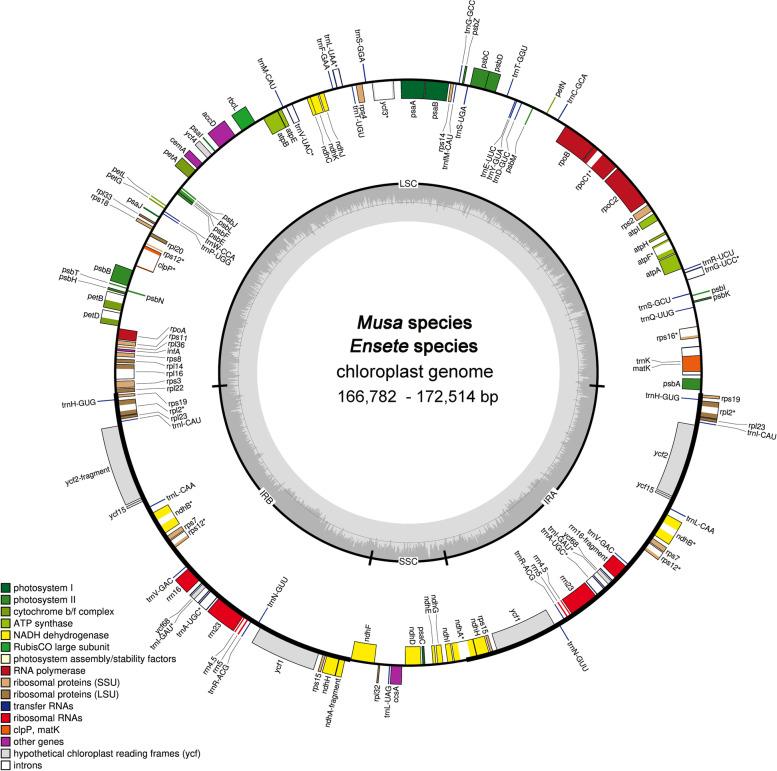
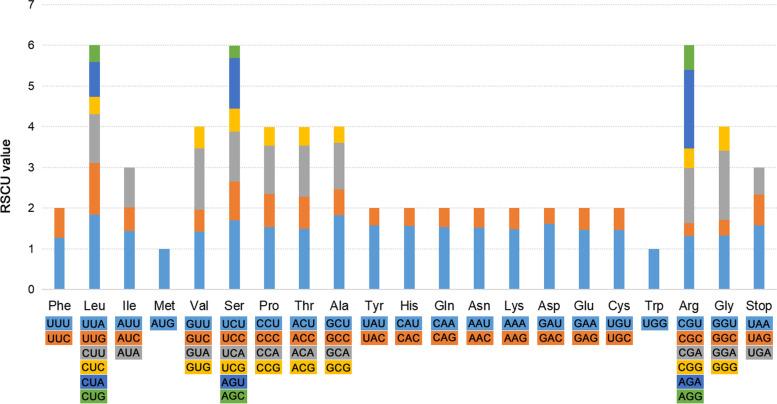
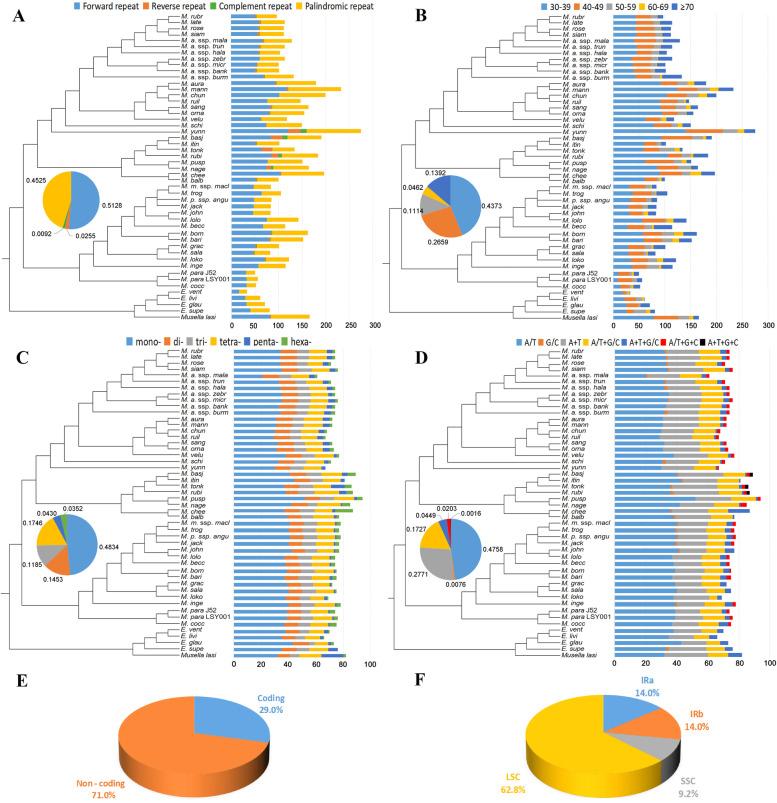
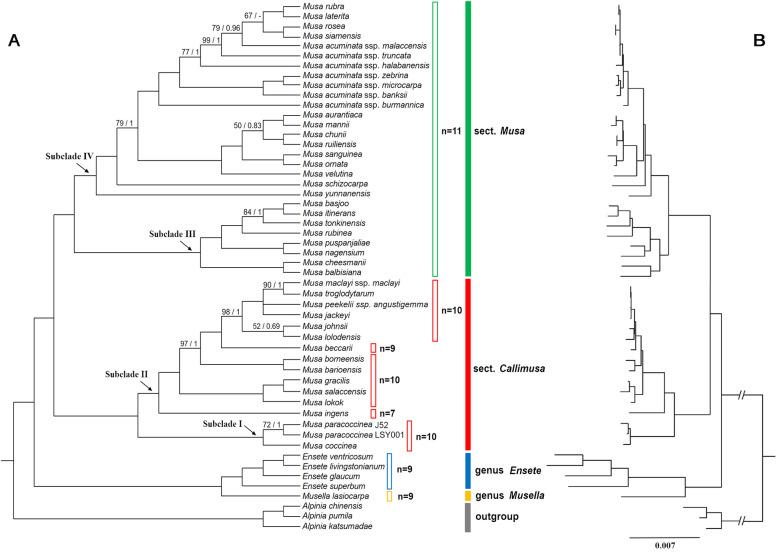
Musaceae plastomes have a relatively well-conserved genomic size and gene content, with a full length ranging from 166,782 bp to 172,514 bp. Variations in the IR borders were found to show phylogenetic signals to a certain extent in Musa. Codon usage bias analysis showed different preferences for the same codon between species and three genera and a common preference for A/T-ending codons. Among the two genes detected under positive selection (dN/dS > 1), ycf2 was indicated under an intensive positive selection. The divergent hotspot analysis allowed the identification of four regions (ndhF-trnL, ndhF, matK-rps16, and accD) as specific DNA barcodes for Musaceae species. Bayesian and maximum likelihood phylogenetic analyses using full plastome resulted in nearly identical tree topologies with highly supported relationships between species. The monospecies genus Musella is sister to Ensete, and the genus Musa was divided into two large clades, which corresponded well to the basic number of n = x = 11 and n = x =10/9/7, respectively. Four subclades were divided within the genus Musa. A dating analysis covering the whole Zingiberales indicated that the divergence of Musaceae family originated in the Palaeocene (59.19 Ma), and the genus Musa diverged into two clades in the Eocene (50.70 Ma) and then started to diversify from the late Oligocene (29.92 Ma) to the late Miocene. Two lineages (Rhodochlamys and Australimusa) radiated recently in the Pliocene /Pleistocene periods.
CONCLUSIONS
The plastome sequences performed well in resolving the phylogenetic relationships of Musaceae and generated new insights into its evolution. Plastome sequences provided valuable resources for population genetics and phylogenetics at lower taxon.
背景
芭蕉科是一个具有经济重要性的科,由 70-80 种组成。阐明该科的种间关系对于提高香蕉遗传资源的保护和利用效率至关重要。然而,标本的稀缺性和质量的分子标记限制了我们对野生芭蕉科物种系统发育关系的理解。为了提高芭蕉科的系统发育分辨率,我们分析了代表该科三个属的 48 个种/亚种的 49 个质体基因组。
结果
芭蕉科的质体基因组具有相对保守的基因组大小和基因组成,全长范围为 166782bp 至 172514bp。IR 边界的变异在 Musa 中显示出一定程度的系统发育信号。密码子使用偏性分析表明,不同物种和三个属之间对同一密码子有不同的偏好,并且都偏爱 A/T 结尾的密码子。在检测到的两个受正选择影响的基因(dN/dS > 1)中,ycf2 受到强烈的正选择。发散热点分析确定了四个区域(ndhF-trnL、ndhF、matK-rps16 和 accD)作为芭蕉科物种的特定 DNA 条形码。使用全质体进行的贝叶斯和最大似然系统发育分析产生了几乎相同的树拓扑结构,物种之间的关系得到了高度支持。单种属 Musella 与 Ensete 是姐妹关系,属 Musa 分为两个大的分支,分别与基本核型数 n = x = 11 和 n = x = 10/9/7 相对应。在 Musa 中又分为四个亚分支。对整个姜目进行的定年分析表明,芭蕉科的起源于古近纪(59.19Ma),属 Musa 在始新世(50.70Ma)分为两个分支,然后从渐新世晚期(29.92Ma)开始多样化到晚中新世。两个谱系(Rhodochlamys 和 Australimusa)在更新世/全新世时期辐射进化。
结论
质体序列在解决芭蕉科的系统发育关系方面表现良好,并为其进化提供了新的见解。质体序列为较低分类单元的种群遗传学和系统发育学提供了有价值的资源。


 Zotero 插件