
RibU 是一种致病的必要决定因素,它在细胞内生长过程中介导 FMN 和 FAD 的获取。
RibU is an essential determinant of pathogenesis that mediates acquisition of FMN and FAD during intracellular growth.
机构信息
Department of Molecular and Cell Biology, University of California, Berkeley, CA 94720.
Department of Plant and Microbial Biology, University of California, Berkeley, CA 94720.
出版信息
Proc Natl Acad Sci U S A. 2022 Mar 29;119(13):e2122173119. doi: 10.1073/pnas.2122173119. Epub 2022 Mar 22.
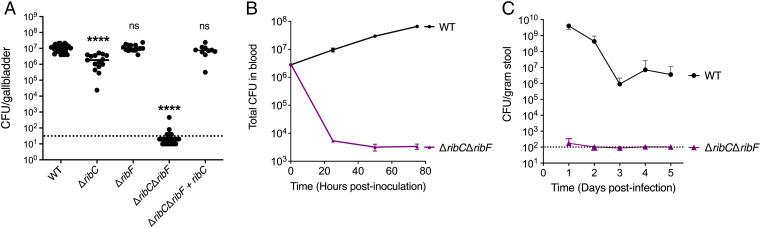
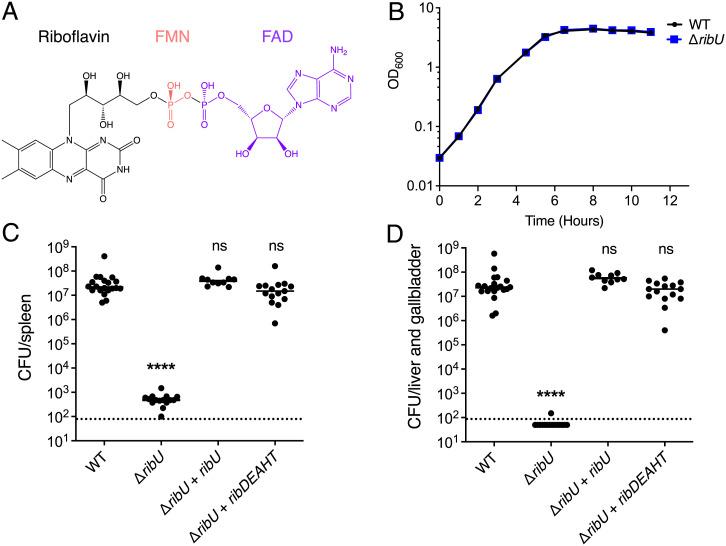
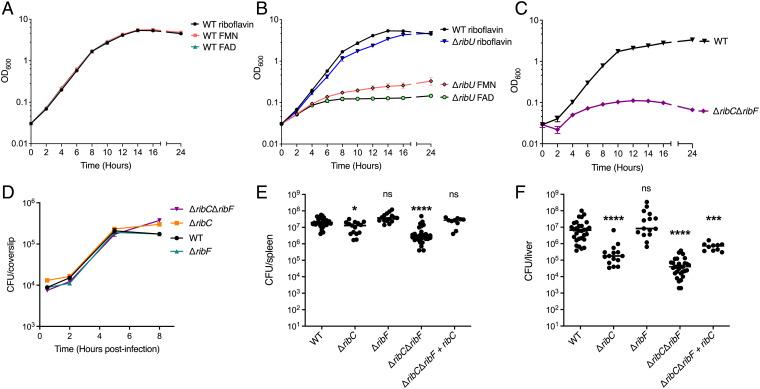
Flavin mononucleotide (FMN) and flavin adenine dinucleotide (FAD) are essential riboflavin-derived cofactors involved in a myriad of redox reactions across all forms of life. Nevertheless, the basis of flavin acquisition strategies by riboflavin auxotrophic pathogens remains poorly defined. In this study, we examined how the facultative intracellular pathogen Listeria monocytogenes, a riboflavin auxotroph, acquires flavins during infection. A L. monocytogenes mutant lacking the putative riboflavin transporter (RibU) was completely avirulent in mice but had no detectable growth defect in nutrient-rich media. However, unlike wild type, the RibU mutant was unable to grow in defined media supplemented with FMN or FAD or to replicate in macrophages starved for riboflavin. Consistent with RibU functioning to scavenge FMN and FAD inside host cells, a mutant unable to convert riboflavin to FMN or FAD retained virulence and grew in cultured macrophages and in spleens and livers of infected mice. However, this FMN- and FAD-requiring strain was unable to grow in the gallbladder or intestines, where L. monocytogenes normally grows extracellularly, suggesting that these sites do not contain sufficient flavin cofactors to promote replication. Thus, by deleting genes required to synthesize FMN and FAD, we converted L. monocytogenes from a facultative to an obligate intracellular pathogen. Collectively, these data indicate that L. monocytogenes requires riboflavin to grow extracellularly in vivo but scavenges FMN and FAD to grow in host cells.
黄素单核苷酸(FMN)和黄素腺嘌呤二核苷酸(FAD)是必不可少的核黄素衍生辅因子,参与所有生命形式的无数氧化还原反应。然而,依赖核黄素的病原体获取黄素的策略基础仍未得到明确界定。在这项研究中,我们研究了兼性细胞内病原体李斯特菌(Listeria monocytogenes)如何在感染期间获取黄素,李斯特菌是核黄素营养缺陷型细菌。缺乏假定的核黄素转运蛋白(RibU)的李斯特菌突变体在小鼠中完全丧失毒力,但在营养丰富的培养基中没有检测到明显的生长缺陷。然而,与野生型不同的是,RibU 突变体无法在补充 FMN 或 FAD 的限定培养基中生长,也无法在缺乏核黄素的巨噬细胞中复制。与 RibU 在内细胞中摄取 FMN 和 FAD 的功能一致,无法将核黄素转化为 FMN 或 FAD 的突变体保留了毒力,并在培养的巨噬细胞以及感染小鼠的脾脏和肝脏中生长。然而,这种需要 FMN 和 FAD 的菌株无法在胆囊或肠道中生长,而李斯特菌通常在这些部位以外生性方式生长,这表明这些部位没有足够的黄素辅因子来促进复制。因此,通过删除合成 FMN 和 FAD 所需的基因,我们将李斯特菌从兼性细胞内病原体转变为必需的细胞内病原体。总的来说,这些数据表明李斯特菌需要核黄素在体内外生性地生长,但通过摄取 FMN 和 FAD 来在宿主细胞中生长。

 Zotero 插件