
临床前毒液抑制试验确定金属蛋白酶抑制药物为未来治疗蛇咬伤中毒的潜在疗法。
and preclinical venom inhibition assays identify metalloproteinase inhibiting drugs as potential future treatments for snakebite envenoming by .
作者信息
Menzies Stefanie K, Clare Rachel H, Xie Chunfang, Westhorpe Adam, Hall Steven R, Edge Rebecca J, Alsolaiss Jaffer, Crittenden Edouard, Marriott Amy E, Harrison Robert A, Kool Jeroen, Casewell Nicholas R
机构信息
Centre for Snakebite Research and Interventions, Department of Tropical Disease Biology, Liverpool School of Tropical Medicine, Pembroke Place, Liverpool, L3 5QA, England, UK.
Centre for Drugs and Diagnostics, Department of Tropical Disease Biology, Liverpool School of Tropical Medicine, Pembroke Place, Liverpool, L3 5QA, England, UK.
出版信息
Toxicon X. 2022 Mar 18;14:100118. doi: 10.1016/j.toxcx.2022.100118. eCollection 2022 Jun.
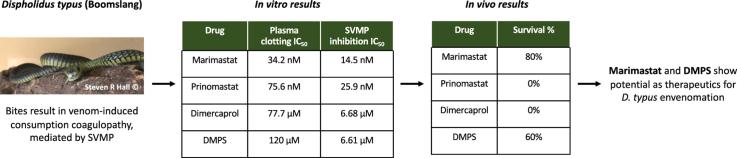
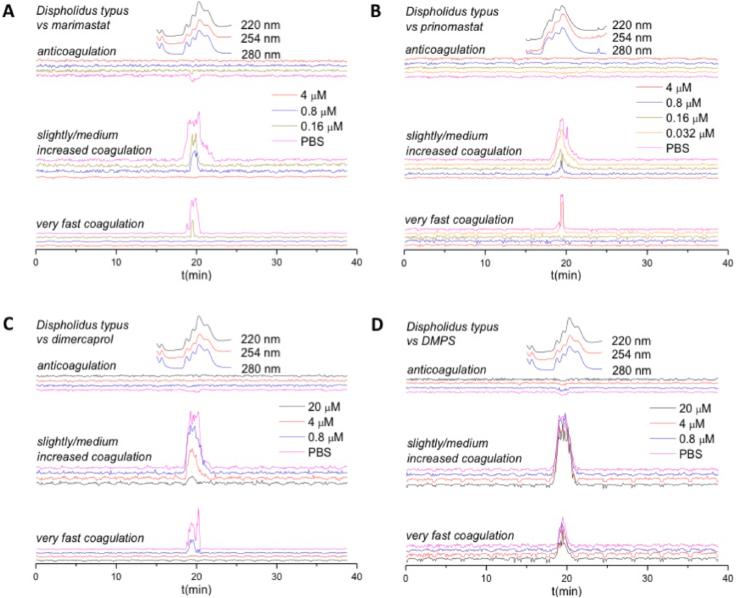
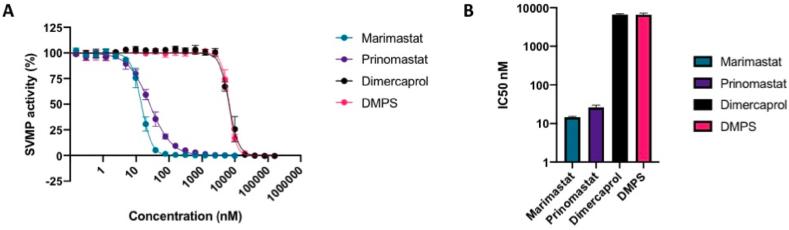
Snakebite envenoming affects more than 250,000 people annually in sub-Saharan Africa. Envenoming by (boomslang) results in venom-induced consumption coagulopathy (VICC), whereby highly abundant prothrombin-activating snake venom metalloproteinases (SVMPs) consume clotting factors and deplete fibrinogen. The only available treatment for envenoming is the monovalent SAIMR Boomslang antivenom. Treatment options are urgently required because this antivenom is often difficult to source and, at US$6000/vial, typically unaffordable for most snakebite patients. We therefore investigated the and preclinical efficacy of four SVMP inhibitors to neutralise the effects of venom; the matrix metalloproteinase inhibitors marimastat and prinomastat, and the metal chelators dimercaprol and DMPS The venom of exhibited an SVMP-driven procoagulant phenotype . Marimastat and prinomastat demonstrated equipotent inhibition of the SVMP-mediated procoagulant activity of the venom , whereas dimercaprol and DMPS showed considerably lower potency. However, when tested in preclinical murine models of envenoming using mixed sex CD1 mice, DMPS and marimastat demonstrated partial protection against venom lethality, demonstrated by prolonged survival times of experimental animals, whereas dimercaprol and prinomastat failed to confer any protection at the doses tested. The preclinical results presented here demonstrate that DMPS and marimastat show potential as novel small molecule-based therapeutics for snakebite envenoming. These two drugs have been previously shown to be effective against VICC in preclinical models, and thus we conclude that marimastat and DMPS should be further explored as potentially valuable early intervention therapeutics to broadly treat VICC following snakebite envenoming in sub-Saharan Africa.
在撒哈拉以南非洲地区,每年有超过25万人遭受蛇咬伤中毒。鼓腹咝蝰咬伤会导致蛇毒诱导的消耗性凝血病(VICC),即高丰度的凝血酶原激活蛇毒金属蛋白酶(SVMPs)消耗凝血因子并耗尽纤维蛋白原。治疗鼓腹咝蝰咬伤的唯一可用药物是单价的南非医学研究所鼓腹咝蝰抗蛇毒血清。迫切需要其他治疗选择,因为这种抗蛇毒血清通常很难获得,而且每瓶售价6000美元,大多数蛇咬伤患者通常无力承担。因此,我们研究了四种SVMP抑制剂中和鼓腹咝蝰毒液作用的体外和临床前疗效;基质金属蛋白酶抑制剂马立马司他和普林司他,以及金属螯合剂二巯丙醇和二巯基丙磺酸钠。鼓腹咝蝰的毒液表现出由SVMP驱动的促凝表型。马立马司他和普林司他对毒液的SVMP介导的促凝活性表现出同等效力的抑制作用,而二巯丙醇和二巯基丙磺酸钠的效力则低得多。然而,在使用混合性别的CD1小鼠进行的临床前中毒小鼠模型试验中,二巯基丙磺酸钠和马立马司他对毒液致死性表现出部分保护作用,实验动物的存活时间延长证明了这一点,而在测试剂量下,二巯丙醇和普林司他未能提供任何保护。此处呈现的临床前结果表明,二巯基丙磺酸钠和马立马司他作为基于小分子的新型鼓腹咝蝰蛇咬伤中毒治疗药物具有潜力。这两种药物此前已在临床前模型中显示对鼓腹咝蝰VICC有效,因此我们得出结论,马立马司他和二巯基丙磺酸钠应作为潜在有价值的早期干预治疗药物进一步探索,以广泛治疗撒哈拉以南非洲地区蛇咬伤中毒后的VICC。


 Zotero 插件