
来自L.f.的抗氧化植物化学物质及抗炎作用分析
Analysis of Antioxidant Phytochemicals and Anti-Inflammatory Effect from L.f.
作者信息
Le DucDat, Han Sanghee, Ahn Jeongjun, Yu Jayeon, Kim Chang-Kwon, Lee Mina
机构信息
College of Pharmacy and Research Institute of Life and Pharmaceutical Sciences, Sunchon National University, 255 Jungangno, Suncheon 57922, Jeonnam, Korea.
出版信息
Antioxidants (Basel). 2022 Feb 24;11(3):454. doi: 10.3390/antiox11030454.
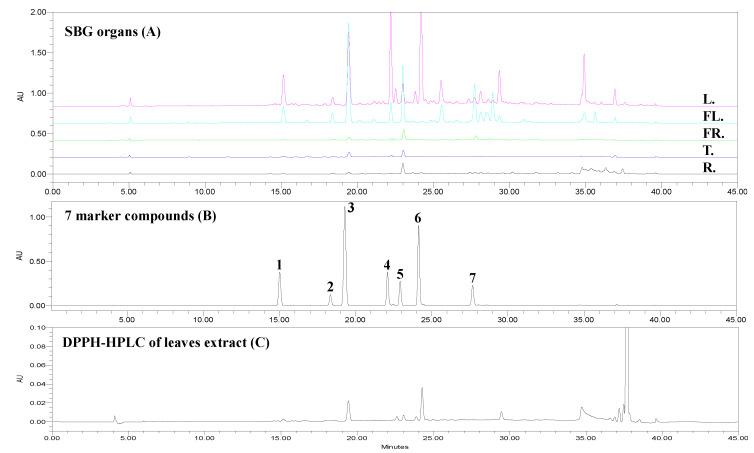
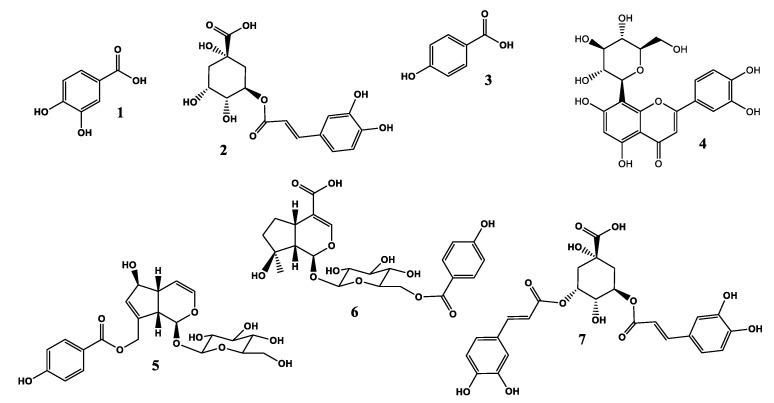
An extraction method using 80% EtOH was selected and applied to obtain the total extracts from leaves, flowers, fruits, twigs, and roots of L.f. based on the antioxidant activity-guided experiments. Subsequently, total extract from each part of . was successfully partitioned into fractions, which were evaluated for their antioxidant and anti-inflammatory properties via DPPH, ABTS, and NO assays, respectively. Among them, EtOAc (E) and -butanol (B) fractions showed the potent antioxidant activity and the methylene chloride (MC) fractions of roots, leaves, and fruits that exhibited strong scavenging activity on DPPH and ABTS radicals. In the anti-inflammatory assay, -hexane (H) and MC fractions of leaves potently inhibited NO production in LPS-stimulated RAW264.7 cells, followed by E fractions derived from fruits, flowers, twigs, and roots, along with B fractions from flowers and twigs. Additionally, a comprehensive HPLC-decoupled MS profiling was established and validated using seven isolated marker compounds (-), which were identified by analysis of their UV, NMR, and MS data. The established method was also applied for quantification of these marker compounds in each organ collected from different locations, and to assess their antioxidant capacity by a screening DPPH-HPLC method. Principal component analysis suggested the botanical organs from this plant correlated with the marker compound contents in association with bioactivity. The study results are a prelude to further studies involving the active fractions and provide a comprehensive insight into the functional products of this plant against oxidative diseases.
基于抗氧化活性导向实验,选择并应用了一种使用80%乙醇的提取方法,从光叶海桐的叶、花、果实、嫩枝和根中获得总提取物。随后,成功地将光叶海桐各部位的总提取物分离成不同的馏分,分别通过DPPH、ABTS和NO测定法对其抗氧化和抗炎特性进行评估。其中,乙酸乙酯(E)和正丁醇(B)馏分表现出较强的抗氧化活性,根、叶和果实的二氯甲烷(MC)馏分对DPPH和ABTS自由基具有较强的清除活性。在抗炎试验中,叶的正己烷(H)和MC馏分能有效抑制脂多糖刺激的RAW264.7细胞中NO的产生,其次是果实、花、嫩枝和根的E馏分,以及花和嫩枝的B馏分。此外,建立并验证了一种综合的HPLC-去耦质谱分析方法,该方法使用了七种分离得到的标记化合物(-),通过对其紫外、核磁共振和质谱数据的分析对其进行了鉴定。所建立的方法还用于定量分析从不同地点采集的各器官中的这些标记化合物,并通过DPPH-HPLC筛选方法评估其抗氧化能力。主成分分析表明,该植物的植物器官与标记化合物含量以及生物活性相关。该研究结果为进一步研究活性馏分奠定了基础,并为该植物对抗氧化疾病的功能产物提供了全面的见解。

 Zotero 插件