
MDM4 多态性(rs4245739、rs1563828、rs11801299、rs10900598 和 rs1380576)与癌症易感性的相关性:一项荟萃分析。
The Correlation of Mouse Double Minute 4 (MDM4) Polymorphisms (rs4245739, rs1563828, rs11801299, rs10900598, and rs1380576) with Cancer Susceptibility: A Meta-Analysis.
机构信息
Department of General Surgery, First Affiliated Hospital of Nanchang University, Nanchang, Jiangxi, China (mainland).
Department of Surgery,, Wannian Maternal and Child Health Hospital, Shangrao, Jiangxi, China (mainland).
出版信息
Med Sci Monit. 2022 Mar 29;28:e935671. doi: 10.12659/MSM.935671.
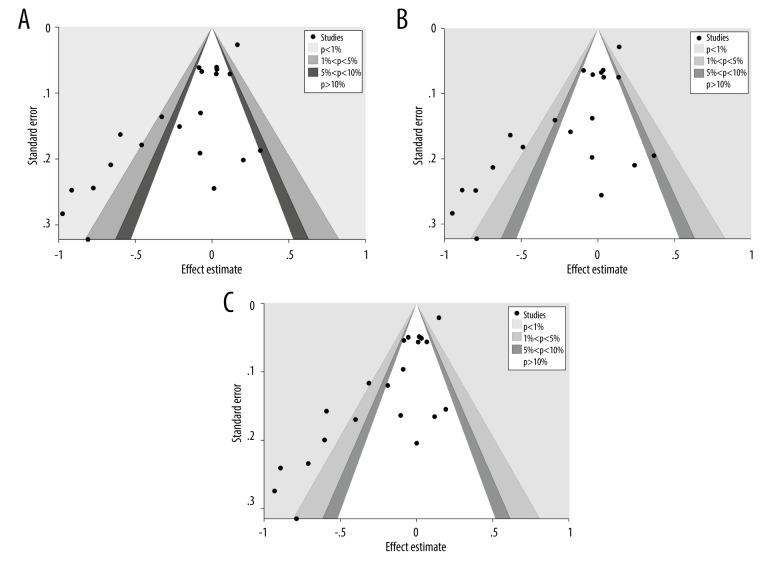
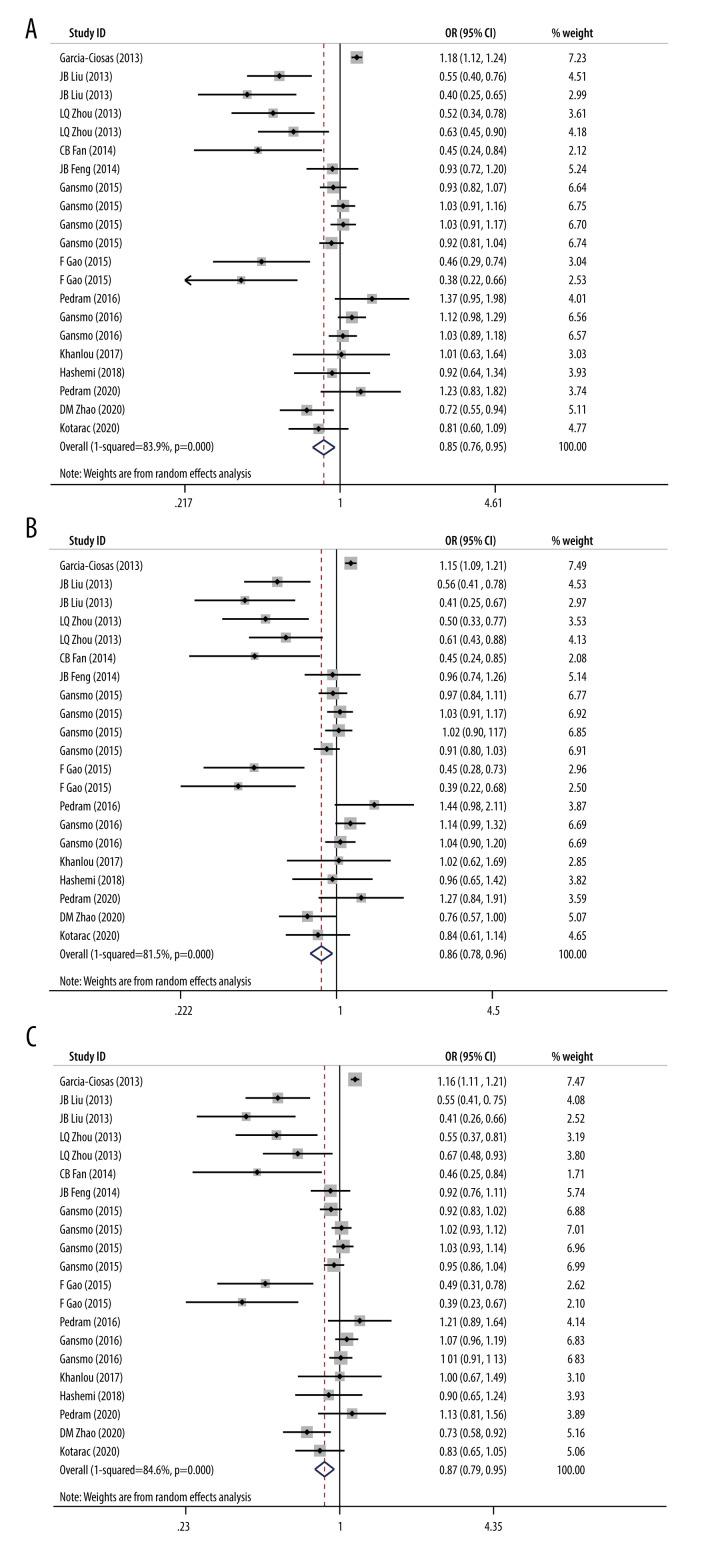
BACKGROUND Mouse double minute 4 (MDM4) has been extensively investigated as a negative regulator of P53, its negative feedback loop, and the effect of its genetic polymorphisms on cancers. However, many studies showed varying and even conflicting results. Therefore, we employed meta-analysis to further assess the intensity of the connection between MDM4 polymorphisms and malignancies. MATERIAL AND METHODS We searched eligible articles in 5 databases (Cochrane Library, PubMed, Web of Science, Wan Fang Database, and China National Knowledge Infrastructure) up to August 2021. Odds ratios (ORs) and 95% confidence intervals (CIs) were utilized to probe the correlation of 5 MDM4 polymorphisms (rs4245739, rs1563828, rs11801299, rs10900598, and rs1380576) with carcinomas. We employed meta-regression and subgroup analysis to probe for sources of heterogeneity; Funnel plots, Begg's test, and Egger's test were used to evaluate publication bias. Sensitivity analysis was applied to assess the stability of the study. RESULTS Twenty-two studies, comprising 77 reports with 29 853 cases and 72 045 controls, were included in our meta-analysis. We found that rs4245739 polymorphism was a factor in reducing overall cancer susceptibility (dominant model, OR=0.85, 95% CI=0.76-0.95; heterozygous model, OR=0.86, 95% CI=0.78-0.96; additive model, OR=0.87, 95% CI=0.79-0.95), especially in Asian populations, and it also reduces the risk for esophageal squamous cell carcinoma (ESCC). The remaining 4 SNPs were not associated with cancers. CONCLUSIONS The rs4245739 polymorphism might reduce the risk of malignancies, especially in Asian populations, and it is a risk-reducing factor for ESCC incidence. However, rs1563828, rs11801299, rs10900598, and rs1380576 are not relevant to cancer susceptibility.
背景
鼠双微体基因 4(MDM4)作为 P53 的负调控因子、其负反馈回路以及其遗传多态性对癌症的影响,已被广泛研究。然而,许多研究显示出不同甚至相互矛盾的结果。因此,我们采用荟萃分析进一步评估 MDM4 多态性与恶性肿瘤之间的关联强度。
材料和方法
我们在 Cochrane 图书馆、PubMed、Web of Science、万方数据库和中国知网 5 个数据库中检索了截至 2021 年 8 月的合格文章。使用比值比(ORs)和 95%置信区间(CIs)来探究 5 种 MDM4 多态性(rs4245739、rs1563828、rs11801299、rs10900598 和 rs1380576)与癌症的相关性。我们采用meta 回归和亚组分析来探究异质性的来源;漏斗图、贝叶斯检验和埃格检验用于评估发表偏倚;敏感性分析用于评估研究的稳定性。
结果
纳入了我们荟萃分析的 22 项研究,共包含 77 份报告,涉及 29853 例病例和 72045 例对照。我们发现 rs4245739 多态性是降低总体癌症易感性的一个因素(显性模型,OR=0.85,95%CI=0.76-0.95;杂合模型,OR=0.86,95%CI=0.78-0.96;加性模型,OR=0.87,95%CI=0.79-0.95),尤其是在亚洲人群中,它还降低了食管鳞状细胞癌(ESCC)的风险。其余 4 个 SNP 与癌症无关。
结论
rs4245739 多态性可能降低恶性肿瘤的风险,尤其是在亚洲人群中,并且是 ESCC 发病率的降低因素。然而,rs1563828、rs11801299、rs10900598 和 rs1380576 与癌症易感性无关。

 Zotero 插件