
围绝经期妇女血脂与胰岛素抵抗的时间顺序:全国妇女健康研究。
Temporal sequence of blood lipids and insulin resistance in perimenopausal women: the study of women's health across the nation.
机构信息
Department of Biostatistics, Cheeloo College of Medicine, Shandong University, Jinan, Shandong, China.
Department of Human Resources, Zibo Central Hospital, Zibo, Shandong, China.
出版信息
BMJ Open Diabetes Res Care. 2022 Mar;10(2). doi: 10.1136/bmjdrc-2021-002653.
INTRODUCTION
To explore the temporal relationship between blood lipids and insulin resistance in perimenopausal women.
RESEARCH DESIGN AND METHODS
The longitudinal cohort consisted of 1386 women (mean age 46.4 years at baseline) in the Study of Women's Health Across the Nation. Exploratory factor analysis was used to identify appropriate latent factors of lipids (total cholesterol (TC); triglyceride (TG); high-density lipoprotein cholesterol (HDL-C); low-density lipoprotein cholesterol (LDL-C); lipoprotein A-I (LpA-I); apolipoprotein A-I (ApoA-I); apolipoprotein B (ApoB)). Cross-lagged path analysis was used to explore the temporal sequence of blood lipids and homeostasis model assessment of insulin resistance (HOMA-IR).
RESULTS
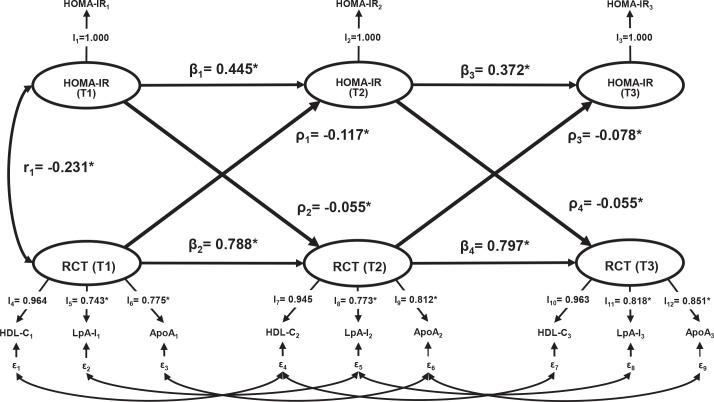
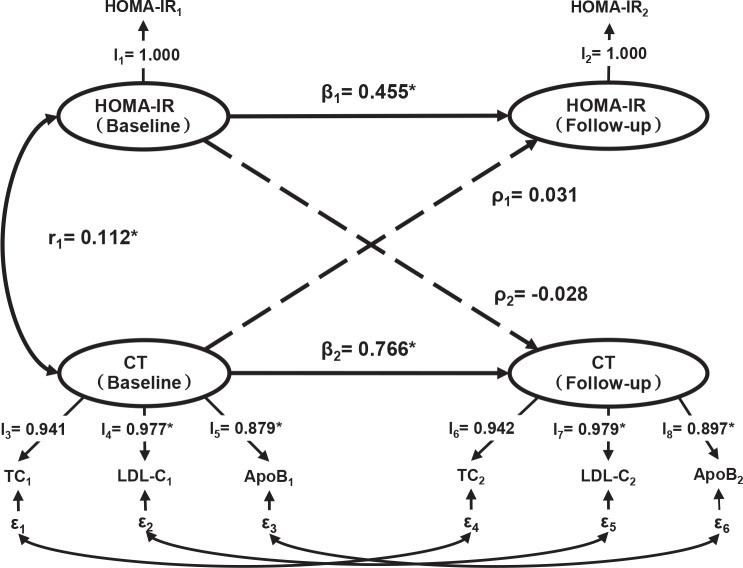
Three latent lipid factors were defined as: the TG factor, the cholesterol transport factor (CT), including TC, LDL-C, and ApoB; the reverse cholesterol transport factor (RCT), including HDL-C, LpA-I, and ApoA-I. The cumulative variance contribution rate of the three factors was 86.3%. The synchronous correlations between baseline TG, RCT, CT, and baseline HOMA-IR were 0.284, -0.174, and 0.112 (p<0.05 for all). After adjusting for age, race, smoking, drinking, body mass index, and follow-up years, the path coefficients of TG→HOMA-IR (0.073, p=0.004), and HOMA-IR→TG (0.057, p=0.006) suggested a bidirectional relationship between TG and HOMA-IR. The path coefficients of RCT→HOMA-IR (-0.091, < 0.001) and HOMA-IR→RCT (-0.058, p=0.002) were also significant, but the path coefficients of CT→HOMA-IR (0.031, p=0.206) and HOMA-IR→CT (-0.028, p=0.113) were not. The sensitivity analyses showed consistent results.
CONCLUSIONS
These findings provide evidence that TG and the reverse cholesterol transport-related lipids are related with insulin resistance bidirectionally, while there is no temporal relationship between the cholesterol transport factor and insulin resistance.
简介
旨在探讨围绝经期女性血脂与胰岛素抵抗之间的时间关系。
研究设计与方法
该纵向队列研究包括 1386 名女性(基线时平均年龄为 46.4 岁),来自全国妇女健康研究。采用探索性因子分析确定血脂(总胆固醇(TC);甘油三酯(TG);高密度脂蛋白胆固醇(HDL-C);低密度脂蛋白胆固醇(LDL-C);脂蛋白 A-I(LpA-I);载脂蛋白 A-I(ApoA-I);载脂蛋白 B(ApoB)的适当潜在因素。交叉滞后路径分析用于探讨血脂和稳态模型评估的胰岛素抵抗(HOMA-IR)之间的时间顺序。
结果
确定了三个潜在的血脂因子:TG 因子、胆固醇转运因子(CT),包括 TC、LDL-C 和 ApoB;逆胆固醇转运因子(RCT),包括 HDL-C、LpA-I 和 ApoA-I。三个因子的累积方差贡献率为 86.3%。基线 TG、RCT、CT 与基线 HOMA-IR 之间的同步相关系数分别为 0.284、-0.174 和 0.112(均<0.05)。在调整年龄、种族、吸烟、饮酒、体重指数和随访年限后,TG→HOMA-IR 的路径系数(0.073,p=0.004)和 HOMA-IR→TG 的路径系数(0.057,p=0.006)表明 TG 和 HOMA-IR 之间存在双向关系。RCT→HOMA-IR 的路径系数(-0.091,<0.001)和 HOMA-IR→RCT 的路径系数(-0.058,p=0.002)也具有显著意义,但 CT→HOMA-IR 的路径系数(0.031,p=0.206)和 HOMA-IR→CT 的路径系数(-0.028,p=0.113)不具有显著意义。敏感性分析结果一致。
结论
这些发现提供了证据表明,TG 和与逆胆固醇转运相关的脂质与胰岛素抵抗呈双向相关,而胆固醇转运因子与胰岛素抵抗之间没有时间关系。

 Zotero 插件