
“你什么意思,我不能有医生?这是加拿大!”——一项关于等待初级保健附属的无附属患者的无数后果的定性研究。
"What do you mean I can't have a doctor? this is Canada!" - a qualitative study of the myriad consequences for unattached patients awaiting primary care attachment.
机构信息
Department of Family Medicine, Primary Care Research Unit, Dalhousie University, 1465 Brenton St., Suite 402, Halifax, NS, B3J 3T4, Canada.
Public Health, Nova Scotia Health, Halifax, Canada.
出版信息
BMC Prim Care. 2022 Mar 30;23(1):60. doi: 10.1186/s12875-022-01671-5.
BACKGROUND
Patient access to primary healthcare (PHC) is the foundation of a strong healthcare system and healthy populations. Attachment to a regular PHC provider, a key to healthcare access, has seen a decline in some jurisdictions. This study explored the consequences of unattachment from a patient perspective, an under-studied phenomenon to date.
METHODS
A realist-informed qualitative study was conducted with unattached patients in Nova Scotia, Canada. Semi-structured interviews with nine participants were conducted and transcribed for analysis. The framework method was used to carry out analysis, which was guided by Donabedian's model of assessing healthcare access and quality.
RESULTS
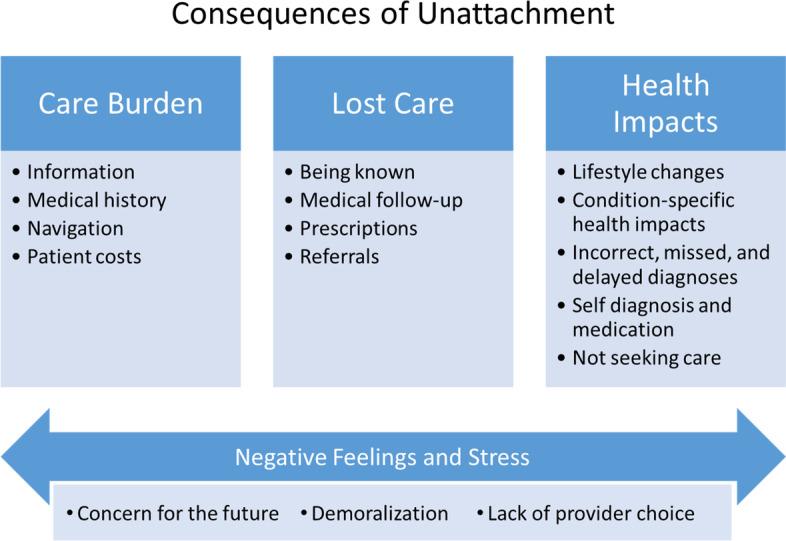
Five key findings were noted in this study: 1) Participants experienced a range of consequences from not having a regular PHC provider. Participants used creative strategies to 2) attempt to gain attachment to a regular PHC provider, and, to 3) address their health needs in the absence of a regular PHC provider. 4) Participants experienced negative feelings about themselves and the healthcare system, and 5) stress related to the consequences and added work of being unattached and lost care.
CONCLUSIONS
Unattached patients experienced a burden of care related to lost care and managing their own health and related information, due to the download of medical record management and system navigation to them. These findings may underestimate the consequences for further at-risk populations who would not have been included in our recruitment. This may result in poorer health outcomes, which could be mitigated by interventions at the structural level, such as enhanced centralized waitlists to promote attachment. Such waitlists may benefit from a triage approach to appropriately attach patients based on need.
背景
患者能否获得初级医疗保健(PHC)是建立强大医疗体系和健康人群的基础。在某些司法管辖区,患者与常规 PHC 提供者的联系(获得医疗保健的关键)有所下降。本研究从患者的角度探讨了这种联系缺失的后果,这是迄今为止研究较少的现象。
方法
在加拿大新斯科舍省进行了一项基于现实主义的定性研究,涉及无固定 PHC 提供者的患者。对 9 名参与者进行了半结构化访谈,并对访谈内容进行了转录以进行分析。采用框架方法进行分析,该方法以 Donabedian 评估医疗保健可及性和质量的模型为指导。
结果
本研究有五个主要发现:1)参与者没有常规 PHC 提供者,经历了一系列后果。参与者使用创造性策略 2)试图与常规 PHC 提供者建立联系,并 3)在没有常规 PHC 提供者的情况下解决他们的健康需求。4)参与者对自己和医疗保健系统感到不满和压力,以及 5)与失去医疗保健和管理自己的健康和相关信息相关的负担。
结论
无固定 PHC 提供者的患者由于将病历管理和系统导航下载到他们手中,因此失去了医疗保健和管理自己健康和相关信息的负担。这些发现可能低估了进一步处于风险中的人群的后果,这些人群可能没有包括在我们的招募中。这可能导致更差的健康结果,可以通过结构层面的干预来缓解,例如加强集中的等待名单以促进联系。这样的等待名单可能受益于基于需求的分诊方法,以适当地将患者联系起来。
 Zotero 插件