
膝关节骨关节炎疼痛高敏性的患病率:Meta 分析与 Meta 回归。
High Prevalence of Pain Sensitization in Knee Osteoarthritis: A Meta-Analysis with Meta-Regression.
机构信息
Service of Orthopaedics and Traumatology, Department of Surgery, EOC, Lugano, Switzerland.
Fisiopatologia e Terapia del Dolore, Dipartimento di Farmacologia, Careggi Università di Firenze, Florence, Italy.
出版信息
Cartilage. 2022 Jan-Mar;13(1):19476035221087698. doi: 10.1177/19476035221087698.
OBJECTIVE
The aim of this meta-analysis was to study the evidence on pain sensitization in knee osteoarthritis (OA), providing a quantitative synthesis of its prevalence and impact. Factors associated with pain sensitization were also investigated.
METHODS
Meta-analysis; PubMed (MEDLINE), Cochrane Central Register (CENTRAL), and Web of Science were searched on February 2021. Level I to level IV studies evaluating the presence of pain sensitization in patients with symptomatic knee OA, documented through a validated method (questionnaires or quantitative sensory testing), were included. The primary outcome was the prevalence of pain sensitization. Factors influencing the prevalence were also evaluated, as well as differences in terms of pain thresholds between knee OA patients and healthy controls.
RESULTS
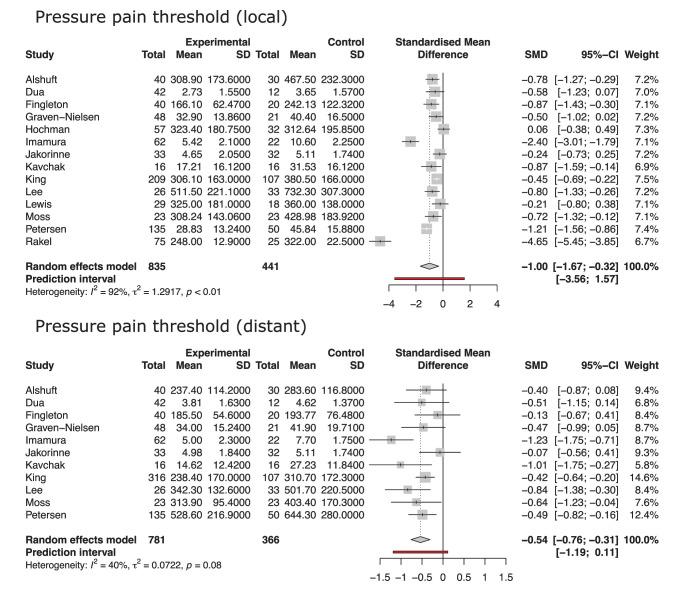
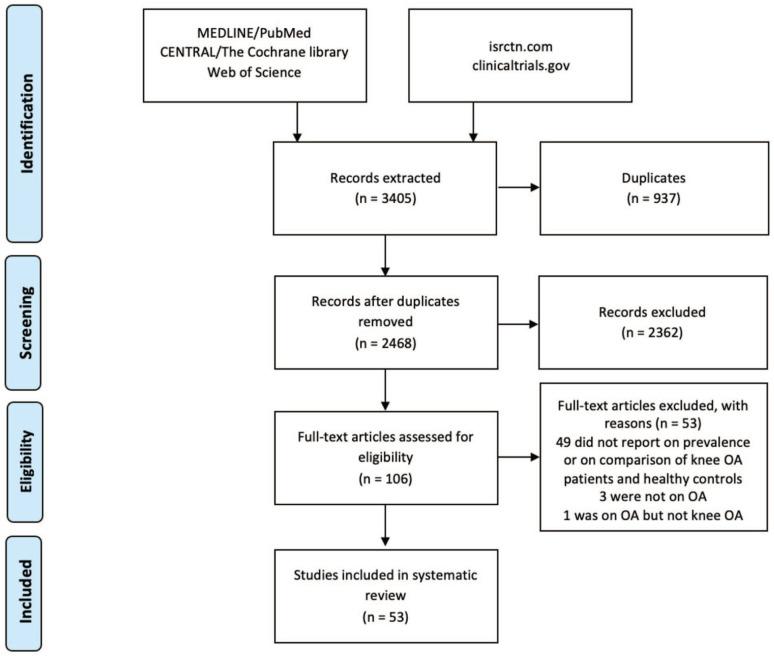
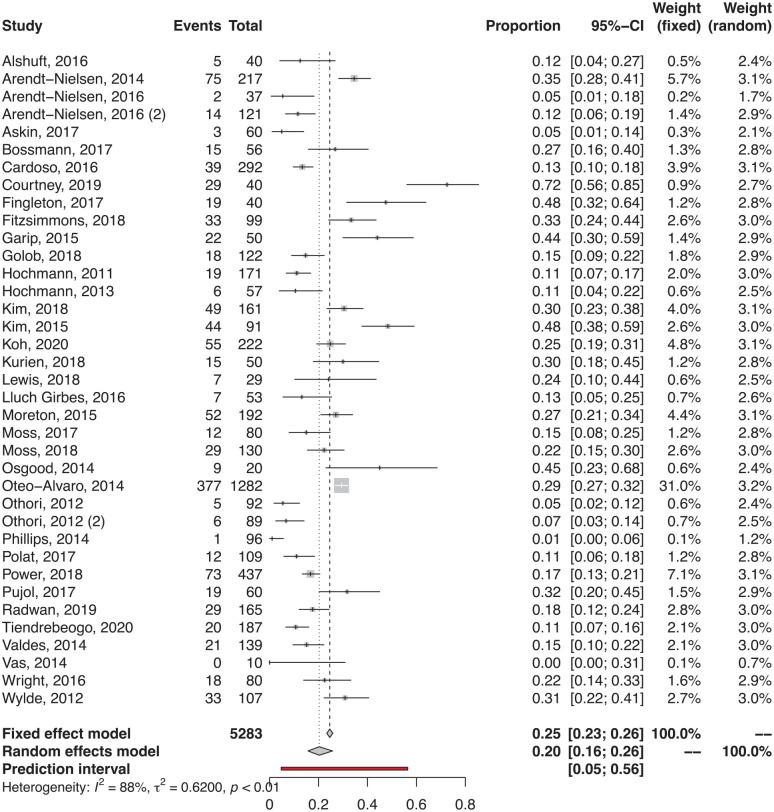
Fifty-three articles including 7,117 patients were included. The meta-analysis of proportion documented a prevalence of pain sensitization of 20% (95% confidence interval [CI] = 16%-26%) with a significant heterogeneity of results ( = 89%, < 0.001). The diagnostic tool used was the main factor influencing the documented prevalence of pain sensitization ( = 0.01). Knee OA patients presented higher pain sensitivity compared with healthy controls, both in terms of local pressure pain threshold (standardized mean difference [SMD] = -1.00, 95% CI = -1.67 to -0.32, = 0.007) and distant pressure pain threshold (SMD = -0.54, 95% CI = -0.76 to -0.31, < 0.001).
CONCLUSIONS
Knee OA pain presents features that are consistent with a significant degree of pain sensitization. There is a high heterogeneity in the reported results, mainly based on the diagnostic tool used. The identification of the best methods to detect pain sensitization is warranted to correctly evaluate and manage symptoms of patients affected by knee OA.
REGISTRATION
PROSPERO CRD42019123347.
目的
本荟萃分析旨在研究膝关节骨关节炎(OA)中疼痛敏化的证据,对其患病率和影响进行定量综合分析。还研究了与疼痛敏化相关的因素。
方法
荟萃分析;2021 年 2 月在 PubMed(MEDLINE)、Cochrane 中央注册(CENTRAL)和 Web of Science 上进行检索。纳入评估有症状膝关节 OA 患者存在疼痛敏化的水平 I 至水平 IV 研究,通过经过验证的方法(问卷或定量感觉测试)记录,包括患者存在疼痛敏化的存在。主要结局为疼痛敏化的患病率。还评估了影响患病率的因素,以及膝关节 OA 患者与健康对照组之间的疼痛阈值差异。
结果
共纳入 53 篇文章,包含 7117 例患者。比例的荟萃分析记录疼痛敏化的患病率为 20%(95%置信区间[CI] = 16%-26%),结果具有显著异质性( = 89%, < 0.001)。使用的诊断工具是影响记录的疼痛敏化患病率的主要因素( = 0.01)。与健康对照组相比,膝关节 OA 患者的疼痛敏感性更高,局部压痛阈值(标准化均数差[SMD] = -1.00,95%CI = -1.67 至 -0.32, = 0.007)和远处压痛阈值(SMD = -0.54,95%CI = -0.76 至 -0.31, < 0.001)。
结论
膝关节 OA 疼痛具有明显疼痛敏化的特征。报告的结果存在很大的异质性,主要基于使用的诊断工具。需要确定检测疼痛敏化的最佳方法,以正确评估和管理受膝关节 OA 影响的患者的症状。
登记
PROSPERO CRD42019123347。
 Zotero 插件