
气体陷闭与慢性阻塞性肺疾病急性加重风险:来自前瞻性KOCOSS队列的分析
Air Trapping and the Risk of COPD Exacerbation: Analysis From Prospective KOCOSS Cohort.
作者信息
Kim Youlim, Kim Sang Hyuk, Rhee Chin Kook, Lee Jae Seung, Lee Chang Youl, Kim Deog Kyeom, Shin Kyeong-Cheol, Jung Ki Suck, Yoo Kwang Ha, Park Yong Bum
机构信息
Division of Pulmonary, Allergy and Critical Care Medicine, Department of Internal Medicine, Konkuk University Hospital, School of Medicine, Konkuk University, Seoul, South Korea.
Division of Pulmonology and Critical Care Medicine, Department of Medicine, Samsung Medical Center, Sungkyunkwan University School of Medicine, Seoul, South Korea.
出版信息
Front Med (Lausanne). 2022 Mar 11;9:835069. doi: 10.3389/fmed.2022.835069. eCollection 2022.
BACKGROUND AND AIMS
Air trapping is a predictive index for a decline in lung function and mortality in patients with chronic obstructive pulmonary disease (COPD). However, the role of air trapping in COPD exacerbation has rarely been studied. Therefore, this study aimed to investigate the impact of air trapping as a continuous parameter on COPD exacerbation.
MATERIALS AND METHODS
To evaluate air trapping, we identified the ratio of residual volume (RV) to total lung capacity (TLC) of patients with COPD from the Korean COPD Subgroup Study (KOCOSS) cohort, which is a multicenter-based, prospective, consecutive cohort in Korea. The primary outcome was a development of COPD exacerbation during 3 years of follow-up.
RESULTS
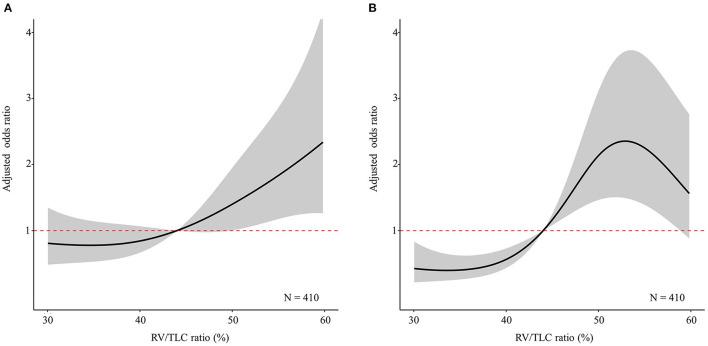
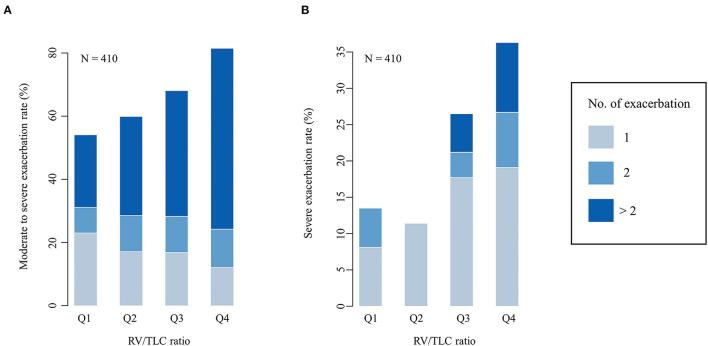
Of 2,181 participants, 902 patients measured the RV/TLC ratio in the baseline enrollment, and 410 were evaluated for assessing the development of COPD exacerbation. Of 410 patients, the rate of moderate to severe exacerbation and severe exacerbation was 70.7% and 25.9%. A 10% increase of RV/TLC ratio increased the risk of the moderate to severe exacerbation by 35% and severe exacerbation by 36%. In subgroup analysis, an interaction effect between triple inhaled therapy and the RV/TLC ratio for severe exacerbation nullified the association between the RV/TLC ratio and severe exacerbation ( for interaction = 0.002).
CONCLUSIONS
In this prospective cohort study, we found that air trapping (representing RV/TLC ratio as a continuous parameter) showed an association with an increased risk of COPD exacerbation, particularly in patients who have not undergone triple inhaler therapy.
背景与目的
气体潴留是慢性阻塞性肺疾病(COPD)患者肺功能下降和死亡率的预测指标。然而,气体潴留在COPD加重中的作用鲜有研究。因此,本研究旨在探讨气体潴留作为一个连续参数对COPD加重的影响。
材料与方法
为评估气体潴留情况,我们从韩国COPD亚组研究(KOCOSS)队列中确定了COPD患者的残气量(RV)与肺总量(TLC)之比,该队列是韩国一项基于多中心的前瞻性连续队列研究。主要结局是随访3年期间COPD加重的发生情况。
结果
在2181名参与者中,902例患者在基线入组时测量了RV/TLC比值,410例患者接受了COPD加重发生情况的评估。在这410例患者中,中重度加重和重度加重的发生率分别为70.7%和25.9%。RV/TLC比值增加10%会使中重度加重风险增加35%,重度加重风险增加36%。在亚组分析中,三联吸入疗法与RV/TLC比值对重度加重的交互作用消除了RV/TLC比值与重度加重之间的关联(交互作用P = 0.002)。
结论
在这项前瞻性队列研究中,我们发现气体潴留(以RV/TLC比值作为连续参数表示)与COPD加重风险增加相关,尤其是在未接受三联吸入疗法的患者中。

 Zotero 插件