
治疗前淋巴细胞计数可预测口咽癌同期放化疗的获益。
Pretreatment Lymphocyte Count Predicts Benefit From Concurrent Chemotherapy With Radiotherapy in Oropharyngeal Cancer.
机构信息
Department of Clinical Oncology, The Christie NHS Foundation Trust, Manchester, United Kingdom.
Division of Cancer Sciences, Faculty of Biology, Medicine and Health, The University of Manchester, Manchester, United Kingdom.
出版信息
J Clin Oncol. 2022 Jul 10;40(20):2203-2212. doi: 10.1200/JCO.21.01991. Epub 2022 Apr 6.
PURPOSE
There is a need to refine the selection of patients with oropharyngeal squamous cell carcinoma (OPSCC) for treatment de-escalation. We investigated whether pretreatment absolute lymphocyte count (ALC) predicted overall survival (OS) benefit from the addition of concurrent chemotherapy to radical radiotherapy.
PATIENTS AND METHODS
This was an observational study of consecutive OPSCCs treated by curative-intent radiotherapy, with or without concurrent chemotherapy (n = 791) with external, independent validation from a separate institution (n = 609). The primary end point was OS at 5 years. Locoregional control (LRC) was assessed using competing risk regression as a secondary end point. Previously determined prognostic factors were used in a multivariable Cox proportional hazards model to assess the prognostic importance of ALC and the interaction between ALC and cisplatin chemotherapy use.
RESULTS
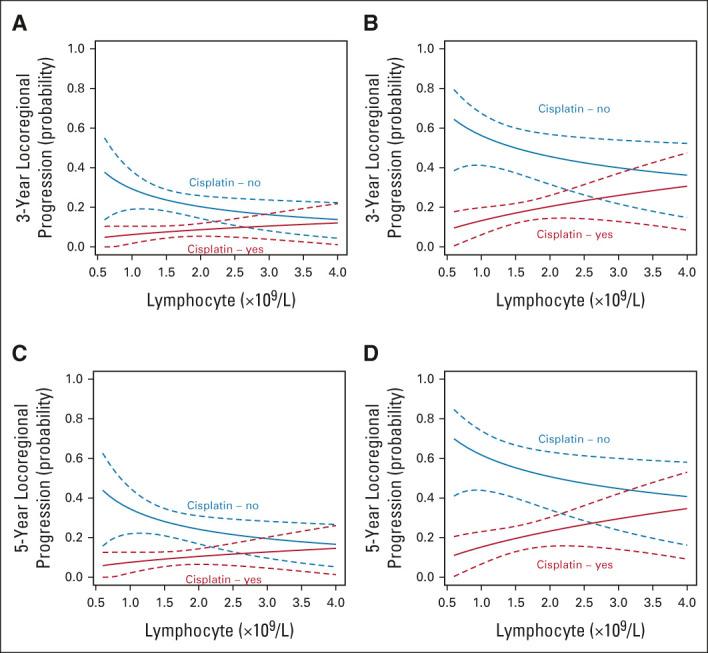
Pretreatment ALC was prognostic for 5-year OS on multivariable analysis (hazard ratio [HR] 0.64; 95% CI, 0.42 to 0.98; = .04). It also predicted benefit from the use of concurrent cisplatin chemotherapy, with a significant interaction between cisplatin chemotherapy and pretreatment ALC (likelihood ratio test, = .04): higher ALC count reduced the 5-year OS benefit compared with radiotherapy alone (HR 2.53; 95% CI, 1.03 to 6.19; = .043). This was likely driven by an effect on LRC up to 5 years (interaction subdistribution HR 2.29; 95% CI, 0.68 to 7.71; = .094). An independent validation cohort replicated the OS (HR 2.53; 95% CI, 0.98 to 6.52; = .055) and LRC findings (interaction subdistribution HR 3.43; 95% CI, 1.23 to 9.52; = .018).
CONCLUSION
For OPSCC, the pretreatment ALC is prognostic for OS and also predicts benefit from the addition of cisplatin chemotherapy to radiotherapy. These findings require prospective evaluation, and could inform the selection of good prognosis patients for a de-escalation trial.
目的
需要改进对接受放化疗的口咽鳞状细胞癌(OPSCC)患者的选择,以降低治疗强度。我们研究了治疗前绝对淋巴细胞计数(ALC)是否可以预测接受同期放化疗的 OPSCC 患者的总生存(OS)获益。
方法
这是一项对接受根治性放疗的 OPSCC 患者进行的观察性研究,包括接受同期放化疗(n = 791)和未接受同期放化疗(n = 609)的患者。主要终点为 5 年 OS。采用竞争风险回归评估局部区域控制(LRC)作为次要终点。使用多变量 Cox 比例风险模型评估先前确定的预后因素的预后重要性,以及 ALC 与顺铂化疗使用之间的相互作用。
结果
多变量分析显示,治疗前 ALC 与 5 年 OS 相关(风险比 [HR] 0.64;95%置信区间,0.42 至 0.98;P =.04)。它还预测了同期顺铂化疗的获益,且与治疗前 ALC 之间存在显著的相互作用(似然比检验,P =.04):与单独放疗相比,较高的 ALC 计数降低了 5 年 OS 获益(HR 2.53;95%置信区间,1.03 至 6.19;P =.043)。这可能是由于 5 年内 LRC 的影响(交互亚分布 HR 2.29;95%置信区间,0.68 至 7.71;P =.094)。独立验证队列复制了 OS(HR 2.53;95%置信区间,0.98 至 6.52;P =.055)和 LRC 发现(交互亚分布 HR 3.43;95%置信区间,1.23 至 9.52;P =.018)。
结论
对于 OPSCC,治疗前 ALC 是 OS 的预后因素,并且可以预测顺铂化疗联合放疗的获益。这些发现需要前瞻性评估,并为降低治疗强度的临床试验提供选择预后良好患者的依据。


 Zotero 插件