
机械擦拭可提高液体消毒剂对新型冠状病毒的消毒效果。
Mechanical Wiping Increases the Efficacy of Liquid Disinfectants on SARS-CoV-2.
作者信息
Sloan Angela, Kasloff Samantha B, Cutts Todd
机构信息
National Microbiology Laboratory, Applied Biosafety Research Program, Safety and Environmental Services, Public Health Agency of Canada, Winnipeg, MB, Canada.
出版信息
Front Microbiol. 2022 Mar 22;13:847313. doi: 10.3389/fmicb.2022.847313. eCollection 2022.
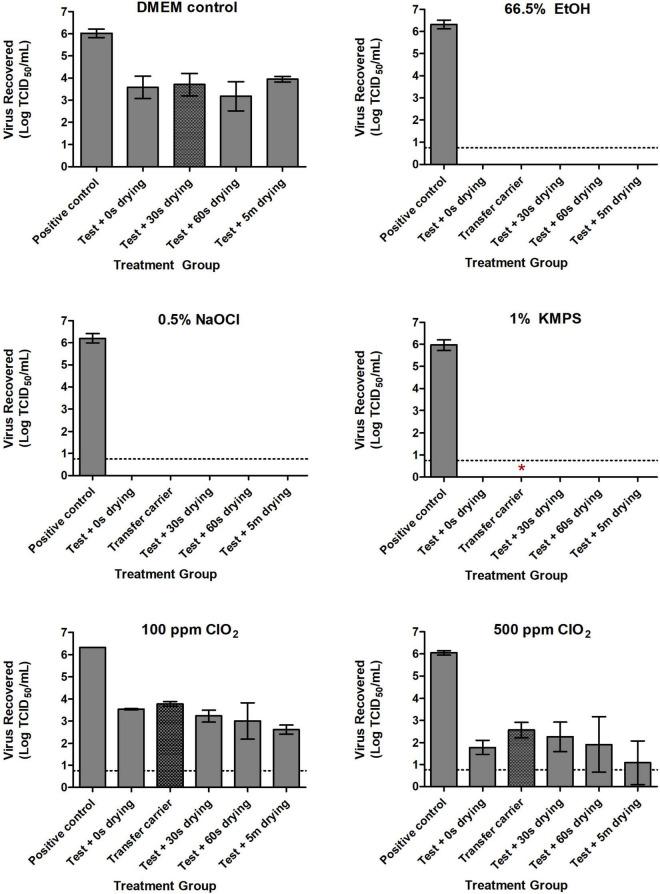
High-touch environmental surfaces are acknowledged as potential sources of pathogen transmission, particularly in health care settings where infectious agents may be readily abundant. Methods of disinfecting these surfaces often include direct application of a chemical disinfectant or simply wiping the surface with a disinfectant pre-soaked wipe (DPW). In this study, we examine the ability of four disinfectants, ethanol (EtOH), sodium hypochlorite (NaOCl), chlorine dioxide (ClO), and potassium monopersulfate (KMPS), to inactivate SARS-CoV-2 on a hard, non-porous surface, assessing the effects of concentration and contact time. The efficacy of DPWs to decontaminate carriers spiked with SARS-CoV-2, as well as the transferability of the virus from used DPWs to clean surfaces, is also assessed. Stainless steel carriers inoculated with approximately 6 logs of SARS-CoV-2 prepared in a soil load were disinfected within 5 min through exposure to 66.5% EtOH, 0.5% NaOCl, and 1% KMPS. The addition of mechanical wiping using DPWs impregnated with these biocides rendered the virus inactive almost immediately, with no viral transfer from the used DPW to adjacent surfaces. Carriers treated with 100 ppm of ClO showed a significant amount of viable virus remaining after 10 min of biocide exposure, while the virus was only completely inactivated after 10 min of treatment with 500 ppm of ClO. Wiping SARS-CoV-2-spiked carriers with DPWs containing either concentration of ClO for 5 s left significant amounts of viable virus on the carriers. Furthermore, higher titers of infectious virus retained on the ClO-infused DPWs were transferred to uninoculated carriers immediately after wiping. Overall, 66.5% EtOH, 0.5% NaOCl, and 1% KMPS appear to be highly effective biocidal agents against SARS-CoV-2, while ClO formulations are much less efficacious.
高接触环境表面被认为是病原体传播的潜在来源,尤其是在医疗机构中,那里感染源可能很丰富。对这些表面进行消毒的方法通常包括直接使用化学消毒剂或简单地用预先浸泡过消毒剂的擦拭布(DPW)擦拭表面。在本研究中,我们检测了四种消毒剂,乙醇(EtOH)、次氯酸钠(NaOCl)、二氧化氯(ClO)和过一硫酸氢钾(KMPS),在坚硬、无孔表面上灭活严重急性呼吸综合征冠状病毒2(SARS-CoV-2)的能力,评估了浓度和接触时间的影响。还评估了DPW对污染了SARS-CoV-2的载体进行去污的效果,以及病毒从用过的DPW转移到清洁表面的可能性。接种了在土壤负载中制备的约6个对数的SARS-CoV-2的不锈钢载体,通过暴露于66.5%的EtOH、0.5%的NaOCl和1%的KMPS,在5分钟内被消毒。使用浸渍有这些杀菌剂的DPW进行机械擦拭,几乎能立即使病毒失活,且没有病毒从用过的DPW转移到相邻表面。用100 ppm的ClO处理的载体在接触杀菌剂10分钟后仍有大量活病毒残留,而用500 ppm的ClO处理10分钟后病毒才完全失活。用含有任何一种浓度ClO的DPW擦拭污染了SARS-CoV-2的载体5秒钟后,载体上仍有大量活病毒。此外,用含ClO的DPW擦拭后,留在上面的较高滴度的感染性病毒会立即转移到未接种的载体上。总体而言,66.5%的EtOH、0.5%的NaOCl和1%的KMPS似乎是对抗SARS-CoV-2的高效杀菌剂,而ClO制剂的效果则差得多。

 Zotero 插件