
暴露于具有不同作用模式的复杂食物相关化学品混合物中的斑马鱼胚胎中颅面畸形的剂量添加。
Dose Addition in the Induction of Craniofacial Malformations in Zebrafish Embryos Exposed to a Complex Mixture of Food-Relevant Chemicals with Dissimilar Modes of Action.
机构信息
Centre for Health Protection, Dutch National Institute of Public Health and Environment (RIVM), Bilthoven, Netherlands.
Centre for Food Safety, RIVM, Bilthoven, Netherlands.
出版信息
Environ Health Perspect. 2022 Apr;130(4):47003. doi: 10.1289/EHP9888. Epub 2022 Apr 8.
BACKGROUND
Humans are exposed to combinations of chemicals. In cumulative risk assessment (CRA), regulatory bodies such as the European Food Safety Authority consider dose addition as a default and sufficiently conservative approach. The principle of dose addition was confirmed previously for inducing craniofacial malformations in zebrafish embryos in binary mixtures of chemicals with either similar or dissimilar modes of action (MOAs).
OBJECTIVES
In this study, we explored a workflow to select and experimentally test multiple compounds as a complex mixture with each of the compounds at or below its no observed adverse effect level (NOAEL), in the same zebrafish embryo model.
METHODS
Selection of candidate compounds that potentially induce craniofacial malformations was done using methods-structural similarity, molecular docking, and quantitative structure-activity relationships-applied to a database of chemicals relevant for oral exposure in humans via food (EuroMix inventory, ). A final subselection was made manually to represent different regulatory fields (e.g., food additives, industrial chemicals, plant protection products), different chemical families, and different MOAs.
RESULTS
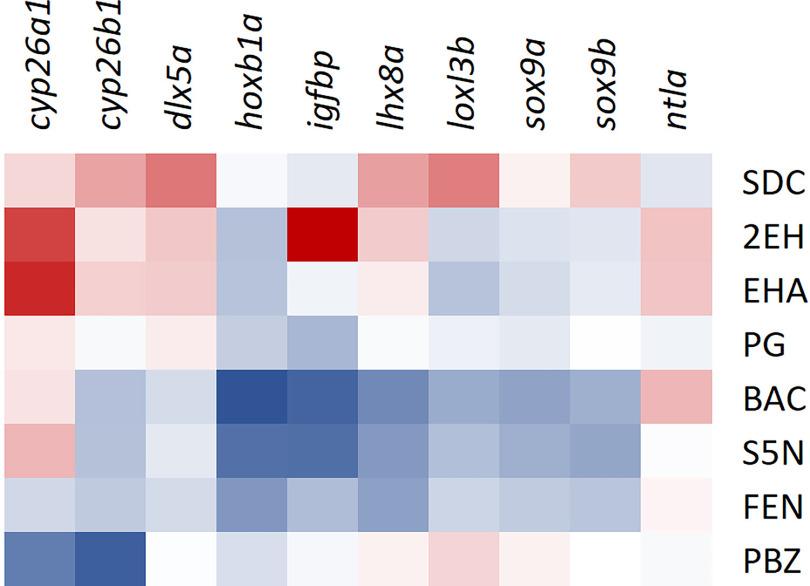
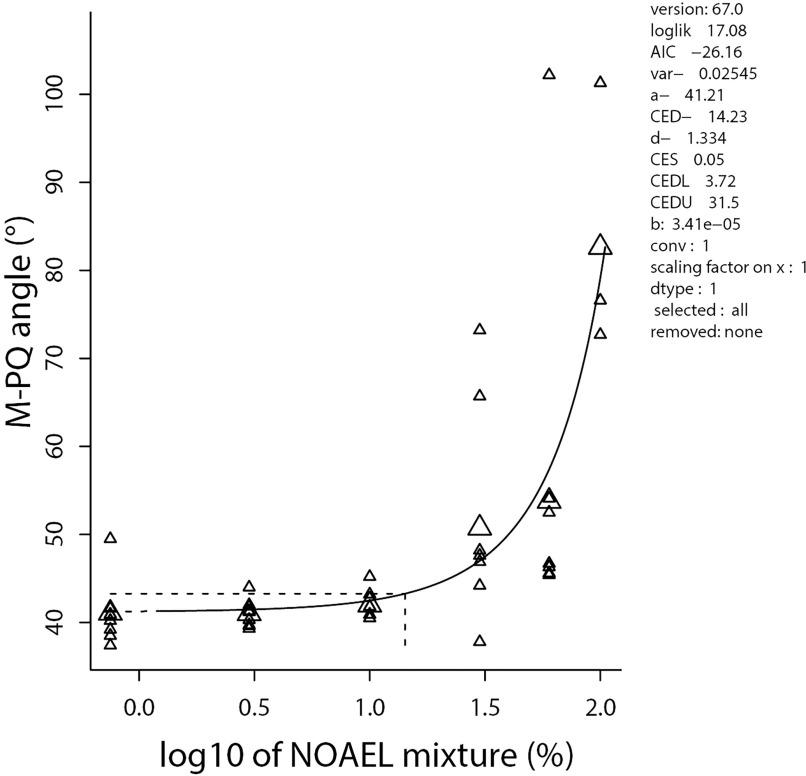
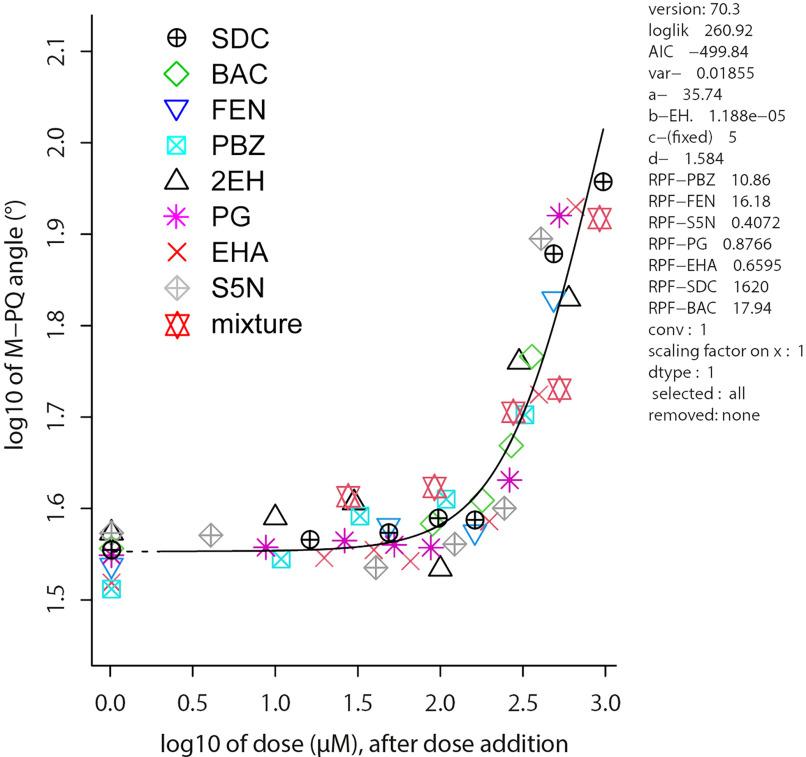
A final selection of eight compounds was examined in the zebrafish embryo model, and craniofacial malformations were observed in embryos exposed to each of the compounds, thus confirming the developmental toxicity as predicted by the methods. When exposed to a mixture of the eight compounds, each at its NOAEL, substantial craniofacial malformations were observed; according to a dose-response analysis, even embryos exposed to a 7-fold dilution of this mixture still exhibited a slight abnormal phenotype. The cumulative effect of the compounds in the mixture was in accordance with dose addition (added doses of the individual compounds after adjustment for relative potencies), despite different MOAs of the compounds involved.
DISCUSSION
This case study of a complex mixture inducing craniofacial malformations in zebrafish embryos shows that dose addition can adequately predicted the cumulative effect of a mixture of multiple substances at low doses, irrespective of the (expected) MOA. The applied workflow may be useful as an approach for CRA in general. https://doi.org/10.1289/EHP9888.
背景
人类会接触到多种化学物质。在累积风险评估(CRA)中,欧洲食品安全局等监管机构将剂量加和视为默认且足够保守的方法。此前,该方法已在利用具有相似或不同作用模式(MOA)的二元混合物在斑马鱼胚胎中诱导颅面畸形方面得到证实。
目的
本研究旨在探索一种工作流程,用于选择和实验测试多种化合物作为复杂混合物,每个化合物的浓度均低于无观察到不良效应水平(NOAEL),并在相同的斑马鱼胚胎模型中进行。
方法
使用结构相似性、分子对接和定量构效关系等方法,从与人类经食物(EuroMix 清单)口腔暴露相关的化学物质数据库中筛选出可能诱导颅面畸形的候选化合物。最后通过手动选择进一步筛选,以代表不同的监管领域(例如食品添加剂、工业化学品、植物保护产品)、不同的化学家族和不同的 MOA。
结果
最终选择了 8 种化合物在斑马鱼胚胎模型中进行研究,结果显示暴露于每种化合物的胚胎均出现颅面畸形,这证实了通过上述方法预测的发育毒性。当暴露于该 8 种化合物的混合物中,每种化合物的浓度均为 NOAEL 时,观察到明显的颅面畸形;根据剂量-反应分析,即使胚胎暴露于该混合物的 7 倍稀释液中,仍表现出轻微的异常表型。尽管涉及的化合物具有不同的 MOA,但混合物中化合物的累积效应与剂量加和一致(经相对效力调整后,单个化合物的加和剂量)。
讨论
本研究通过斑马鱼胚胎中复杂混合物诱导颅面畸形的案例研究表明,剂量加和可以充分预测低剂量多种物质混合物的累积效应,而与(预期)MOA 无关。所应用的工作流程可能对一般的 CRA 具有参考价值。https://doi.org/10.1289/EHP9888.


 Zotero 插件