
T细胞再生:进展与挑战的最新情况
T cell regeneration: an update on progress and challenges.
作者信息
Guo Rongqun, Wu Hongling, Du Juan, Wang Jinyong
机构信息
CAS Key Laboratory of Regenerative Biology, Guangzhou Institutes of Biomedicine and Health, Chinese Academy of Sciences, Guangzhou, China.
Guangzhou Regenerative Medicine and Health-Guangdong Laboratory (GRMH-GDL), Guangzhou, China.
出版信息
Blood Sci. 2020 Jan 16;2(1):22-26. doi: 10.1097/BS9.0000000000000037. eCollection 2020 Jan.
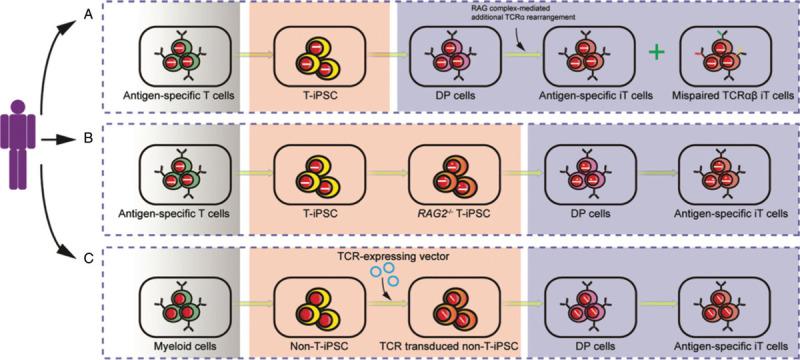
T cells play essential roles in antitumor therapy. Via gene engineering technique to enhance tumor-antigen specificity, patient peripheral blood-derived T cells (PBT) show encouraging clinical outcomes in treating certain blood malignancies. However, the high costs, functionality exhaustion, and disease-condition-dependent availability of PBT prompt the attempts of exploring alternative T cell sources. Theoretically, induced T cells from pluripotent stem cells (PSC) are ideal candidates that integrate plenty of advantages that primary T cells lack, including unlimited off-the-shelf cell source and precision gene editing feasibility. However, researchers are still struggling with developing a straightforward protocol to induce functional and immunocompetent human T cells from PSC. Based on stromal cell-expressing or biomaterial-presenting Notch ligands DLL1 or DLL4, natural and induced blood progenitors can differentiate further toward T lineage commitment. However, none of the reported T induction protocols has yet translated into any clinical application, signaling the existence of numerous technical barriers for regenerating T cells functionally matching their natural PBT counterparts. Alternatively, new approaches have been developed to repopulate induced T lymphopoiesis via reprogramming or transplanting induced T cell precursors. Here, we review the most recent progress in the T cell regeneration field, and the remaining challenges dragging their clinical applications.
T细胞在抗肿瘤治疗中发挥着重要作用。通过基因工程技术提高肿瘤抗原特异性,患者外周血来源的T细胞(PBT)在治疗某些血液恶性肿瘤方面显示出令人鼓舞的临床效果。然而,PBT的高成本、功能耗竭以及依赖疾病状况的可用性促使人们尝试探索替代的T细胞来源。从理论上讲,多能干细胞(PSC)诱导产生的T细胞是理想的候选者,它们具有许多原代T细胞所缺乏的优势,包括无限的现成细胞来源和精确基因编辑的可行性。然而,研究人员仍在努力开发一种直接的方案,以从PSC诱导产生功能性和免疫活性的人类T细胞。基于表达基质细胞或生物材料呈现的Notch配体DLL1或DLL4,天然和诱导的血液祖细胞可以进一步向T细胞谱系分化。然而,目前报道的任何T细胞诱导方案都尚未转化为临床应用,这表明在再生功能上与其天然PBT对应物相匹配T细胞方面存在众多技术障碍。另外,已经开发出了新的方法,通过重编程或移植诱导的T细胞前体来重新填充诱导的T淋巴细胞生成。在此,我们综述了T细胞再生领域的最新进展,以及阻碍其临床应用的剩余挑战。


 Zotero 插件