
在肠道-脑轴的转化性安慰剂范式中,积极的治疗期望塑造了对药物疗效的感知。
Positive Treatment Expectations Shape Perceived Medication Efficacy in a Translational Placebo Paradigm for the Gut-Brain Axis.
作者信息
Benson Sven, Theysohn Nina, Kleine-Borgmann Julian, Rebernik Laura, Icenhour Adriane, Elsenbruch Sigrid
机构信息
Institute for Medical Education, Center for Translational Neuro- and Behavioral Sciences, University Hospital Essen, University of Duisburg-Essen, Essen, Germany.
Institute of Medical Psychology and Behavioral Immunobiology, Center for Translational Neuro- and Behavioral Sciences, University Hospital Essen, University of Duisburg-Essen, Essen, Germany.
出版信息
Front Psychiatry. 2022 Mar 24;13:824468. doi: 10.3389/fpsyt.2022.824468. eCollection 2022.
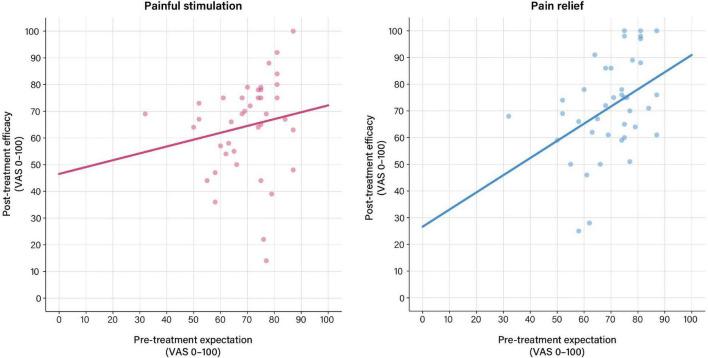
Placebo research has established the pivotal role of treatment expectations in shaping symptom experience and patient-reported treatment outcomes. Perceived treatment efficacy constitutes a relevant yet understudied aspect, especially in the context of the gut-brain axis with visceral pain as key symptom. Using a clinically relevant experimental model of visceral pain, we elucidated effects of pre-treatment expectations on post-treatment perceived treatment efficacy as an indicator of treatment satisfaction in a translational placebo intervention. We implemented positive suggestions regarding intravenous treatment with a spasmolytic drug (in reality saline), herein applied in combination with two series of individually calibrated rectal distensions in healthy volunteers. The first series used distension pressures inducing pain (pain phase). In the second series, pressures were surreptitiously reduced, modeling pain relief (pain relief phase). Using visual analog scales (VAS), expected and perceived treatment efficacy were assessed, along with perceived pain intensity. Manipulation checks supported that the induction of positive pre-treatment expectations and the modeling of pain relief were successful. Generalized Linear Models (GLM) were implemented to assess the role of inter-individual variability in positive pre-treatment expectations in perceived treatment efficacy and pain perception. GLM indicated no association between pre-treatment expectations and perceived treatment efficacy or perceived pain for the pain phase. For the relief phase, pre-treatment expectations ( = 0.024) as well as efficacy ratings assessed after the preceding pain phase ( < 0.001) were significantly associated with treatment efficacy assessed after the relief phase, together explaining 54% of the variance in perceived treatment efficacy. The association between pre-treatment expectations and perceived pain approached significance ( = 0.057) in the relief phase. Our data from an experimental translational placebo intervention in visceral pain support that reported post-treatment medication efficacy is shaped by pre-treatment expectations. The observation that individuals with higher positive expectations reported less pain and higher treatment satisfaction after pain relief may provide first evidence that perceived symptom improvement may facilitate treatment satisfaction. The immediate experience of symptoms within a given psychosocial treatment context may dynamically change perceptions about treatment, with implications for treatment satisfaction, compliance and adherence of patients with conditions of the gut-brain axis.
安慰剂研究已证实治疗期望在塑造症状体验和患者报告的治疗结果方面起着关键作用。感知到的治疗效果是一个相关但研究不足的方面,尤其是在内脏痛作为关键症状的肠-脑轴背景下。我们使用内脏痛的临床相关实验模型,在一项转化性安慰剂干预中,阐明了治疗前期望对治疗后感知到的治疗效果的影响,以此作为治疗满意度的指标。我们对使用解痉药物(实际为生理盐水)进行静脉治疗给出了积极的建议,该药物与两组针对健康志愿者的个体化校准直肠扩张相结合使用。第一组使用诱发疼痛的扩张压力(疼痛阶段)。在第二组中,压力被悄悄降低,模拟疼痛缓解(疼痛缓解阶段)。使用视觉模拟量表(VAS)评估预期和感知到的治疗效果以及感知到的疼痛强度。操作检查支持了积极治疗前期望的诱导和疼痛缓解的模拟是成功的。采用广义线性模型(GLM)来评估个体间积极治疗前期望的变异性在感知治疗效果和疼痛感知中的作用。GLM表明在疼痛阶段,治疗前期望与感知到的治疗效果或感知到的疼痛之间没有关联。对于缓解阶段,治疗前期望(P = 0.024)以及在前一个疼痛阶段后评估的疗效评分(P < 0.001)与缓解阶段后评估的治疗效果显著相关,共同解释了感知治疗效果中54%的方差变异。在缓解阶段,治疗前期望与感知到的疼痛之间的关联接近显著水平(P = 0.057)。我们在内脏痛的实验性转化安慰剂干预中的数据支持,报告的治疗后药物疗效受治疗前期望的影响。观察发现,积极期望较高的个体在疼痛缓解后报告的疼痛较少且治疗满意度较高,这可能首次证明感知到的症状改善可能促进治疗满意度。在特定心理社会治疗背景下症状的即时体验可能会动态改变对治疗的认知,这对肠-脑轴疾病患者的治疗满意度、依从性和坚持性具有影响。


 Zotero 插件