
外泌体 miR-452 和 miR-4713 下调调控预防儿童肥胖的综合分析。
Integrative Analysis of Exosomal miR-452 and miR-4713 Downregulating for the Prevention of Childhood Obesity.
机构信息
Department of Nursing, The Affiliated Wuxi Children's Hospital of Nanjing Medical University, Jiangsu Province 214000, China.
Department of Endocrinology, The Affiliated Wuxi Children's Hospital of Nanjing Medical University, Jiangsu Province 214000, China.
出版信息
Dis Markers. 2022 Mar 30;2022:2843353. doi: 10.1155/2022/2843353. eCollection 2022.
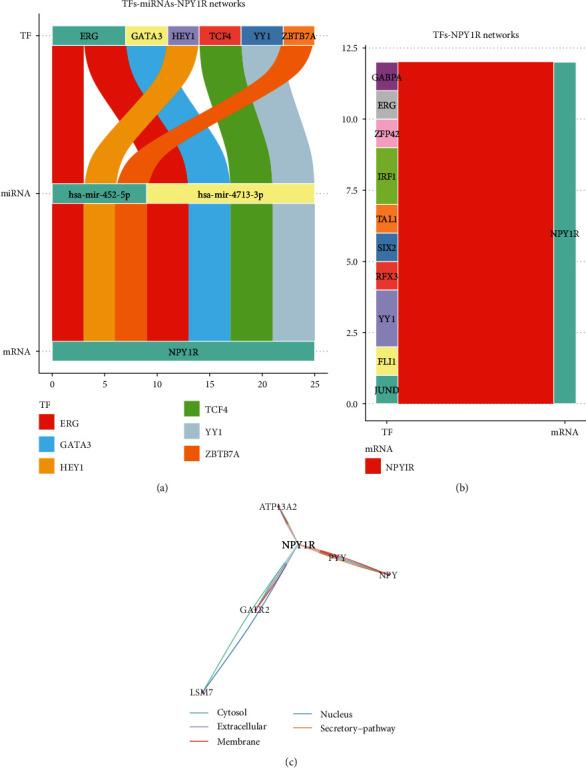
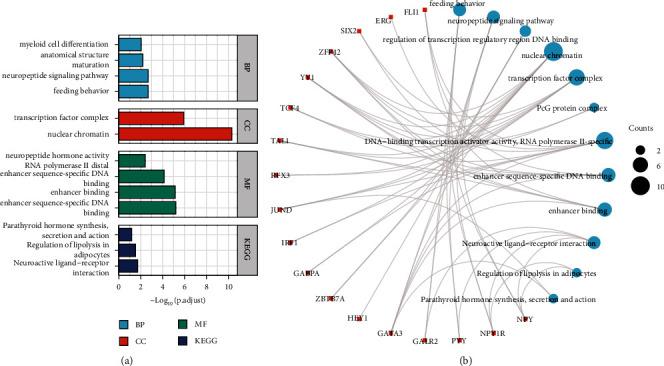
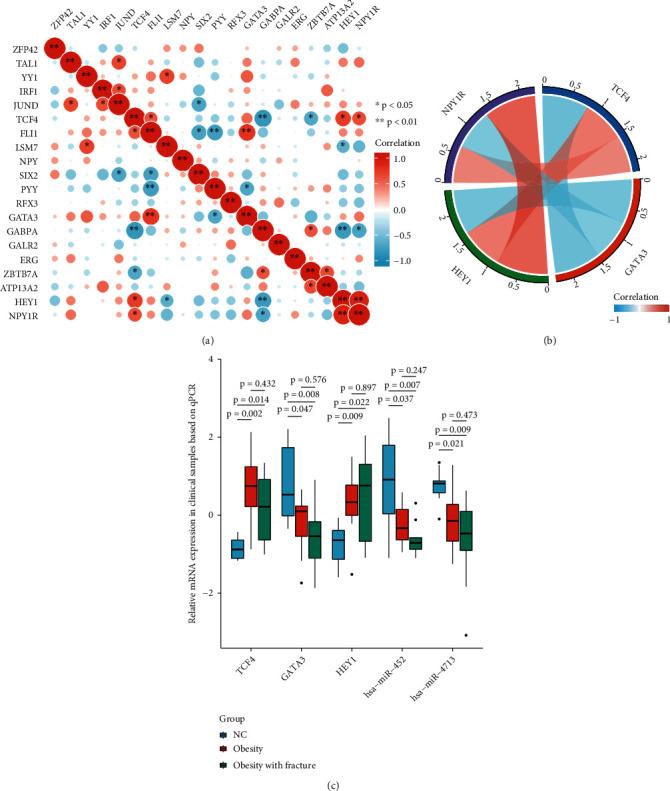
Neuropeptides are associated with childhood obesity and exploring their regulatory mechanisms may reveal new insights for novel treatments. Childhood obesity data were downloaded from the GEO database and were used to screen for differentially expressed neuropeptides in patients with obesity. NPY1R expression was significantly upregulated in children with obesity compared to children without obesity ( < 0.05). The GEO database was used to filter differentially expressed miRNAs in patients with obesity. And hsa-mir-4713 and hsa-mir-452 were found significantly downregulated in adipose tissue. The GEO, TRRUST, and TFacts databases were used to screen all transcription factors for differentially expressed genes (DEGs). The potential regulatory networks between the differentially expressed miRNAs, TFs, and neuropeptides were mapped. In the constructed NPY1R regulatory network, the transcription factors TCF4, HEY1, and GATA3 are significantly associated with . and were positively correlated with , while GATA3 was negatively correlated with NPY1R. In the clinical peripheral blood samples, NPY1R, TCF4, and HEY1 were significantly more expressed in the obesity and the obesity with fracture group compared to the control group, while there was no statistically significant difference between the obesity group and the obesity with fracture group in terms of expression. The expression of GATA3, miR-452, and miR-4713 was also significantly lower in the obesity and the obesity with fracture groups when compared to the NC group. Therefore, NPY1R, TCF4, HEY1, GATA3, miR-452, and miR-4713 may be risk factors for fracture in obese children. The potential NPY1R regulatory function was exerted by two pathways: positive regulation caused by TCF4 and HEY1 acting on miR-4713 and negative regulation via GATA3 acting on miR-452. Potential NPY1R-related targets for the treatment of childhood obesity were provided in this study.
神经肽与儿童肥胖有关,探索其调节机制可能为新的治疗方法提供新的见解。从 GEO 数据库中下载儿童肥胖症数据,并用于筛选肥胖症患者中差异表达的神经肽。与非肥胖儿童相比,肥胖儿童的 NPY1R 表达明显上调(<0.05)。使用 GEO 数据库筛选肥胖症患者中差异表达的 miRNA。发现脂肪组织中 hsa-mir-4713 和 hsa-mir-452 明显下调。使用 GEO、TRRUST 和 TFacts 数据库筛选差异表达基因(DEG)的所有转录因子。绘制差异表达 miRNA、TF 和神经肽之间的潜在调控网络。在所构建的 NPY1R 调控网络中,转录因子 TCF4、HEY1 和 GATA3 与 显著相关,miR-4713 和 miR-452 与 NPY1R 呈正相关,而 GATA3 与 NPY1R 呈负相关。在临床外周血样本中,肥胖症和肥胖症伴骨折组的 NPY1R、TCF4 和 HEY1 表达明显高于对照组,而肥胖症组和肥胖症伴骨折组之间的表达无统计学差异。与 NC 组相比,肥胖症和肥胖症伴骨折组的 GATA3、miR-452 和 miR-4713 表达也明显降低。因此,NPY1R、TCF4、HEY1、GATA3、miR-452 和 miR-4713 可能是肥胖儿童骨折的危险因素。NPY1R 的潜在调控功能是通过两条途径发挥的:TCF4 和 HEY1 作用于 miR-4713 引起的正调控和 GATA3 作用于 miR-452 引起的负调控。本研究为治疗儿童肥胖症提供了潜在的 NPY1R 相关靶点。


 Zotero 插件