
在临床环境中评估快速 MIC 快速抗生素药敏检测试剂盒对革兰氏阴性菌的速度、准确性和精密度。
Evaluation of the Speed, Accuracy and Precision of the QuickMIC Rapid Antibiotic Susceptibility Testing Assay With Gram-Negative Bacteria in a Clinical Setting.
机构信息
Department of Medical Cell Biology, Uppsala University, Uppsala, Sweden.
Gradientech AB, Uppsala, Sweden.
出版信息
Front Cell Infect Microbiol. 2022 Mar 23;12:758262. doi: 10.3389/fcimb.2022.758262. eCollection 2022.
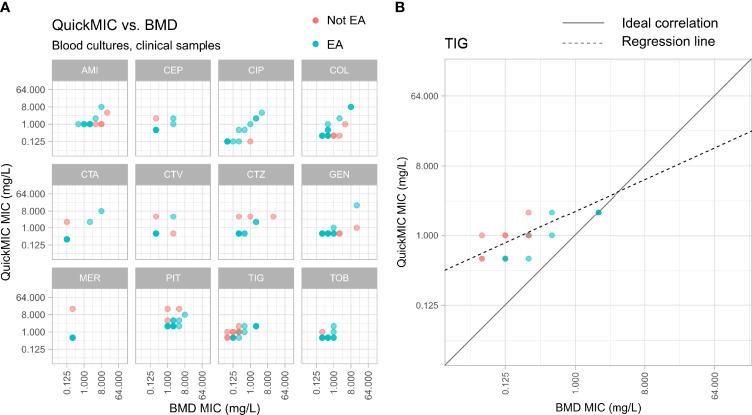
The rapidly changing landscape of antimicrobial resistance poses a challenge for empirical antibiotic therapy in severely ill patients and highlights the need for fast antibiotic susceptibility diagnostics to guide treatment. Traditional methods for antibiotic susceptibility testing (AST) of bacteria such as broth microdilution (BMD) or the disc diffusion method (DDM) are comparatively slow and show high variability. Rapid AST methods under development often trade speed for resolution, sometimes only measuring responses at a single antibiotic concentration. QuickMIC is a recently developed lab-on-a-chip system for rapid AST. Here we evaluate the performance of the QuickMIC method with regard to speed, precision and accuracy in comparison to traditional diagnostic methods. 151 blood cultures of clinical Gram-negative isolates with a high frequency of drug resistance were tested using the QuickMIC system and compared with BMD for 12 antibiotics. To investigate sample turnaround time and method functionality in a clinical setting, another 41 clinical blood culture samples were acquired from the Uppsala University Hospital and analyzed on site in the clinical laboratory with the QuickMIC system, and compared with DDM for 8 antibiotics routinely used in the clinical laboratory. The overall essential agreement between MIC values obtained by QuickMIC and BMD was 83.4%, with an average time to result of 3 h 2 min (SD: 24.8 min) for the QuickMIC method. For the clinical dataset, the categorical agreement between QuickMIC and DDM was 96.8%, whereas essential and categorical agreement against BMD was 91.0% and 96.7%, respectively, and the total turnaround time as compared to routine diagnostics was shown to be reduced by 40% (33 h vs. 55 h). Interexperiment variability was low (average SD: 44.6% from target MIC) compared to the acceptable standard of ±1 log unit ( -50% to +100% deviation from target MIC) in BMD. We conclude that the QuickMIC method can provide rapid and accurate AST, and may be especially valuable in settings with high resistance rates, and for antibiotics where wildtype and antibiotic-resistant bacteria have MIC distributions that are close or overlapping.
快速变化的抗菌药物耐药性格局给重症患者的经验性抗生素治疗带来了挑战,凸显了快速抗生素药敏诊断以指导治疗的必要性。传统的细菌药敏试验(AST)方法,如肉汤微量稀释法(BMD)或纸片扩散法(DDM),相对较慢,且变异较大。正在开发的快速 AST 方法往往为了速度而牺牲分辨率,有时仅测量单个抗生素浓度下的反应。QuickMIC 是一种最近开发的用于快速 AST 的芯片实验室系统。在这里,我们评估了 QuickMIC 方法在速度、精度和准确性方面的表现,并与传统诊断方法进行了比较。我们使用 QuickMIC 系统对 151 株临床革兰氏阴性分离株的血液培养物进行了检测,这些分离株的耐药率较高,与 BMD 相比,共涉及 12 种抗生素。为了在临床环境中研究样本周转时间和方法功能,我们从乌普萨拉大学医院获得了另外 41 份临床血液培养物样本,并在临床实验室现场使用 QuickMIC 系统进行分析,与临床实验室常规使用的 8 种抗生素的 DDM 进行了比较。QuickMIC 和 BMD 获得的 MIC 值的总体一致性为 83.4%,QuickMIC 方法的平均结果时间为 3 小时 2 分钟(标准差:24.8 分钟)。对于临床数据集,QuickMIC 与 DDM 的分类一致性为 96.8%,而与 BMD 的一致性为 91.0%和 96.7%,与常规诊断相比,总周转时间减少了 40%(33 小时对 55 小时)。与 BMD 中可接受的±1 对数单位标准(目标 MIC 的 -50%至+100%偏差)相比,实验间变异性较低(平均标准差:44.6%)。我们得出结论,QuickMIC 方法可以提供快速准确的 AST,对于耐药率较高的情况,以及野生型和耐药菌 MIC 分布接近或重叠的抗生素,可能特别有价值。



 Zotero 插件