
根据疾病严重程度,在 COVID-19 住院患者中停止与继续使用 ACEIs 和 ARBs:BRACE CORONA 试验的见解。
Discontinuing vs continuing ACEIs and ARBs in hospitalized patients with COVID-19 according to disease severity: Insights from the BRACE CORONA trial.
机构信息
D'Or Institute for Research and Education (IDOR), Rio de Janeiro, Brazil; Hospital São Luiz Jabaquara, São Paulo, Brazil; Programa de Pós-Graduação em Medicina Translacional, Universidade Federal de São Paulo, São Paulo, Brazil; Brazilian Clinical Research Institute, São Paulo, Brazil.
Brazilian Clinical Research Institute, São Paulo, Brazil; Centro Universitário São Camilo, São Paulo, Brazil.
出版信息
Am Heart J. 2022 Jul;249:86-97. doi: 10.1016/j.ahj.2022.04.001. Epub 2022 Apr 8.
BACKGROUND
We explored the effect of discontinuing versus continuing angiotensin-converting enzyme inhibitors (ACEIs) and angiotensin II receptor blockers (ARBs) on clinical outcomes in patients with COVID-19 according to baseline disease severity.
METHODS
We randomized 659 patients with a confirmed diagnosis of COVID-19 and classified them as having mild or moderate COVID-19 disease severity at hospital presentation using blood oxygen saturation and lung imaging. The primary outcome was the mean ratio of number of days alive and out of the hospital at 30 days according to disease severity.
RESULTS
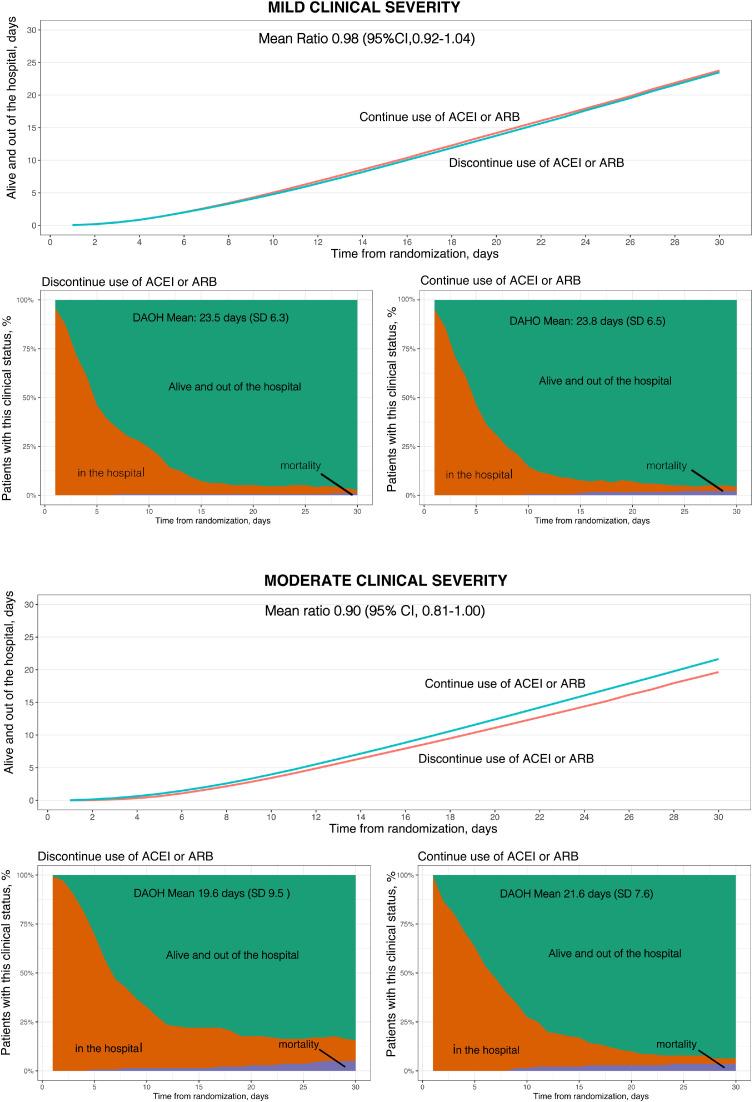
At presentation, 376 patients (57.1%) had mild and 283 (42.9%) had moderate COVID-19. In patients with mild disease, there was no significant difference in the number of days alive and out of the hospital between ACEI/ARB discontinuation (mean 23.5 [SD 6.3] days) and continuation (mean 23.8 [SD 6.5] days), with a mean ratio of 0.98 (95% CI 0.92-1.04). However, in patients with moderate disease, there were fewer days alive and out of the hospital with ACEI/ARB discontinuation (mean 19.6 [SD 9.5] days) than continuation (mean 21.6 [SD 7.6] days), with a mean ratio of 0.90 (95% CI 0.81-1.00; P-interaction = .01). The impact of discontinuing versus continuing ACEIs/ARBs on days alive and out of hospital through 30 days differed according to baseline COVID-19 disease severity.
CONCLUSIONS
Unlike patients with mild disease, patients with moderate disease who continued ACEIs/ARBs had more days alive and out of hospital through 30 days than those who discontinued ACEIs/ARBs. This suggests that ACEIs/ARBs should be continued for patients with moderate COVID-19 disease severity.
CLINICAL TRIAL REGISTRATION
ClinicalTrials.gov (NCT04364893).
背景
我们根据基线疾病严重程度,探讨了在 COVID-19 患者中停止或继续使用血管紧张素转换酶抑制剂(ACEI)和血管紧张素 II 受体阻滞剂(ARB)对临床结局的影响。
方法
我们随机纳入 659 名确诊 COVID-19 的患者,根据入院时血氧饱和度和肺部影像学结果将其分为轻度或中度 COVID-19 疾病严重程度。主要结局是根据疾病严重程度,30 天时存活且出院天数的平均比值。
结果
入组时,376 名患者(57.1%)为轻度,283 名患者(42.9%)为中度 COVID-19。在轻度疾病患者中,ACEI/ARB 停药(平均 23.5[6.3]天)与继续用药(平均 23.8[6.5]天)之间,出院天数无显著差异,比值为 0.98(95%CI 0.92-1.04)。然而,在中度疾病患者中,ACEI/ARB 停药(平均 19.6[9.5]天)的存活且出院天数少于继续用药(平均 21.6[7.6]天),比值为 0.90(95%CI 0.81-1.00;P 交互=0.01)。停止与继续 ACEI/ARB 对通过 30 天存活且出院天数的影响因基线 COVID-19 疾病严重程度而异。
结论
与轻度疾病患者不同,继续 ACEI/ARB 的中度 COVID-19 疾病患者的存活且出院天数多于停止 ACEI/ARB 的患者。这表明中度 COVID-19 疾病患者应继续使用 ACEI/ARB。
临床试验注册
ClinicalTrials.gov(NCT04364893)。
 Zotero 插件