
社区狩猎时野生猎物中病原体或环境化学物质调查的标准化采样方法
Standardised Sampling Approach for Investigating Pathogens or Environmental Chemicals in Wild Game at Community Hunts.
作者信息
Maaz Denny, Gremse Carl, Stollberg Kaya C, Jäckel Claudia, Sutrave Smita, Kästner Carolyn, Korkmaz Birsen, Richter Martin H, Bandick Niels, Steinhoff-Wagner Julia, Lahrssen-Wiederholt Monika, Mader Anneluise
机构信息
German Federal Institute for Risk Assessment (BfR), Max-Dohrn-Str. 8-10, 10589 Berlin, Germany.
Federal Ministry of Food and Agriculture (BMEL), Wilhelmstraße 54, 10117 Berlin, Germany.
出版信息
Animals (Basel). 2022 Mar 31;12(7):888. doi: 10.3390/ani12070888.
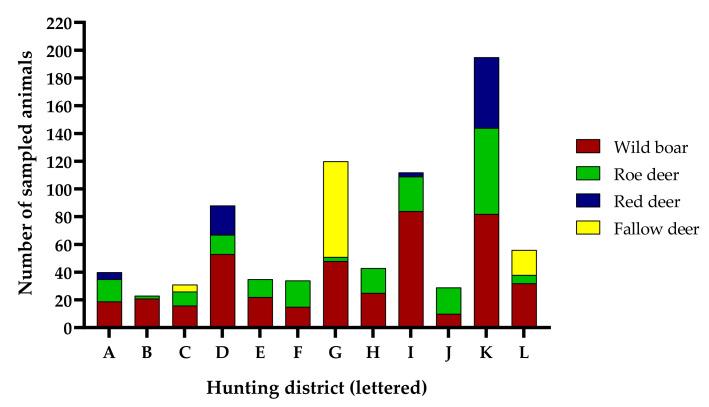
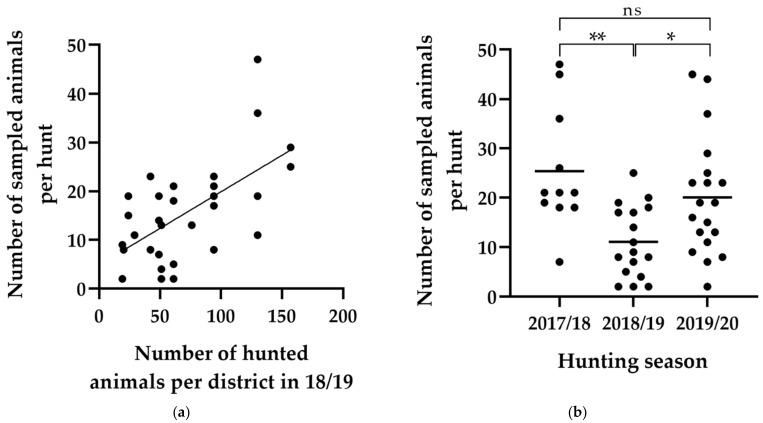
Wildlife may host pathogens and chemicals of veterinary and public health relevance, as well as pathogens with significant economic relevance for domestic livestock. In conducting research on the occurrence and distribution of these agents in wildlife, a major challenge is the acquisition of a sufficient number of samples coupled with efficient use of manpower and time. The aim of this article is to present the methodology and output of a sampling approach for game animals, which was implemented from 2017/18 to 2020/21 at drive hunts in Brandenburg, Germany. The central element was a framework agreement with the BImA, whereby federal forest officials and other hunters collected most of the samples during field dressing. Further samples of game carcasses were obtained by scientists during subsequent gathering at a collection point. Altogether, 3185 samples from 938 wild ungulates of four species were obtained for various studies analysing-in this case-food-borne agents in game animals. Sampling was representative and reflected the proportional distribution of ungulate species hunted in Brandenburg. Hunting district and hunting season strongly influenced hunting bag and hence sampling success. This sampling approach was demonstrated to be a suitable basis for monitoring programs, that can be adapted to other regions.
野生动物可能携带与兽医和公共卫生相关的病原体和化学物质,以及对家畜具有重大经济影响的病原体。在开展关于这些病原体在野生动物中的发生和分布的研究时,一个主要挑战是获取足够数量的样本,同时有效利用人力和时间。本文旨在介绍一种针对狩猎动物的采样方法及其成果,该方法于2017/18年至2020/21年在德国勃兰登堡的驱赶狩猎活动中实施。核心要素是与德国联邦自然保护局(BImA)达成的一项框架协议,据此,联邦森林官员和其他猎人在野外处理猎物时采集了大部分样本。科学家们随后在收集点对猎获的动物尸体进行进一步采样。总共从938头分属四个物种的野生有蹄类动物身上采集了3185个样本,用于各种研究,在本案例中是分析狩猎动物中食源性病原体。采样具有代表性,反映了勃兰登堡被猎杀的有蹄类物种的比例分布。狩猎区和狩猎季节对狩猎量有很大影响,进而影响采样成功率。事实证明,这种采样方法是监测项目的合适基础,并且可以适用于其他地区。


 Zotero 插件