
14 天高海拔训练营对奥运级公开水域游泳运动员睡眠的影响。
The Impact of a 14-Day Altitude Training Camp on Olympic-Level Open-Water Swimmers' Sleep.
机构信息
IRCCS Istituto Ortopedico Galeazzi, 20161 Milan, Italy.
Department of Movement, Human and Health Sciences, University of Rome Foro Italico, 00135 Rome, Italy.
出版信息
Int J Environ Res Public Health. 2022 Apr 2;19(7):4253. doi: 10.3390/ijerph19074253.
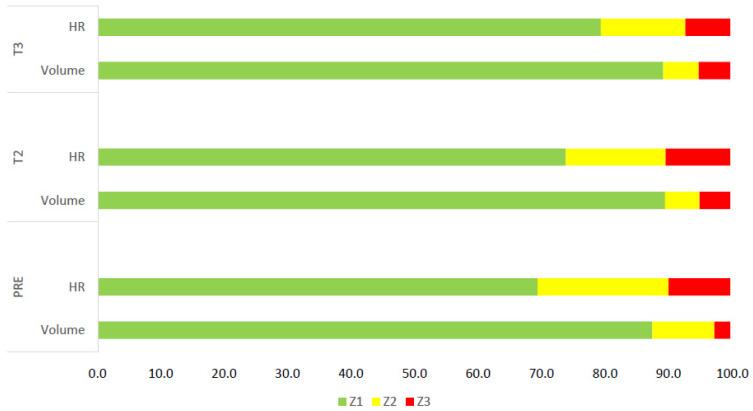
Despite the common belief that sleep quality at altitude is poor, the scientific evidence to support this notion is still modest. Therefore, the purpose of the present study was to evaluate possible changes of actigraphy-based and subjective sleep parameters in a group of elite open-water swimmers during a 14-day altitude training camp (ATC) at 1500 m. The study subjects were five Olympic-level open-water swimmers (mean age: 25.0 ± 3.2 years; 3 females and 2 males). All subjects wore a wrist activity monitor and filled a sleep diary for 18 consecutive nights, 4 nights before and 14 nights during ATC. The data were then analyzed at four different time points: before ATC (PRE), the first two days of ATC (T1), and after one (T2) and two weeks of ATC (T3). Training load, assessed as the covered distance (km), session rating of perceived exertion (sRPE), and heart rate (HR), was monitored during the week before and the first and second week of ATC. No significant differences in objective and subjective scores of sleep quality were detected, whereas the sleep onset time (p = 0.018; η2p = 0.83, large) and sleep offset time (p < 0.001; η2p = 0.95, large) significantly differed among PRE, T1, T2, and T3: elite athletes started to sleep and woke up ≃ 1 h earlier the first two days of ATC compared to PRE (sleep onset time: p = 0.049; sleep offset time: p = 0.016). Further, an increase in the training volume during the two weeks of the ATC was observed, with the most time spent in a low-intensity regime and an increase in time spent in a high-intensity regime compared to PRE. Sleep quality was not negatively influenced by a 14-day altitude training camp at 1500 m in a group of Olympic-level elite swimmers despite an increase in perceived exertion during training sessions. Nonetheless, early sleep onset and sleep offset times were observed for the first two nights of ATC: elite athletes started to sleep and woke up ≃ 1 h earlier compared to the baseline nights.
尽管普遍认为高海拔地区的睡眠质量较差,但支持这一观点的科学证据仍然有限。因此,本研究的目的是评估一组精英公开水域游泳运动员在海拔 1500 米的 14 天高原训练营地(ATC)期间,基于活动监测仪和主观睡眠参数可能发生的变化。研究对象为五名奥运级别的公开水域游泳运动员(平均年龄:25.0±3.2 岁;3 名女性和 2 名男性)。所有受试者均佩戴腕部活动监测器,并在 18 个连续夜晚填写睡眠日记,包括 ATC 前 4 晚和 ATC 期间 14 晚。数据随后在四个不同时间点进行分析:ATC 前(PRE)、ATC 的头两天(T1)以及之后的一周(T2)和两周(T3)。在 ATC 前一周和第一周和第二周,监测了训练负荷,即覆盖的距离(km)、运动感觉等级(sRPE)和心率(HR)。未发现客观和主观睡眠质量评分有显著差异,而入睡时间(p=0.018;η2p=0.83,大)和睡眠结束时间(p<0.001;η2p=0.95,大)在 PRE、T1、T2 和 T3 之间存在显著差异:精英运动员在 ATC 的头两天入睡和醒来时间比 PRE 早约 1 小时(入睡时间:p=0.049;睡眠结束时间:p=0.016)。此外,在 ATC 的两周内观察到训练量增加,与 PRE 相比,低强度训练时间增加,高强度训练时间增加。尽管在 1500 米的高原训练营地中进行了 14 天的训练,但对一组奥运级别的精英游泳运动员的睡眠质量没有产生负面影响,尽管训练期间的感知用力增加。尽管如此,在 ATC 的头两个晚上还是观察到了较早的入睡和醒来时间:与基线晚上相比,精英运动员入睡和醒来时间提前了约 1 小时。

 Zotero 插件